M. K. Garg – författare
2 605 kr
Skickas inom 5-8 vardagar
2 412 kr
Skickas inom 5-8 vardagar
2 870 kr
Läs direkt efter köp
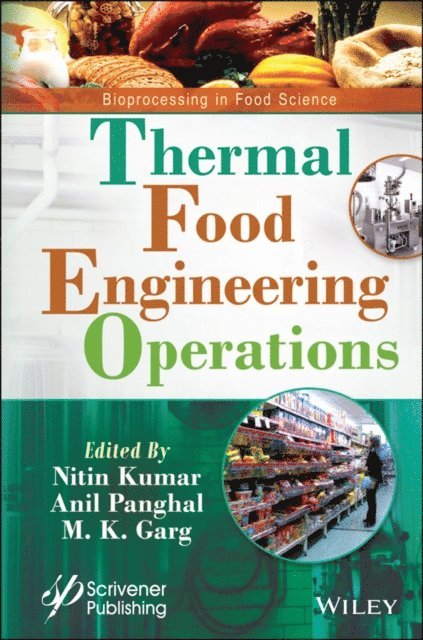
Presenting cutting-edge information on new and emerging food engineering processes, Thermal Food Engineering Operations, the first volume in the new series, “Bioprocessing in Food Science,” is an essential reference on the modeling, quality, safety, and technologies associated with food processing operations today.
As the demand for healthy food increases in the current global scenario, manufacturers are searching for new possibilities for occupying a greater share in the rapidly changing food market. Compiled reports and updated knowledge on thermal processing of food products are imperative for commercial enterprises and manufacturing units. In the current scenario, academia, researchers, and food industries are working in a scattered manner and different technologies developed at each level are not compiled to implement for the benefits of different stakeholders. However, advancements in bioprocesses are required at all levels for the betterment of food industries and consumers. This series of groundbreaking edited volumes will be a comprehensive compilation of all the research that has been carried out so far, their practical applications, and the future scope of research and development in the food bioprocessing industry.
This first volume includes all the conventional and novel thermal technologies based on conduction, convection, and radiation principles and covers the basics of microbial inactivation with heat treatments, aseptic processing, retorting, drying, dehydration, combined high-pressure thermal treatments, and safety and quality concerns in food processing. Before studying the novel non-thermal processes and the concept of minimal processing, comprehensive knowledge about the conventional thermal technologies is desired along with benefits, constraints, equipment, and implementation of these technologies. Whether for the engineer, scientist, or student, this series is a must-have for any library.
This outstanding new volume:
Discusses food safety and quality and thermal processing, laying the groundwork for further study and research Provides case studies of solid–liquid and supercritical fluid extraction Explores pasteurization, ohmic heating, irradiation, and more Presents cutting-edge information on new and emerging food engineering processesAudience: Process and chemical engineers, chemists, engineers in other disciplines, managers, researchers, scientists, students, and teachers working in the field of food engineering and processing
2 895 kr
Läs direkt efter köp
Presenting cutting-edge information on new and emerging food engineering processes, Thermal Food Engineering Operations, the first volume in the new series, “Bioprocessing in Food Science,” is an essential reference on the modeling, quality, safety, and technologies associated with food processing operations today.
As the demand for healthy food increases in the current global scenario, manufacturers are searching for new possibilities for occupying a greater share in the rapidly changing food market. Compiled reports and updated knowledge on thermal processing of food products are imperative for commercial enterprises and manufacturing units. In the current scenario, academia, researchers, and food industries are working in a scattered manner and different technologies developed at each level are not compiled to implement for the benefits of different stakeholders. However, advancements in bioprocesses are required at all levels for the betterment of food industries and consumers. This series of groundbreaking edited volumes will be a comprehensive compilation of all the research that has been carried out so far, their practical applications, and the future scope of research and development in the food bioprocessing industry.
This first volume includes all the conventional and novel thermal technologies based on conduction, convection, and radiation principles and covers the basics of microbial inactivation with heat treatments, aseptic processing, retorting, drying, dehydration, combined high-pressure thermal treatments, and safety and quality concerns in food processing. Before studying the novel non-thermal processes and the concept of minimal processing, comprehensive knowledge about the conventional thermal technologies is desired along with benefits, constraints, equipment, and implementation of these technologies. Whether for the engineer, scientist, or student, this series is a must-have for any library.
This outstanding new volume:
Discusses food safety and quality and thermal processing, laying the groundwork for further study and research Provides case studies of solid–liquid and supercritical fluid extraction Explores pasteurization, ohmic heating, irradiation, and more Presents cutting-edge information on new and emerging food engineering processesAudience: Process and chemical engineers, chemists, engineers in other disciplines, managers, researchers, scientists, students, and teachers working in the field of food engineering and processing
3 081 kr
Läs direkt efter köp
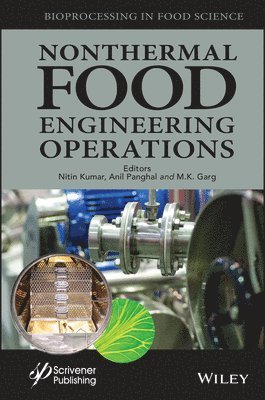
Presenting cutting-edge information on new and emerging food engineering processes, Nonthermal Food Engineering Operations, the latest volume in the series, “Bioprocessing in Food Science,” is an essential reference on the modeling, quality, safety, and technologies associated with food processing operations today.
“Bioprocessing in Food Science” is a series of volumes covering the entirety of unit operations in food processing. This latest volume covers nonthermal food engineering operations, focusing on packaging techniques, artificial intelligence and other emerging technologies and their use and relevance within food engineering, fluid extraction, nanotechnology, and many other topics.
As the demand for healthy food is increasing in the current global scenario, manufacturers are searching for new possibilities for occupying a greater share in the rapidly changing food market. Compiled reports and updated knowledge on thermal processing of food products are imperative for commercial enterprises and manufacturing units. In the current scenario, academia, researchers, and food industries are working in a scattered manner and different technologies developed at each level are not compiled to implement for the benefits of different stakeholders. However, advancements in bioprocesses are required at all levels for the betterment of food industries and consumers. This series of groundbreaking edited volumes will be a comprehensive compilation of all the research that has been carried out so far, their practical applications, and the future scope of research and development in the food bioprocessing industry.
During the last decade, there have been major developments in novel technologies for food processing. This series will cover all the novel technologies employed for processing different types of foods, encompassing the background, principles, classification, applications, equipment, effect on foods, legislative issue, technology implementation, constraints, and food and human safety concerns.
3 054 kr
Läs direkt efter köp
Presenting cutting-edge information on new and emerging food engineering processes, Nonthermal Food Engineering Operations, the latest volume in the series, “Bioprocessing in Food Science,” is an essential reference on the modeling, quality, safety, and technologies associated with food processing operations today.
“Bioprocessing in Food Science” is a series of volumes covering the entirety of unit operations in food processing. This latest volume covers nonthermal food engineering operations, focusing on packaging techniques, artificial intelligence and other emerging technologies and their use and relevance within food engineering, fluid extraction, nanotechnology, and many other topics.
As the demand for healthy food is increasing in the current global scenario, manufacturers are searching for new possibilities for occupying a greater share in the rapidly changing food market. Compiled reports and updated knowledge on thermal processing of food products are imperative for commercial enterprises and manufacturing units. In the current scenario, academia, researchers, and food industries are working in a scattered manner and different technologies developed at each level are not compiled to implement for the benefits of different stakeholders. However, advancements in bioprocesses are required at all levels for the betterment of food industries and consumers. This series of groundbreaking edited volumes will be a comprehensive compilation of all the research that has been carried out so far, their practical applications, and the future scope of research and development in the food bioprocessing industry.
During the last decade, there have been major developments in novel technologies for food processing. This series will cover all the novel technologies employed for processing different types of foods, encompassing the background, principles, classification, applications, equipment, effect on foods, legislative issue, technology implementation, constraints, and food and human safety concerns.