Maciej Pietrzyk - Böcker
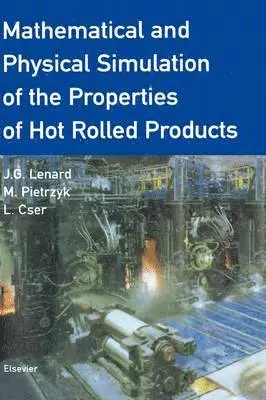
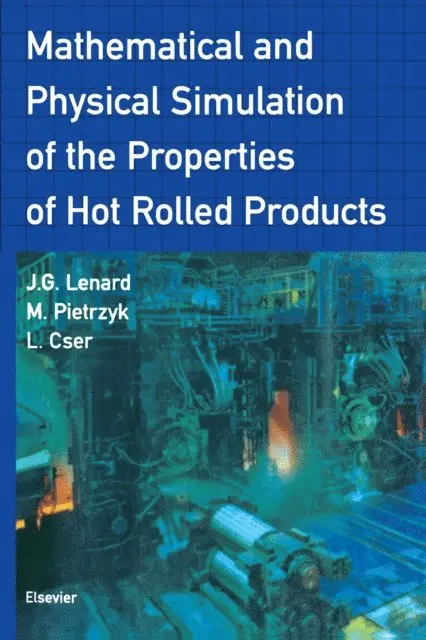
Mathematical and Physical Simulation of the Properties of Hot Rolled Products
2 020 kr
Skickas inom 7-10 vardagar
The objective of this publication is to comprehensively discuss the possibilities of producing steels with pre-determined attributes, demanded by the customer to fit exacting specifications. The information presented in the book has been designed to indicate the reasons for the expenses and to aid in the process of overcoming the difficulties and reducing the costs.
In nine detailed chapters, the authors cover topics including:. steel as a major contributor to the economic wealth of a country in terms of its capabilities and production. current concerns of major steel producers. phenomena contributing to the quality of the product. information concerning the boundary conditions of the rolling process and initial conditions, put to use by mathematical models. the solid state incremental approach and flow formulation. parameters and variables - most of which make use of the exponential nature of phenomena that are activated by thermal energy. the application of three dimensional analysis to shape rolling. the evaluation of parameters by a form of inverse analysis to the flat rolling process. knowledge based modeling, using artificial intelligence, expert systems and neural networks
They conclude that when either mathematical or physical modeling of the rolling process is considered and the aim is to satisfy the demands for customers, it is possible to produce what the customer wants, exactly.
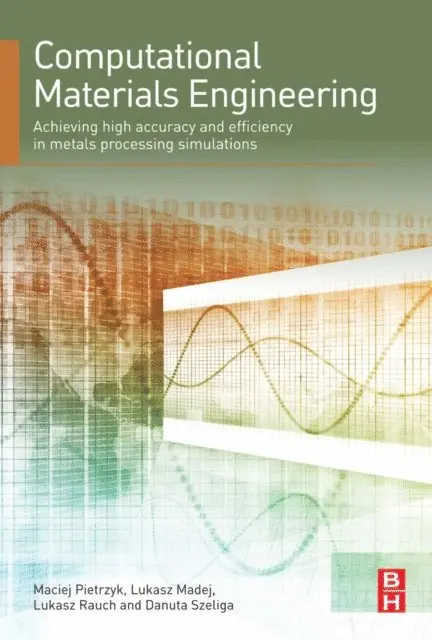
Computational Materials Engineering
Achieving High Accuracy and Efficiency in Metals Processing Simulations
1 446 kr
Skickas inom 7-10 vardagar
Computational Materials Engineering: Achieving High Accuracy and Efficiency in Metals Processing Simulations describes the most common computer modeling and simulation techniques used in metals processing, from so-called "fast" models to more advanced multiscale models, also evaluating possible methods for improving computational accuracy and efficiency.
Beginning with a discussion of conventional fast models like internal variable models for flow stress and microstructure evolution, the book moves on to advanced multiscale models, such as the CAF� method, which give insights into the phenomena occurring in materials in lower dimensional scales.
The book then delves into the various methods that have been developed to deal with problems, including long computing times, lack of proof of the uniqueness of the solution, difficulties with convergence of numerical procedures, local minima in the objective function, and ill-posed problems. It then concludes with suggestions on how to improve accuracy and efficiency in computational materials modeling, and a best practices guide for selecting the best model for a particular application.
Presents the numerical approaches for high-accuracy calculations Provides researchers with essential information on the methods capable of exact representation of microstructure morphology Helpful to those working on model classification, computing costs, heterogeneous hardware, modeling efficiency, numerical algorithms, metamodeling, sensitivity analysis, inverse method, clusters, heterogeneous architectures, grid environments, finite element, flow stress, internal variable method, microstructure evolution, and more Discusses several techniques to overcome modeling and simulation limitations, including distributed computing methods, (hyper) reduced-order-modeling techniques, regularization, statistical representation of material microstructure, and the Gaussian process Covers both software and hardware capabilities in the area of improved computer efficiency and reduction of computing time1 419 kr
Skickas inom 7-10 vardagar
1 064 kr
Skickas inom 10-15 vardagar