Maggie Tallerman - Böcker
Visar alla böcker från författaren Maggie Tallerman. Handla med fri frakt och snabb leverans.
8 produkter
8 produkter
2 933 kr
Skickas inom 5-8 vardagar
This book addresses central questions in the evolution of language: where it came from; how and why it evolved; how it came to be culturally transmitted; and how languages diversified. It does so from the perspective of the latest work in linguistics, neuroscience, psychology, and computer science, and deploys the latest methods and theories to probe into the origins and subsequent development of the only species that has languages.
556 kr
Skickas inom 7-10 vardagar
This book addresses central questions in the evolution of language: where it came from; how it relates to primate communication; how and why it evolved; how it came to be culturally transmitted; and how languages diversified. The chapters are written from the perspective of the latest work in linguistics, neuroscience, psychology, and computer science, and reflect the idea that various cognitive, physical, neurological, social, and cultural prerequisites led to the development of full human language. Some of these evolutionary changes were preadaptations for language, while others were adaptive changes allowing the development of particular linguistic characteristics. The authors consider a broad spectrum of ideas about the conditions that led to the evolution of protolanguage and full language. Some examine changes that occurred in the course of evolution to Homo sapiens; others consider how languages themselves have adapted by evolving to be learnable. Some chapters look at the workings of the brain, and others deploy sophisticated computer simulations that model such aspects as the emergence of speech sounds and the development of grammar. All make use of the latest methods and theories to probe into the origins and subsequent development of the only species that has language. The book will interest a wide range of linguists, cognitive scientists, biologists, psychologists, neuroscientists, and experts in artificial intelligence, as well as all those fascinated by issues, puzzles, and problems raised by the evolution of language.
2 447 kr
Skickas inom 7-10 vardagar
In The Oxford Handbook of Language Evolution, sixty leading scholars present critical accounts of every aspect of the field. The Volume's five parts are devoted to insights from comparative animal behaviour; the biology of language evolution (anatomy, genetics, and neurology); the prehistory of language (when and why did language evolve?); the development of a linguistic species; and language creation, transmission, and change.Research on language evolution has burgeoned over the last three decades. Interdisciplinary activity has produced fundamental advances in the understanding of language evolution and in human and primate evolution more generally. This book presents a wide-ranging summation of work in all the disciplines involved. It highlights the links in different lines of research, shows what has been achieved to date, and considers the most promising directions for future work. The Oxford Handbook of Language Evolution will be valued by everyone interested in one of the most productive and fascinating fields in natural and cognitive science.
580 kr
Skickas inom 7-10 vardagar
In The Oxford Handbook of Language Evolution, sixty leading scholars present critical accounts of every aspect of the field. Its five parts are devoted to insights from comparative animal behaviour; the biology of language evolution; the prehistory of language; the development of a linguistic species; and language creation, transmission, and change. Research on language evolution has burgeoned over the last three decades. Interdisciplinary activity has produced fundamental advances in the understanding of language evolution and in the evolution of human andanimal communication more generally. This book presents a wide-ranging summation of work in all the disciplines involved. It highlights the links between different lines of research, shows what has been achieved, and considers promising directions for the future. The Oxford Handbook of Language Evolution will be valued by everyone interested in one of the most productive and fascinating fields in natural and cognitive science.
1 756 kr
Skickas inom 7-10 vardagar
Welsh, like the other Celtic languages, is best known amongst linguists for its verb-initial word order and its use of initial consonant mutations. However it has many more characteristics which are of interest to syntacticians. This book, first published in 2007, provides a concise and accessible overview of the major syntactic phenomena of Welsh. A broad variety of topics are covered, including finite and infinitival clauses, noun phrases, agreement and tense, word order, clause structure, dialect variation, and the language's historical Celtic background. Drawing on work carried out in both Principles and Parameters theory and Head-driven Phrase Structure Grammar, it takes contemporary colloquial Welsh as its starting point and draws contrasts with a range of literary and dialectal forms of the language, as well as earlier forms (Middle Welsh) were appropriate. An engaging guide to all that is interesting about Welsh syntax, this book will be welcomed by syntactic theorists, typologists, historical linguists and Celticists alike.
663 kr
Skickas inom 10-15 vardagar
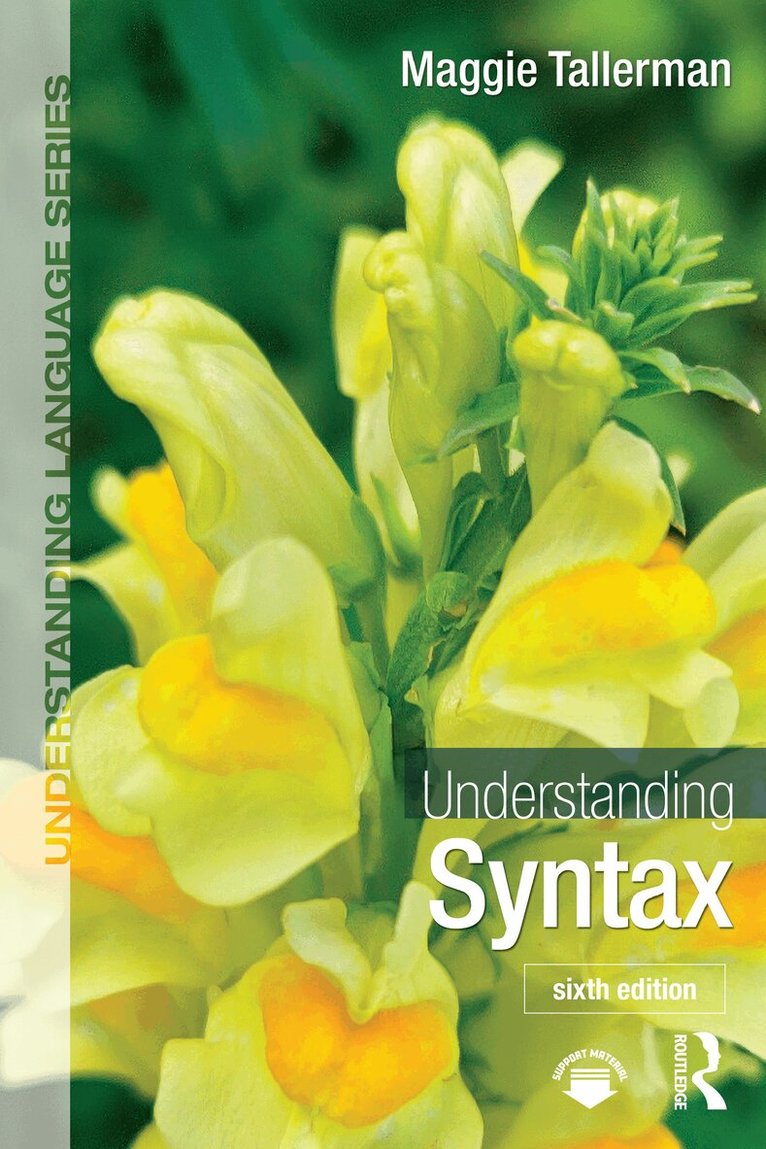
Assuming no prior grammatical knowledge, Understanding Syntax explains and illustrates the major concepts, categories and terminology involved in the study of cross-linguistic syntax. Taking a largely theory-neutral and descriptive viewpoint throughout, this book:introduces syntactic typology, syntactic description and the major typological categories found in the languages of the worldclarifies with examples grammatical constructions and relationships between words in a clause, including word classes and their syntactic properties; grammatical relations such as subject and object; case and agreement processes; passives and other valency-changing processes; questions and relative clausesfeatures in-text and chapter-end exercises to extend the reader’s knowledge of syntactic concepts and argumentation, drawing on data from over 100 languageshighlights the principles involved in writing a brief syntactic sketch of languageThis sixth edition has been revised to include updated further readings, improved examples and exercises and additional explanations of the most demanding concepts.Understanding Syntax is an essential textbook for students studying the description of language, cross-linguistic syntax, language typology and linguistic fieldwork, and will be the foundation for all studies of theoretical syntax.
2 150 kr
Skickas inom 10-15 vardagar
Assuming no prior grammatical knowledge, Understanding Syntax explains and illustrates the major concepts, categories and terminology involved in the study of cross-linguistic syntax. Taking a largely theory-neutral and descriptive viewpoint throughout, this book:introduces syntactic typology, syntactic description and the major typological categories found in the languages of the worldclarifies with examples grammatical constructions and relationships between words in a clause, including word classes and their syntactic properties; grammatical relations such as subject and object; case and agreement processes; passives and other valency-changing processes; questions and relative clausesfeatures in-text and chapter-end exercises to extend the reader’s knowledge of syntactic concepts and argumentation, drawing on data from over 100 languageshighlights the principles involved in writing a brief syntactic sketch of languageThis sixth edition has been revised to include updated further readings, improved examples and exercises and additional explanations of the most demanding concepts.Understanding Syntax is an essential textbook for students studying the description of language, cross-linguistic syntax, language typology and linguistic fieldwork, and will be the foundation for all studies of theoretical syntax.
604 kr
Skickas inom 7-10 vardagar
Welsh, like the other Celtic languages, is best known amongst linguists for its verb-initial word order and its use of initial consonant mutations. However it has many more characteristics which are of interest to syntacticians. This book, first published in 2007, provides a concise and accessible overview of the major syntactic phenomena of Welsh. A broad variety of topics are covered, including finite and infinitival clauses, noun phrases, agreement and tense, word order, clause structure, dialect variation, and the language's historical Celtic background. Drawing on work carried out in both Principles and Parameters theory and Head-driven Phrase Structure Grammar, it takes contemporary colloquial Welsh as its starting point and draws contrasts with a range of literary and dialectal forms of the language, as well as earlier forms (Middle Welsh) were appropriate. An engaging guide to all that is interesting about Welsh syntax, this book will be welcomed by syntactic theorists, typologists, historical linguists and Celticists alike.