• Fri frakt över 249 kr
  • •
  • Snabba leveranser
  • •
  • Billiga böcker
Kundservice

Du är på sajten för privatpersoner.

Företag, bibliotek eller offentlig verksamhet?

Du handlar på classic.bokus.com, där alla dina funktioner finns intakta.
Till classic.bokus.com
Bokus logotyp. Gå till startsidan.
  • Erbjudanden
  • Nyheter
  • Student
  • Topplistor
  • Barn & ungdom
  • Bokus Play
  • E-böcker
  • Pocketböcker
  • Spel & pussel

10% rabatt på allt med kod NYSTART10 →

Sidfot

Mina sidor

    Hjälp

    • Kundservice
    • Vanliga frågor och svar
    • Frakt och leverans
    • Retur vid ångerrätt
    • Reklamera vara
    • Betalning
    • Köpvillkor
    • Allmänna villkor
    • Information om webbplatsens tillgänglighet

    Om Bokus

    • Om oss
    • Pressrum
    • För studenter
    • För företag
    • För bibliotek och offentlig verksamhet
    • För leverantörer
    • Hållbarhet

    Populärt

    • Aktuella erbjudanden
    • Presentkort
    • Studentlitteratur
    • Nya böcker
    • Topplistor
    • Signerade böcker
    • Engelska böcker

    Inspiration

    • Boktips
    • BookTok
    • Populära bokserier
    • Barnbokskaraktärer
    • Populära författare
    Logotyp för Bokus
    Följ oss på Facebook (extern länk)Följ oss på Instagram (extern länk)Följ oss på YouTube (extern länk)Följ oss på TikTok (extern länk)
    bokus @ CookiesAnpassa cookiesIntegritetspolicyKöpvillkor
    Till Citymail hemsida (extern länk)Till Budbee hemsida (extern länk)Till Postnord hemsida (extern länk)Till Schenker hemsida (extern länk)Till Early Bird hemsida (extern länk)Till Walleys hemsida (extern länk)
    1. Samhälle och politik
    2. Sociologi och antropologi
    3. Antropologi

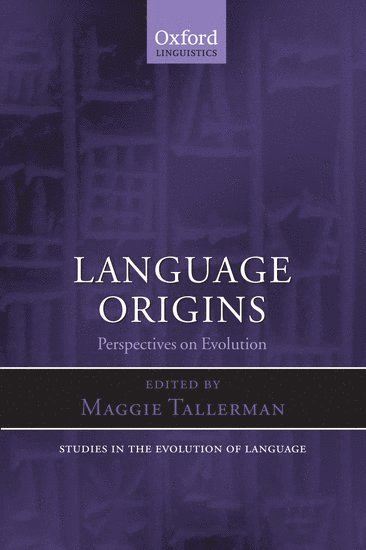
    Language Origins

    Perspectives on Evolution

    AvMaggie Tallerman

    Häftad, Engelska, 2005

    Del i serien Studies in the Evolution of Language

    593 kr

    Beställningsvara. Skickas inom 7-10 vardagar. Fri frakt över 249 kr.

    Beskrivning

    This book addresses central questions in the evolution of language: where it came from; how it relates to primate communication; how and why it evolved; how it came to be culturally transmitted; and how languages diversified. The chapters are written from the perspective of the latest work in linguistics, neuroscience, psychology, and computer science, and reflect the idea that various cognitive, physical, neurological, social, and cultural prerequisites led to the development of full human language. Some of these evolutionary changes were preadaptations for language, while others were adaptive changes allowing the development of particular linguistic characteristics. The authors consider a broad spectrum of ideas about the conditions that led to the evolution of protolanguage and full language. Some examine changes that occurred in the course of evolution to Homo sapiens; others consider how languages themselves have adapted by evolving to be learnable. Some chapters look at the workings of the brain, and others deploy sophisticated computer simulations that model such aspects as the emergence of speech sounds and the development of grammar. All make use of the latest methods and theories to probe into the origins and subsequent development of the only species that has language. The book will interest a wide range of linguists, cognitive scientists, biologists, psychologists, neuroscientists, and experts in artificial intelligence, as well as all those fascinated by issues, puzzles, and problems raised by the evolution of language.

    Produktinformation

    • Utgivningsdatum:2005-05-26
    • Mått:157 x 234 x 27 mm
    • Vikt:683 g
    • Format:Häftad
    • Språk:Engelska
    • Serie:Studies in the Evolution of Language
    • Antal sidor:446
    • Förlag:OUP OXFORD
    • ISBN:9780199279043

    Utforska kategorier

    • Antropologi inom Samhälle och politik
    • Språkvetenskap och lingvistik inom Språk och ordböcker
    • Biovetenskap inom Naturvetenskap och teknik

    Mer om författaren

    Maggie Tallerman is Reader in Linguistics at Newcastle University. She has spent her professional life in North East England, having previously taught for 21 years at the University of Durham. Her research interests centre on the origins and evolution of syntax and morphology; modern Brythonic Celtic syntax and morphology; and language typology. She is the author of Understanding Syntax (1998; second edition 2005), and has published widely on the morphosyntax of modern Welsh and Breton, as well as on language evolution. She was review editor for the Journal of Linguistics from 1994 to 2005.

    Recensioner i media

    ...will interest a wide range of linguists, cognitive scientists, biologists, psychologists, neuroscientists, and experts in artificial intelligence, as well as those fascinated by issues, puzzles, and problems raised by the evolution of language.

    Innehållsförteckning

    • 1. Introduction ; PART I EVOLUTION OF SPEECH AND SPEECH SOUNDS: HOW DID SPOKEN LANGUAGE EMERGE? ; Introduction to Part I: How did links between perception and production emerge for spoken language? ; 2. The Mirror System Hypothesis: How did protolanguage evolve? ; 3. How Did Language go Discrete? ; 4. From Holistic to Discrete Speech Sounds: The blind snowflake maker hypothesis ; 5. Infant-Directed Speech and Evolution of Language ; PART II EVOLUTION OF GRAMMAR: HOW DID SYNTAX AND MORPHOLOGY EMERGE? ; Introduction to Part II: Protolanguage and the Development of Complexity ; 6. Initial Syntax and Modern Syntax: Did the clause evolve from the syllable? ; 7. The Potential Role of Production in the Evolution of Syntax ; 8. The Evolutionary Origin of Morphology ; 9. The Evolution of Grammatical Structures and 'Functional Need' Explanations ; 10. Deception and Mate Selection: Some implications for relevance and the evolution of language ; PART III ANALOGOUS AND HOMOLOGOUS TRAITS: WHAT CAN WE LEARN FROM OTHER SPECIES? ; Introductin to Part III: The Broadening Scope of Animal Communication Research ; 11. An Avian Perspective on Language Evolution: Implications of simultaneous development of vocal and physical object combinations by a Grey parrot (Psittacus erithacus) ; 12. Linguistic Prerequisites in the Primate Lineage ; PART IV LEARNABILITY AND DIVERSITY: HOW DID LANGUAGES EMERGE AND DIVERGE? ; Introduction to Part IV: Computer Modelling Widens the Focus of Language Study ; 13. Cultural Selection for Learnability: Three principles underlying the view that language adapts to be learnable ; 14. Coevolution of the Language Faculty and Language(s) With Decorrelated Encodings ; 15. Acquisition and Evolution of Quasi-regular Languages: Two puzzles for the price of one ; 16. Evolution of Language Diversity: Why fitness counts ; 17. Mutual Exclusivity: Communicative success despite conceptual divergence