Malcolm K. Hughes - Böcker
Visar alla böcker från författaren Malcolm K. Hughes. Handla med fri frakt och snabb leverans.
5 produkter
5 produkter
1 578 kr
Skickas inom 10-15 vardagar
A top priority in climate research is obtaining broad-extent and long-term data to support analyses of historical patterns and trends, and for model development and evaluation. Along with directly measured climate data from the present and recent past, it is important to obtain estimates of long past climate variations spanning multiple centuries and millennia. These longer time perspectives are needed for assessing the unusualness of recent climate changes, as well as for providing insight on the range, variation and overall dynamics of the climate system over time spans exceeding available records from instruments, such as rain gauges and thermometers. Tree rings have become increasingly valuable in providing this long-term information because extensive data networks have been developed in temperate and boreal zones of the Earth, and quantitative methods for analyzing these data have advanced. Tree rings are among the most useful paleoclimate information sources available because they provide a high degree of chronological accuracy, high replication, and extensive spatial coverage spanning recent centuries. With the expansion and extension of tree-ring data and analytical capacity new climatic insights from tree rings are being used in a variety of applications, including for interpretation of past changes in ecosystems and human societies. This volume presents an overview of the current state of dendroclimatology, its contributions over the last 30 years, and its future potential. The material included is useful not only to those who generate tree-ring records of past climate-dendroclimatologists, but also to users of their results-climatologists, hydrologists, ecologists and archeologists. ‘With the pressing climatic questions of the 21st century demanding a deeper understanding of the climate system and our impact upon it, this thoughtful volume comes at critical moment. It will be of fundamental importance in notonly guiding researchers, but in educating scientists and the interested lay person on the both incredible power and potential pitfalls of reconstructing climate using tree-ring analysis.’, Glen M. MacDonald, UCLA Institute of the Environment, CA, USA ‘This is an up-to-date treatment of all branches of tree-ring science, by the world’s experts in the field, reminding us that tree rings are the most important source of proxy data on climate change. Should be read by all budding dendrochronology scientists.’, Alan Robock, Rutgers University, NJ, USA
2 416 kr
Skickas inom 10-15 vardagar
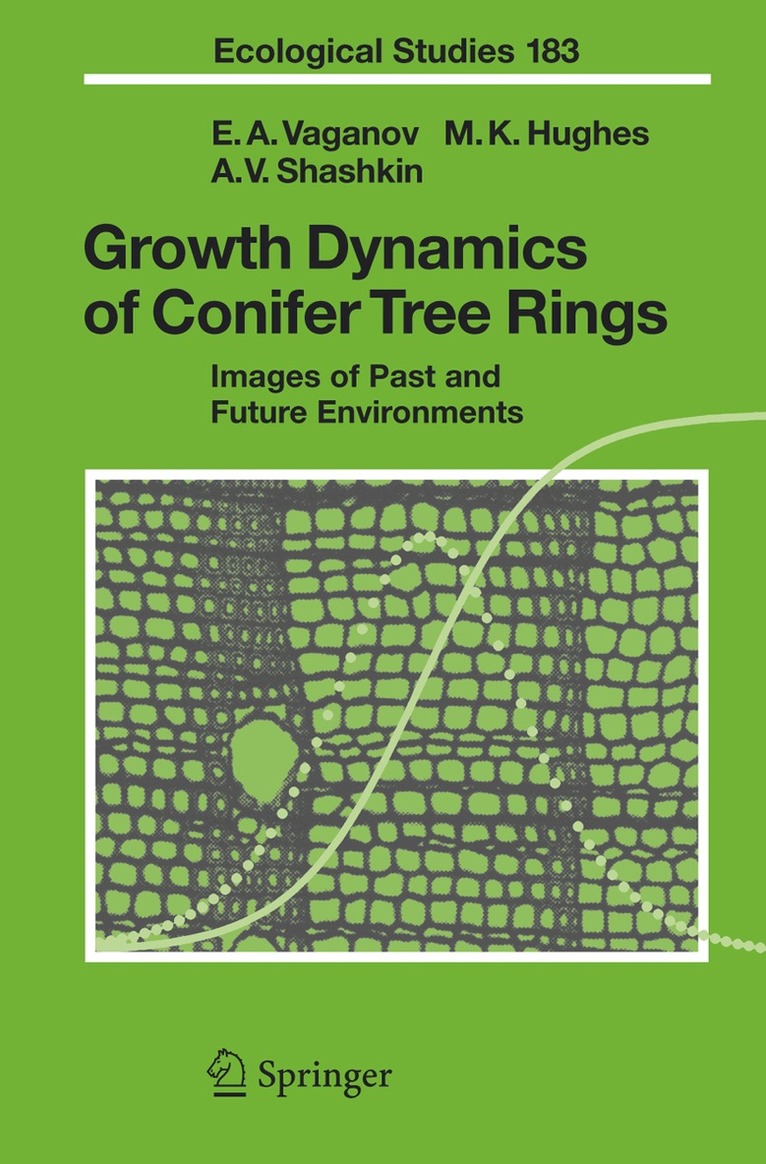
Each tree ring contains an image of the time when the ring formed, projected onto the ring's size, structure, and composition. Tree rings thus are natural archives of past environments, and contain records of past climate. While dendrochronologists have investigated the impact of climate on tree-ring growth by empirical–statistical methods, this volume presents a process-based model complementing previous approaches. Basic ideas concerning the biology of tree-ring growth and its control by environmental factors are treated, especially for conifers. The use of the model is illustrated by means of several examples from widely differing environments, and possible future directions for model development and application are discussed. The volume provides an improved mechanistic basis for the interpretation of tree rings as records of past climate. It advances process understanding of the large-scale environmental control of wood growth. As forests are the main carbon sink on land, the results are of great importance for all global change studies.
2 416 kr
Skickas inom 10-15 vardagar
Each tree ring contains an image of the time when the ring formed, projected onto the ring's size, structure, and composition. Tree rings thus are natural archives of past environments, and contain records of past climate. While dendrochronologists have investigated the impact of climate on tree-ring growth by empirical–statistical methods, this volume presents a process-based model complementing previous approaches. Basic ideas concerning the biology of tree-ring growth and its control by environmental factors are treated, especially for conifers. The use of the model is illustrated by means of several examples from widely differing environments, and possible future directions for model development and application are discussed. The volume provides an improved mechanistic basis for the interpretation of tree rings as records of past climate. It advances process understanding of the large-scale environmental control of wood growth. As forests are the main carbon sink on land, the results are of great importance for all global change studies.
1 578 kr
Skickas inom 10-15 vardagar
A top priority in climate research is obtaining broad-extent and long-term data to support analyses of historical patterns and trends, and for model development and evaluation. Along with directly measured climate data from the present and recent past, it is important to obtain estimates of long past climate variations spanning multiple centuries and millennia. These longer time perspectives are needed for assessing the unusualness of recent climate changes, as well as for providing insight on the range, variation and overall dynamics of the climate system over time spans exceeding available records from instruments, such as rain gauges and thermometers. Tree rings have become increasingly valuable in providing this long-term information because extensive data networks have been developed in temperate and boreal zones of the Earth, and quantitative methods for analyzing these data have advanced. Tree rings are among the most useful paleoclimate information sources available because they provide a high degree of chronological accuracy, high replication, and extensive spatial coverage spanning recent centuries. With the expansion and extension of tree-ring data and analytical capacity new climatic insights from tree rings are being used in a variety of applications, including for interpretation of past changes in ecosystems and human societies. This volume presents an overview of the current state of dendroclimatology, its contributions over the last 30 years, and its future potential. The material included is useful not only to those who generate tree-ring records of past climate-dendroclimatologists, but also to users of their results-climatologists, hydrologists, ecologists and archeologists. ‘With the pressing climatic questions of the 21st century demanding a deeper understanding of the climate system and our impact upon it, this thoughtful volume comes at critical moment. It will be of fundamental importance in notonly guiding researchers, but in educating scientists and the interested lay person on the both incredible power and potential pitfalls of reconstructing climate using tree-ring analysis.’, Glen M. MacDonald, UCLA Institute of the Environment, CA, USA ‘This is an up-to-date treatment of all branches of tree-ring science, by the world’s experts in the field, reminding us that tree rings are the most important source of proxy data on climate change. Should be read by all budding dendrochronology scientists.’, Alan Robock, Rutgers University, NJ, USA
536 kr
Skickas inom 10-15 vardagar
The Medieval Warm Period and the Little Ice Age are widely considered to have been the major features of the Earth's climate over the past 1000 years. In this volume the issue of whether there really was a Medieval Warm Period, and if so, where and when, is addressed. The types of evidence examined include historical documents, tree rings, ice cores, glacial-geological records, borehole temperature, paleoecological data and records of solar receipts inferred from cosmogenic isotopes. Growth in the availability of several of these types of data in recent years, and technical advances in their derivation and use, warrant this state-of-the-art re-examination of Medieval Warm Period. The book will be of value to all those with an interest in the natural variability of the climate system, for example those concerned with anticipating and detecting anthropogenic climate change.