Malin Brannback – författare
914 kr
Läs direkt efter köp
This is the complete, up-to-date guide to creating a successful new venture. Using real-life examples, it helps you assemble every piece of the puzzle: you, your team, your opportunity, your business concept and revenue model, your resources, and your successful launch, execution, and growth.
The authors illuminate entrepreneurial mindsets, motivation, attitudes, and leadership, and cover the entire process of starting a company, from idea through your first four years of operations. You’ll learn how to recognize, define, test, and exploit opportunities; transform ideas into revenue models that earn sustainable value; demonstrate viability to funders; establish a strong ethical and legal foundation for your concept; and build a thriving team to execute on it.
510 kr
Läs direkt efter köp
This is the complete, up-to-date guide to creating a successful new venture. Using real-life examples, it helps you assemble every piece of the puzzle: you, your team, your opportunity, your business concept and revenue model, your resources, and your successful launch, execution, and growth.
The authors illuminate entrepreneurial mindsets, motivation, attitudes, and leadership, and cover the entire process of starting a company, from idea through your first four years of operations. You’ll learn how to recognize, define, test, and exploit opportunities; transform ideas into revenue models that earn sustainable value; demonstrate viability to funders; establish a strong ethical and legal foundation for your concept; and build a thriving team to execute on it.
You can use this guide’s entrepreneurship techniques and approaches in many ways: to build a profitable new venture, to succeed as a self-employed professional, to make a non-profit or public agency more successful, or even to transform your current organization!
Entrepreneurship: From dreams to outcomesDefining success for yourself—and achieving it
Designing concepts for profitability and growthPlanning your high-potential business, step by step
Innovating in product/service development and marketingDelivering something new that your market will value
Building your entrepreneurial venture, one person at a timeDeveloping great teams—and avoiding common hiring mistakes
Mastering the essentials of entrepreneurial financeRevenue models, financing options, metrics, and growth
443 kr
Läs direkt efter köp
The distinguished authors also address subjects such as theory development and testing in entrepreneurship, as well as determining if progress in research has been made and how that can be measured. Critically, many of the chapters highlight ways in which research can be both practical yet theoretically important.
Bringing together quantitative and qualitative techniques and taking an investigative approach almost totally ignored in entrepreneurship research, this unique volume will be of special interest to anyone studying small and family businesses or entrepreneurship and business.
Contributors: K. Berglund, B. Bird, M. Brännback, C.G. Brush, A. Carsrud, D. Deeds, L.F. Edelman, R.T. Harrison, B. Johannisson, T. Kenworthy, S. Lång, S. Latham, C.M. Leitch, T.S. Manolova, E. McMullen, M. Renko, L. Schjoedt, K.G. Shaver, S. Terjesen, C. Wigren
Handbook of Research Methods and Applications in Entrepreneurship and Small Business, Second Edition
849 kr
Läs direkt efter köp
Building on rich scholarly traditions, the Handbook places particular focus on ignored and misunderstood research concepts. New chapters consider the complex ethical dilemmas facing researchers in entrepreneurship and assess how to best leverage large-scale secondary data for maximum research impact. Expert contributors analyse key issues in the field including how to measure progress in research, experimental methods, theory development and testing, and how to conduct cross-cultural studies. They identify fruitful research directions for emerging and seasoned scholars, demonstrating how to produce work that is both practical and theoretically important.
Covering both quantitative and qualitative techniques, this Handbook is an essential resource for students and scholars of entrepreneurship. It is also a valuable read for academics across business and management more widely, providing a detailed overview of essential methods for all researchers in the field.
2 036 kr
Läs direkt efter köp
708 kr
Läs direkt efter köp
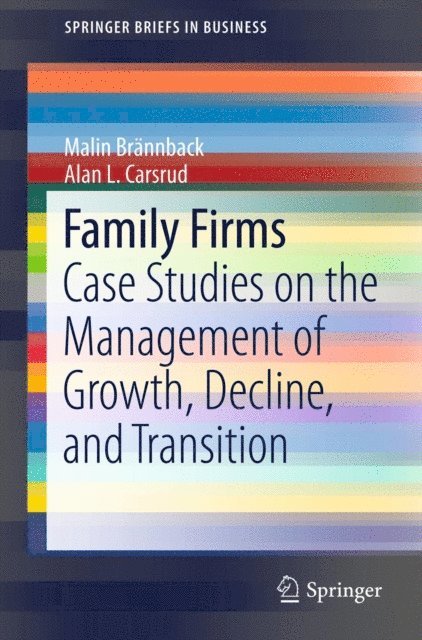
Family-owned and managed firms are often beset by a variety of crises that can impact the firm’s very survival. These may include changes in technology, deaths of critical family members, competition within an industrial sector, shifts in market dynamics and product mixes, economic turmoil, political upheaval and revolution, firm growth, succession, and selecting new firm leadership. Such crises may be internal to the firm or a function of the external environment, and several may occur simultaneously; all of them contribute to a context of uncertainty, risk, and change, presenting particular challenges that are unique to family-owned businesses.
This volume presents eight in-depth case studies of family-owned firms that represent a variety of industries and situations. Each case explores the dynamics of managing in chaotic environments and how family leadership responded to crises. Lessons learned from these experiences will help readers understand how to solve problems under conditions of uncertainty and how to avoid failure, when the survival of the firm is at stake. Featuring questions and learning notes designed to engage the reader directly, this volume will be a valuable resources for students and members of entrepreneurial and family-owned firms, as well as consultants, investors, and other professional advisors.
1 367 kr
Läs direkt efter köp
Businesses owned and operated by families constitute the vast majority of firms around the world. These firms are found in all industrial segments, from retail and service establishments to heavy manufacturers. Their sizes and revenues range from the smallest venture of a husband and wife roadside food stall in rural India to the largest multinational, highly diversified corporations in the United States and Europe. Many challenges, such as competition, regulation, environmental concerns, access to capital, and macroeconomic factors confront family and nonfamily firms alike. In addition, family and closely-held firms grapple with such issues of succession, continuity, conflict resolution, identity and organizational roles, estate and financial planning that are idiosyncratic to them; when psychological, social, and emotional factors are in play, constantly changing familial relationships influence the strategic and financial choices they make. Yet, there has been comparatively little theoretical or empirical research undertaken on family firms, relative to entrepreneurship and strategic management.
This book addresses gaps in the literature by presenting a holistic, multi-disciplinary approach to the study and practice of family business that draws from such fields as psychology, anthropology, sociology, strategy, family therapy, family studies, wealth management, and international business. An international array of experts addresses both macro issues (including the role of family businesses in new business creation and economic development, influences of culture on family business, public policies that can encourage or threaten family business) and firm management (strategic and financial decision making, governance, entering and exiting). Featuring case studies from firms in a variety of industries,Understanding Family Businesses not only offers provocative new insights on family business dynamics, but outlines an agenda for future research.
708 kr
Läs direkt efter köp
Many of the challenges faced by family-owned businesses develop after the firm has reached a stage of maturity, when the first generation is faced with issues concerning the role of their children in the business and the long-term future of the enterprise. This collection of case studies from around the world demonstrates how governance of both the business and the family (or lack thereof) impacts succession of leadership in the firm and the inheritance of ownership and wealth.It is the role of governance and how it impacts both family and firm that link these family business cases together with succession and inheritance. These topics have been clustered together because the social systems of the family and the management system of the firm have significant impacts on the success, or failure, of succession plans. All the planning in the world for succession and inheritance will not succeed if the firm does not have a well established and functional governance system. Likewise, if the family does not understand its role in the governance of the firm and the mechanisms for making sound decisions, succession choices may not be accepted by family members. Most family firms fail because of succession issues, not economic ones.
This volume features nine in-depth cases of family-owned business from a variety of industries to illuminate the dynamics of governance, succession, and inheritance. Each case illustrates the complexity of issues and, through interactive exercises and questions, offers readers approaches to solutions, which may include less-than-optimal compromises or even selling the business as the only viable option. The examples and insights will prove valuable for students and members of entrepreneurial and family-ownedfirms, as well as consultants, investors, and other professional advisors.
708 kr
Läs direkt efter köp
865 kr
Läs direkt efter köp
In this volume, the authors challenge some long held assumptions about entrepreneurial firms held by academics, public policy makers, investors and even entrepreneurs themselves. The first is assumption is that growth is what really differentiates an entrepreneurial firm from a small business. The second is that growth is always good. Third, if growth is rapid, and/or high growth, it is even better.
Drawing from a fresh review of the literature, their own primary research and experience in entrepreneurial ventures, the authors argue that the relationship between growth and firm performance is, in fact, inconclusive. Despite the strength of contemporary bias, there is strong evidence that the growth-profitability relationship is problematic. For example, rapid growth may lead to considerable organizational challenges that can seriously constrain a firm’s ability to generate sustainable profits. Also, it is not uncommon that a growth firm becomes a victim of its own success.
Using examples from industries as diverse as airlines, accounting, biotechnology, information technology, personal products, wineries, and food establishments, the authors highlight limitations to research due to variations in the choice of growth indicators, the calculation of growth measures, the measurement periods, and whether objective or subjective measures have been used. Moreover, researchers have equated growth with high growth and almost automatically assumed that this also means high technology, while policy makers appear to have interpreted this as high employment.
Armed with more precise definitions and understandings of key concepts and the nature of their causality, the authors consider the implications of restoring profitability to the core of entrepreneurship for future research, firm strategy, financing, organizational structure, resource allocation, and public policy.
535 kr
Läs direkt efter köp
A Research Agenda for Entrepreneurial Cognition and Intention suggests new directions and approaches to study the internal thought processes of entrepreneurs by examining areas that have been under-researched, ignored or overlooked.
Proposing new views on the idea of an entrepreneurial personality, new methodologies and theories of cognition and influence of personality, the contributors go beyond the study of individual intentions to evaluate group intentions. Furthermore, the book proposes that current research methods limit our understanding of entrepreneurial processes by not connecting to the wider entrepreneurial audience. With this in mind, key chapters focus on the role and relevance of language and gender in entrepreneurship.
Academic researchers and advanced students looking to explore the latest research methods and statistical approaches will find this Research Agenda extremely useful for creating new research pathways. The case studies will also be exceptionally useful for those with a wider interest in entrepreneurship and those who wish to have a greater understanding of entrepreneurial intention.
Contributors include: G.A. Alsos, G. Bertrand, M. Brännback, C.G. Brush, A.L. Carsrud, R. Germon, P.G. Greene, D.M. Hechavarria, A. Ingram, I. Jaén, F. Kropp, N. Krueger, F. Liñán, A. Maalaoui, J. Mezei, S. Nikou, T.F. Nogueira, C. Perez, M. Razgallah, L. Schjoedt, K.G. Shaver, R. Yitshaki
2 303 kr
Läs direkt efter köp
The book explores various aspects of cognitive and motivational psychology as they impact entrepreneurial behavior. Building upon the 2009 volume, Understanding the Entrepreneurial Mind, the editors and contributors explore the cognitions, motivations, passions, intentions, perceptions, and emotions associated with entrepreneurial behaviors, in each case preserving their original chapters and enhancing them with thoughtful and targeted updates, reflecting on the most recent developments in theory and practice, telling the story of what has transpired in the last decade in the field of entrepreneurial psychology.
The volume addresses such questions as: Why do some people start business and others do not? Is entrepreneurship a natural quality or can it be taught? Do entrepreneurs think differently from others? While there is a great deal of literature exploring the dynamics of new firm creation, policies to promote innovation and technology transfer, and the psychology of creativity; research on entrepreneurial mindset or cognition is relatively new, and draws largely from such related fields as organizational behavior, cognitive and social psychology, career development, and consumer research. In this book, editors Brännback and Carsrud have reassembled the contributors to Understanding the Entrepreneurial Mind to discuss new research paradigms given their vantage point years after the original volume was published.
Featuring the most current literature references, Revisiting the Entrepreneurial Mind continues to challenge conventional approaches to entrepreneurship and articulate an agenda for future research.