Malte Henkel – författare
Visar alla böcker från författaren Malte Henkel. Handla med fri frakt och snabb leverans.
16 produkter
Non-Equilibrium Phase Transitions
Volume 1: Absorbing Phase Transitions
Av Malte Henkel, Haye Hinrichsen m. fl.
Inbunden, 2009
1641 kr
Lägg i varukorg
"The career structure and funding of the universities [...] currently strongly d- courages academics and faculties from putting any investment into teaching - there are no career or ?nancial rewards in it. This is a great pity, because [...] it is the need toengage indialogue,and to makethings …
Non-Equilibrium Phase Transitions
Volume 1: Absorbing Phase Transitions
Av Sven Lubeck, Haye Hinrichsen m. fl.
E-bok, 2008
2119 kr
Lägg i varukorg
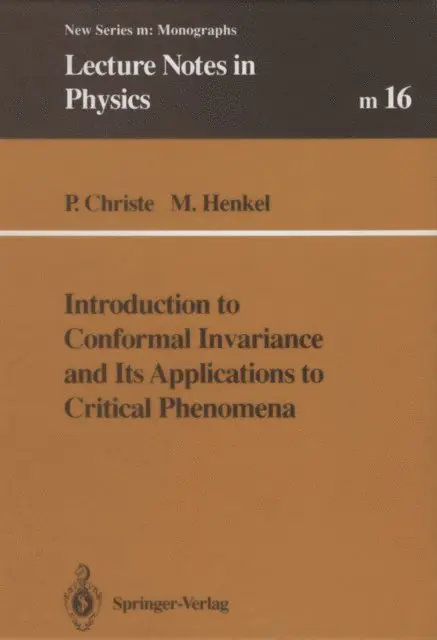
Introduction to Conformal Invariance and Its Applications to Critical Phenomena
Av Malte Henkel, Philippe Christe
E-bok, 2008
1459 kr
Lägg i varukorg
The history of critical phenomena goes back to the year 1869 when Andrews discovered the critical point of carbon dioxide, located at about 31°C and 73 atmospheres pressure. In the neighborhood ofthis point the carbon dioxide was observed to become opalescent, that is, light is strongly scattered. …
Conformal Invariance and Critical Phenomena
Av Malte Henkel
Inbunden, 1999
549 kr
Lägg i varukorg
Critical phenomena arise in a wide variety of physical systems. Classi cal examples are the liquid-vapour critical point or the paramagnetic ferromagnetic transition. Further examples include multicomponent fluids and alloys, superfluids, superconductors, polymers and fully developed tur bulence …
Ageing and the Glass Transition
Av Malte Henkel, Michel Pleimling m. fl.
Inbunden, 2007
549 kr
Lägg i varukorg
Understanding cooperative phenomena far from equilibrium is one of fascinating challenges of present-day many-body physics. Glassy behaviour and the physical ageing process of such materials are paradigmatic examples. The present volume, primarily intended as introduction and reference for …
Ageing and the Glass Transition
Av Roland Sanctuary, Michel Pleimling m. fl.
E-bok, 2007
734 kr
Lägg i varukorg
Conformal Invariance and Critical Phenomena
Av Malte Henkel
Häftad, 2010
552 kr
Lägg i varukorg
Critical phenomena arise in a wide variety of physical systems. Classi cal examples are the liquid-vapour critical point or the paramagnetic ferromagnetic transition. Further examples include multicomponent fluids and alloys, superfluids, superconductors, polymers and fully developed tur bulence …
Ageing and the Glass Transition
Av Malte Henkel, Michel Pleimling m. fl.
Häftad, 2010
552 kr
Lägg i varukorg
Understanding cooperative phenomena far from equilibrium is one of the fascinating challenges of present-day many-body physics. Glassy behaviour and the physical ageing process of such materials are paradigmatic examples. The present volume, primarily intended as introduction and reference, …
Conformal Invariance: an Introduction to Loops, Interfaces and Stochastic Loewner Evolution
Av Malte Henkel, Dragi Karevski
Häftad, 2012
552 kr
Lägg i varukorg
Conformal invariance has been a spectacularly successful tool in advancing our understanding of the two-dimensional phase transitions found in classical systems at equilibrium. This volume sharpens our picture of the applications of conformal invariance, introducing non-local observables such as …
Conformal Invariance: an Introduction to Loops, Interfaces and Stochastic Loewner Evolution
Av Dragi Karevski, Malte Henkel
E-bok, 2012
734 kr
Lägg i varukorg
Conformal invariance has been a spectacularly successful tool in advancing our understanding of the two-dimensional phase transitions found in classical systems at equilibrium. This volume sharpens our picture of the applications of conformal invariance, introducing non-local observables such as …
Conformal Invariance and Critical Phenomena
Av Malte Henkel
E-bok, 2013
734 kr
Lägg i varukorg
Critical phenomena arise in a wide variety of physical systems. Classi cal examples are the liquid-vapour critical point or the paramagnetic ferromagnetic transition. Further examples include multicomponent fluids and alloys, superfluids, superconductors, polymers and fully developed tur bulence …
Introduction to Conformal Invariance and Its Applications to Critical Phenomena
Av Philippe Christe, Malte Henkel
Häftad, 2014
1096 kr
Lägg i varukorg
The history of critical phenomena goes back to the year 1869 when Andrews discovered the critical point of carbon dioxide, located at about 31°C and 73 atmospheres pressure. In the neighborhood ofthis point the carbon dioxide was observed to become opalescent, that is, light is strongly scattered. …
Non-Equilibrium Phase Transitions
Volume 2: Ageing and Dynamical Scaling Far from Equilibrium
Av Malte Henkel, Michel Pleimling m. fl.
Inbunden, 2010
1096 kr
Lägg i varukorg
“The importance of knowledge consists not only in its direct practical utility but also in the fact the it promotes a widely contemplative habit of mind; on this ground, utility is to be found in much of the knowledge that is nowadays labelled ‘useless’. ” Bertrand Russel, In Praise of Idleness, …
Non-Equilibrium Phase Transitions
Volume 2: Ageing and Dynamical Scaling Far from Equilibrium
Av Michel Pleimling, Malte Henkel
E-bok, 2011
1459 kr
Lägg i varukorg
“The importance of knowledge consists not only in its direct practical utility but also in the fact the it promotes a widely contemplative habit of mind; on this ground, utility is to be found in much of the knowledge that is nowadays labelled ‘useless’. ” Bertrand Russel, In Praise of Idleness, …
Non-Equilibrium Phase Transitions
Volume 1: Absorbing Phase Transitions
Av Malte Henkel, Haye Hinrichsen m. fl.
Häftad, 2014
1641 kr
Lägg i varukorg
"The career structure and funding of the universities [...] currently strongly d- courages academics and faculties from putting any investment into teaching - there are no career or ?nancial rewards in it. This is a great pity, because [...] it is the need toengage indialogue,and to makethings …
Non-Equilibrium Phase Transitions
Volume 2: Ageing and Dynamical Scaling Far from Equilibrium
Av Malte Henkel, Michel Pleimling
Häftad, 2014
1096 kr
Lägg i varukorg
“The importance of knowledge consists not only in its direct practical utility but also in the fact the it promotes a widely contemplative habit of mind; on this ground, utility is to be found in much of the knowledge that is nowadays labelled ‘useless’. ” Bertrand Russel, In Praise of Idleness, …