Michel Pleimling - Böcker
Visar alla böcker från författaren Michel Pleimling. Handla med fri frakt och snabb leverans.
4 produkter
4 produkter
536 kr
Skickas inom 7-10 vardagar
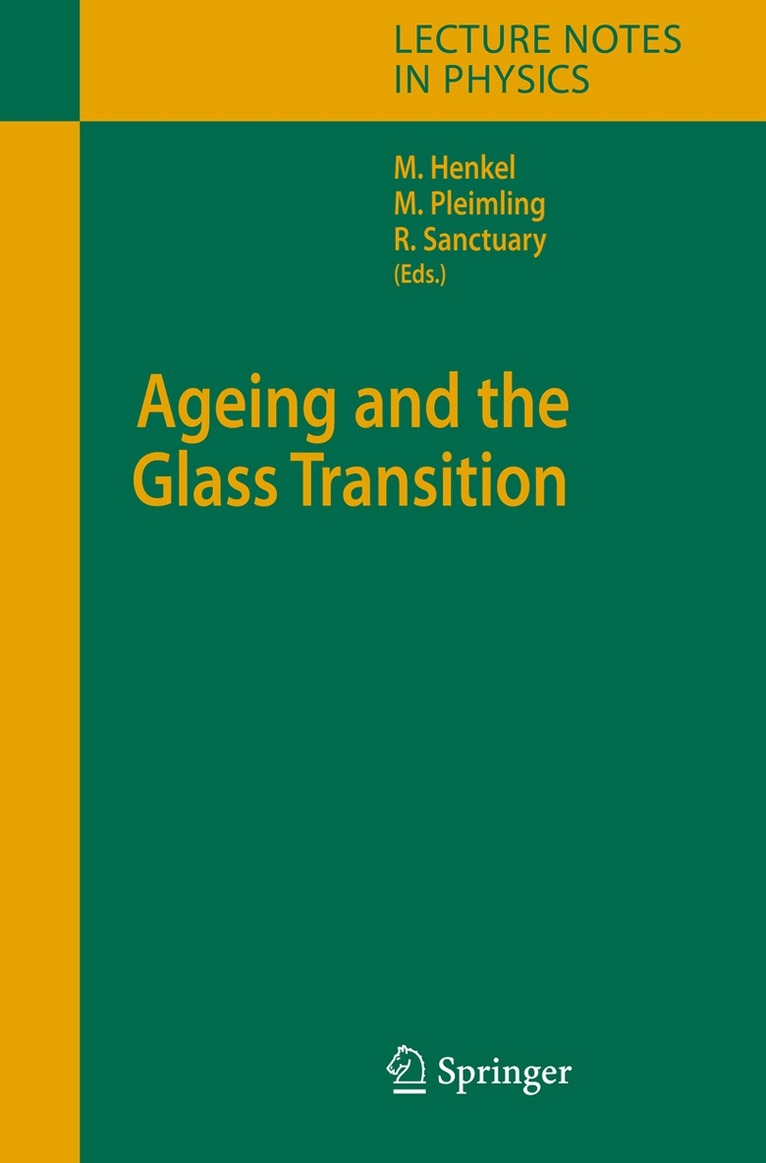
Understanding cooperative phenomena far from equilibrium is one of fascinating challenges of present-day many-body physics. Glassy behaviour and the physical ageing process of such materials are paradigmatic examples. The present volume, primarily intended as introduction and reference for postgraduate students and nonspecialist researchers from related fields, collects six extensive lectures addressing selected experimental and theoretical issues in the field of glassy systems. Lecture 1 gives an introduction and overview of the time-dependent behaviour of magnetic spin glasses. Lecture 2 is devoted to an in-depth discussion on the nature of the thermal glass-transition in structural glasses. Lecture 3 examines the glassy behaviour of granular systems. Lecture 4 gives a thorough introduction to the techniques and applications of Monte-Carlo simulations and the analysis of the resulting data through scaling methods. Lecture 5 introduces the zero-range-process concept as simple but subtle model to describe a range of static and dynamic properties of glassy systems. Lecture 6 shows how familiar RG methods for equilibrium systems can be extended to systems far from equilibrium.
536 kr
Skickas inom 10-15 vardagar
Understanding cooperative phenomena far from equilibrium is one of the fascinating challenges of present-day many-body physics. Glassy behaviour and the physical ageing process of such materials are paradigmatic examples. The present volume, primarily intended as introduction and reference, collects six extensive lectures addressing selected experimental and theoretical issues in the field of glassy systems.
Non-Equilibrium Phase Transitions
Volume 2: Ageing and Dynamical Scaling Far from Equilibrium
Inbunden, Engelska, 2010
1 064 kr
Skickas inom 10-15 vardagar
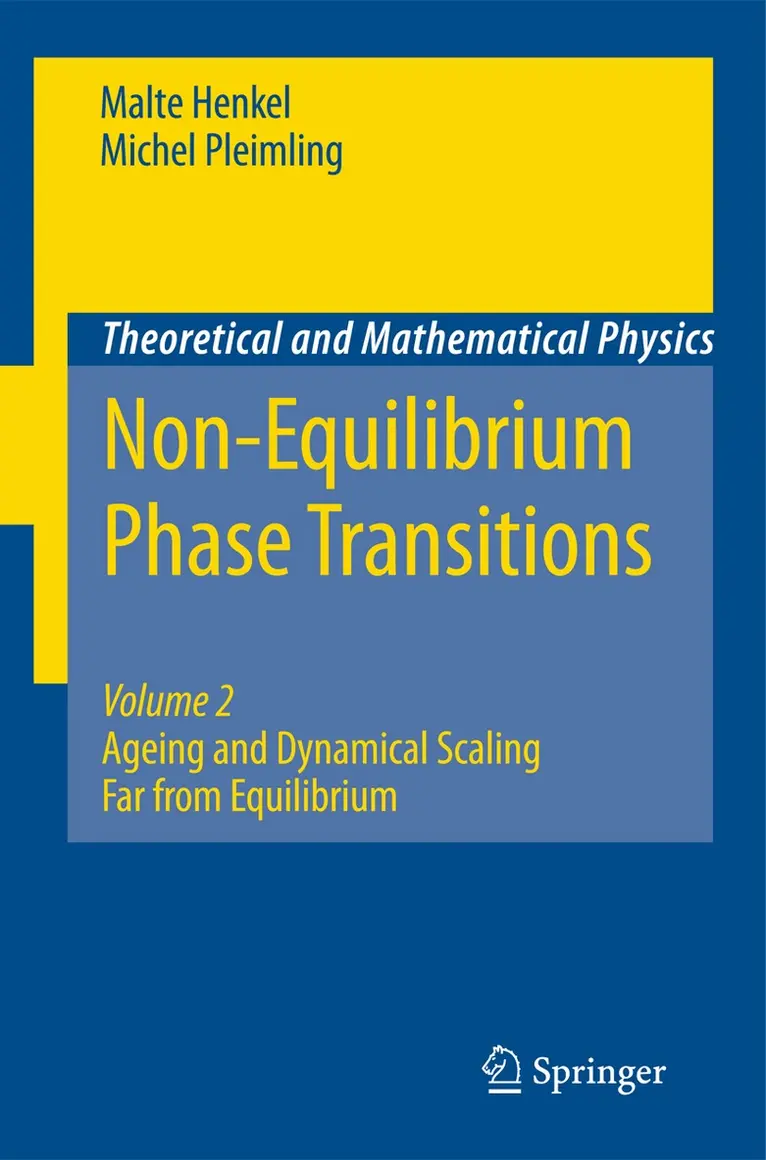
“The importance of knowledge consists not only in its direct practical utility but also in the fact the it promotes a widely contemplative habit of mind; on this ground, utility is to be found in much of the knowledge that is nowadays labelled ‘useless’. ” Bertrand Russel, In Praise of Idleness, London (1935) “Why are scientists in so many cases so deeply interested in their work ? Is it merely because it is useful ? It is only necessary to talk to such scientists to discover that the utilitarian possibilities of their work are generally of secondary interest to them. Something else is primary. ” David Bohm, On creativity, Abingdon (1996) In this volume, the dynamical critical behaviour of many-body systems far from equilibrium is discussed. Therefore, the intrinsic properties of the - namics itself, rather than those of the stationary state, are in the focus of 1 interest. Characteristically, far-from-equilibrium systems often display - namical scaling, even if the stationary state isvery far from being critical. A 1 As an example of a non-equilibrium phase transition, with striking practical c- sequences, consider the allotropic change of metallic ?-tin to brittle ?-tin. At o equilibrium, the gray ?-Sn becomes more stable than the silvery ?-Sn at 13. 2 C. Kinetically, the transition between these two solid forms of tin is rather slow at higher temperatures. It starts from small islands of ?-Sn, the growth of which proceeds through an auto-catalytic reaction.
Non-Equilibrium Phase Transitions
Volume 2: Ageing and Dynamical Scaling Far from Equilibrium
Häftad, Engelska, 2014
1 064 kr
Skickas inom 10-15 vardagar
“The importance of knowledge consists not only in its direct practical utility but also in the fact the it promotes a widely contemplative habit of mind; on this ground, utility is to be found in much of the knowledge that is nowadays labelled ‘useless’. ” Bertrand Russel, In Praise of Idleness, London (1935) “Why are scientists in so many cases so deeply interested in their work ? Is it merely because it is useful ? It is only necessary to talk to such scientists to discover that the utilitarian possibilities of their work are generally of secondary interest to them. Something else is primary. ” David Bohm, On creativity, Abingdon (1996) In this volume, the dynamical critical behaviour of many-body systems far from equilibrium is discussed. Therefore, the intrinsic properties of the - namics itself, rather than those of the stationary state, are in the focus of 1 interest. Characteristically, far-from-equilibrium systems often display - namical scaling, even if the stationary state isvery far from being critical. A 1 As an example of a non-equilibrium phase transition, with striking practical c- sequences, consider the allotropic change of metallic ?-tin to brittle ?-tin. At o equilibrium, the gray ?-Sn becomes more stable than the silvery ?-Sn at 13. 2 C. Kinetically, the transition between these two solid forms of tin is rather slow at higher temperatures. It starts from small islands of ?-Sn, the growth of which proceeds through an auto-catalytic reaction.