Manali Desai – författare
Visar alla böcker från författaren Manali Desai. Handla med fri frakt och snabb leverans.
15 produkter
15 produkter
2 527 kr
Skickas inom 10-15 vardagar
State Formation and Radical Democracy in India analyzes one of the most important cases of developmental change in the twentieth century, namely, Kerala in southern India and begs the question of whether insurgency among the marginalized poor can use formal representative democracy to create better life chances. Going back to pre-independence, colonial India, Manali Desai takes a long historical view of Kerala and compares it with the state of West Bengal, which like Kerala has been ruled by leftists but has not had the same degree of success in raising equal access to welfare, literacy, and basic subsistence. This comparison brings the role of left party formation and its mode of insertion in civil society to the fore, raising the question of what kinds of parties can effect the most substantive anti-poverty reforms within a vibrant democracy. This book offers a new, historically based explanation for Kerala’s post-independence political and economic direction.
778 kr
Skickas inom 10-15 vardagar
State Formation and Radical Democracy in India analyzes one of the most important cases of developmental change in the twentieth century, namely, Kerala in southern India and begs the question of whether insurgency among the marginalized poor can use formal representative democracy to create better life chances. Going back to pre-independence, colonial India, Manali Desai takes a long historical view of Kerala and compares it with the state of West Bengal, which like Kerala has been ruled by leftists but has not had the same degree of success in raising equal access to welfare, literacy, and basic subsistence. This comparison brings the role of left party formation and its mode of insertion in civil society to the fore, raising the question of what kinds of parties can effect the most substantive anti-poverty reforms within a vibrant democracy. This book offers a new, historically based explanation for Kerala’s post-independence political and economic direction.
1 174 kr
Skickas inom 5-8 vardagar
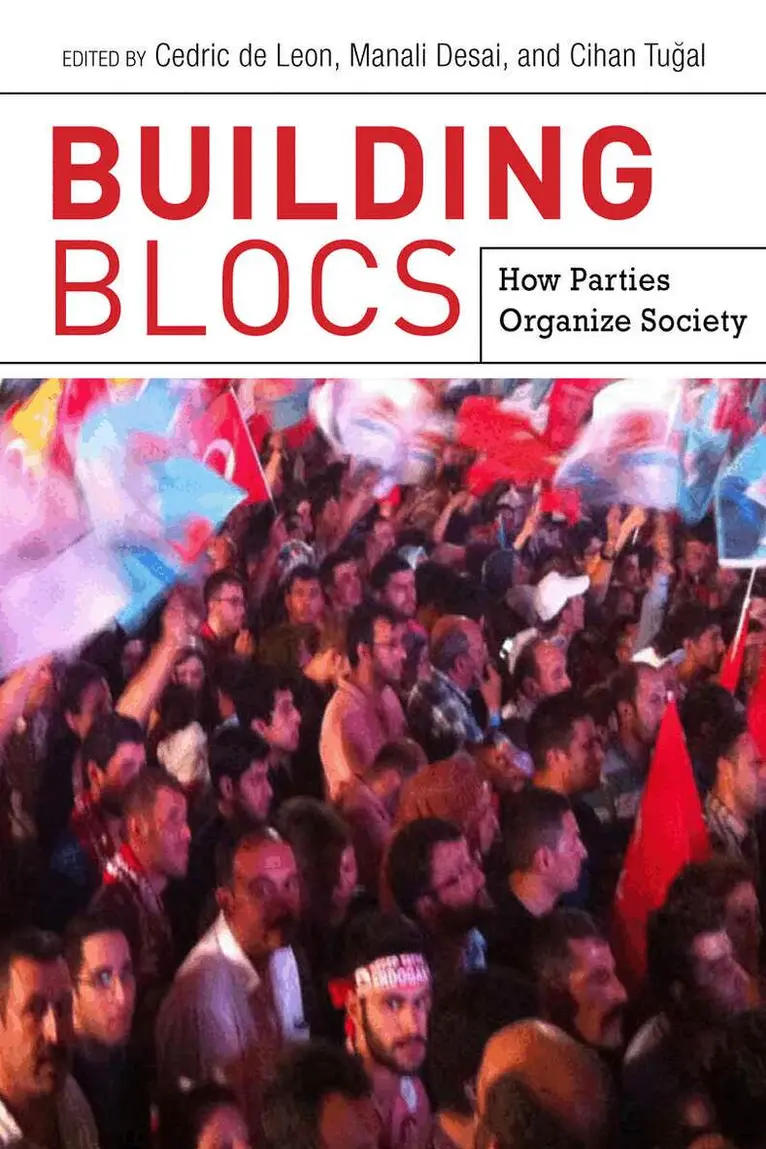
Do political parties merely represent divisions in society? Until now, scholars and other observers have generally agreed that they do. But Building Blocs argues the reverse: that some political parties in fact shape divisions as they struggle to remake the social order. Drawing on the contributors' expertise in Indonesia, India, the United States, Canada, Egypt, and Turkey, this volume demonstrates further that the success and failure of parties to politicize social differences has dramatic consequences for democratic change, economic development, and other large-scale transformations.This politicization of divisions, or "political articulation," is neither the product of a single charismatic leader nor the machinations of state power, but is instead a constant call and response between parties and would-be constituents. When articulation becomes inconsistent, as it has in Indonesia, partisan calls grow faint and the resulting vacuum creates the possibility for other forms of political expression. However, when political parties exercise their power of interpellation efficiently, they are able to silence certain interests such as those of secular constituents in Turkey. Building Blocs exposes political parties as the most influential agencies that structure social cleavages and invites further critical investigation of the related consequences.
285 kr
Skickas inom 5-8 vardagar
Do political parties merely represent divisions in society? Until now, scholars and other observers have generally agreed that they do. But Building Blocs argues the reverse: that some political parties in fact shape divisions as they struggle to remake the social order. Drawing on the contributors' expertise in Indonesia, India, the United States, Canada, Egypt, and Turkey, this volume demonstrates further that the success and failure of parties to politicize social differences has dramatic consequences for democratic change, economic development, and other large-scale transformations.This politicization of divisions, or "political articulation," is neither the product of a single charismatic leader nor the machinations of state power, but is instead a constant call and response between parties and would-be constituents. When articulation becomes inconsistent, as it has in Indonesia, partisan calls grow faint and the resulting vacuum creates the possibility for other forms of political expression. However, when political parties exercise their power of interpellation efficiently, they are able to silence certain interests such as those of secular constituents in Turkey. Building Blocs exposes political parties as the most influential agencies that structure social cleavages and invites further critical investigation of the related consequences.
154 kr
Skickas inom 5-8 vardagar
124 kr
Skickas inom 5-8 vardagar
118 kr
Skickas inom 5-8 vardagar
256 kr
Skickas inom 3-6 vardagar
112 kr
Skickas inom 5-8 vardagar
100 kr
Skickas inom 5-8 vardagar
220 kr
Skickas inom 5-8 vardagar
125 kr
Skickas inom 5-8 vardagar
202 kr
Skickas inom 5-8 vardagar
117 kr
Skickas inom 5-8 vardagar
125 kr
Skickas inom 5-8 vardagar