Mansoor Niaz – författare
Visar alla böcker från författaren Mansoor Niaz. Handla med fri frakt och snabb leverans.
15 produkter
15 produkter
From 'Science in the Making' to Understanding the Nature of Science
An Overview for Science Educators
Inbunden, Engelska, 2011
2 235 kr
Skickas inom 10-15 vardagar
The Nature of Science is highly topical among science teacher educators and researchers. Increasingly, it is a mandated topic in state curriculum documents. This book draws together recent research on Nature of Science studies within a historical and philosophical framework suitable for students and teacher educators. Traditional science curricula and textbooks present science as a finished product. Taking a different approach, this book provides a glimpse of “science in the making” — scientific practice imbued with arguments, controversies, and competition among rival theories and explanations. Teaching about “science in the making” is a rich source of motivating students to engage creatively with the science curriculum.Readers are introduced to “science in the making” through discussion and analysis of a wide range of historical episodes from the early 19th century to early 21st century. Recent cutting-edge research is presented to provide insight into the dynamics of scientific progress. More than 90 studies from major science education journals, related to nature of science are reviewed. A theoretical framework, field tested with in-service science teachers, is developed for moving from ‘science in the making’ to understanding the Nature of Science.
Inbunden, Engelska, 2010
2 302 kr
Skickas inom 10-15 vardagar
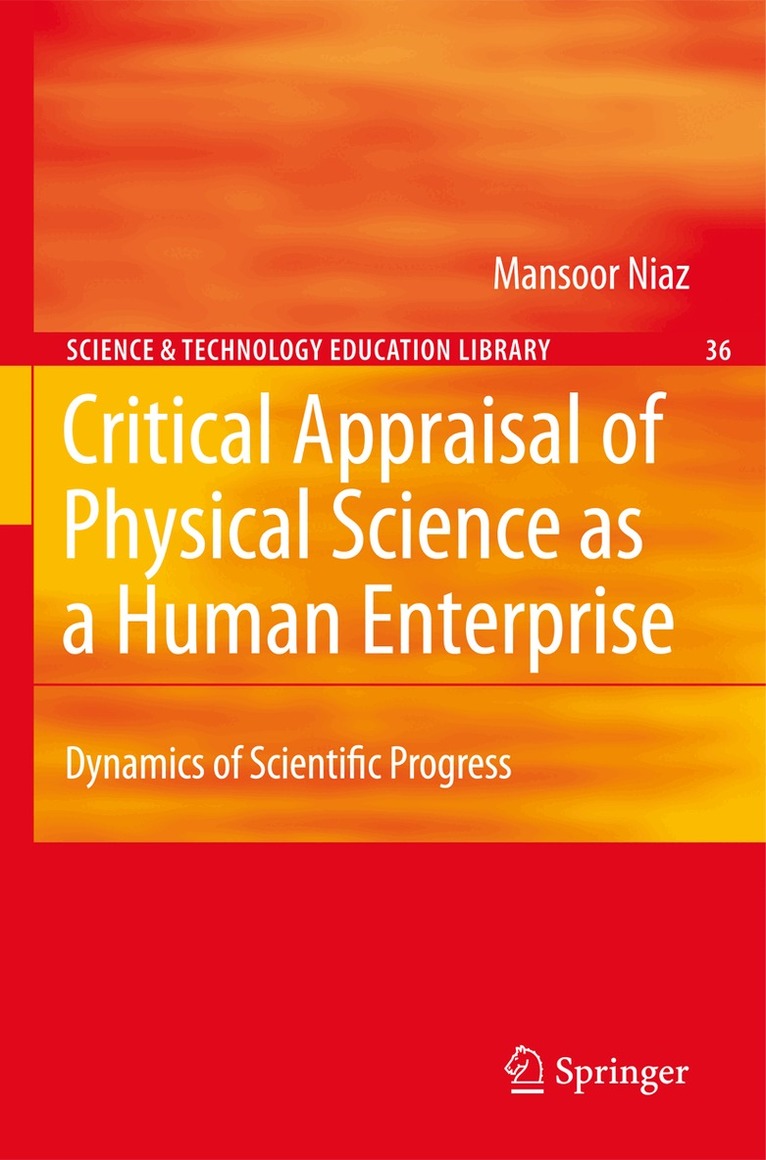
How teachers view the nature of scientific knowledge is crucial to their understanding of science content and how it can be taught. This book presents an overview of the dynamics of scientific progress and its relationship to the history and philosophy of science, and then explores their methodological and educational implications and develops innovative strategies based on actual classroom practice for teaching topics such the nature of science, conceptual change, constructivism, qualitative-quantitative research, and the role of controversies, presuppositions, speculations, hypotheses, and predictions. Field-tested in science education courses, this book is designed to involve readers in critically thinking about the history and philosophy of science and to engage science educators in learning how to progressively introduce various aspects of ‘science-in-the-making’ in their classrooms, to promote discussions highlighting controversial historical episodes included in the science curriculum, and to expose their students to the controversies and encourage them to support, defend or critique the different interpretations. Innovating Science Teacher Education offers guidelines to go beyond traditional textbooks, curricula, and teaching methods and innovate with respect to science teacher education and classroom teaching.
Häftad, Engelska, 2010
682 kr
Skickas inom 10-15 vardagar
How teachers view the nature of scientific knowledge is crucial to their understanding of science content and how it can be taught. This book presents an overview of the dynamics of scientific progress and its relationship to the history and philosophy of science, and then explores their methodological and educational implications and develops innovative strategies based on actual classroom practice for teaching topics such the nature of science, conceptual change, constructivism, qualitative-quantitative research, and the role of controversies, presuppositions, speculations, hypotheses, and predictions. Field-tested in science education courses, this book is designed to involve readers in critically thinking about the history and philosophy of science and to engage science educators in learning how to progressively introduce various aspects of ‘science-in-the-making’ in their classrooms, to promote discussions highlighting controversial historical episodes included in the science curriculum, and to expose their students to the controversies and encourage them to support, defend or critique the different interpretations. Innovating Science Teacher Education offers guidelines to go beyond traditional textbooks, curricula, and teaching methods and innovate with respect to science teacher education and classroom teaching.
Inbunden, Engelska, 2009
1 405 kr
Skickas inom 10-15 vardagar
It is generally believed that doing science means accumulating empirical data with no or little reference to the interpretation of the data based on the scientist’s th- retical framework or presuppositions. Holton (1969a) has deplored the widely accepted myth (experimenticism) according to which progress in science is presented as the inexorable result of the pursuit of logically sound conclusions from un- biguous experimental data. Surprisingly, some of the leading scientists themselves (Millikan is a good example) have contributed to perpetuate the myth with respect to modern science being essentially empirical, that is carefully tested experim- tal facts (free of a priori conceptions), leading to inductive generalizations. Based on the existing knowledge in a field of research a scientist formulates the guiding assumptions (Laudan et al. , 1988), presuppositions (Holton, 1978, 1998) and “hard core” (Lakatos, 1970) of the research program that constitutes the imperative of presuppositions, which is not abandoned in the face of anomalous data. Laudan and his group consider the following paraphrase of Kant by Lakatos as an important guideline: philosophy of science without history of science is empty. Starting in the 1960s, this “historical school” has attempted to redraw and replace the positivist or logical empiricist image of science that dominated for the first half of the twentieth century. Among other aspects, one that looms large in these studies is that of “guiding assumptions” and has considerable implications for the main thesis of this monograph (Chapter 2).
Del 50 - Contemporary Trends and Issues in Science Education
Feyerabend’s Epistemological Anarchism
How Science Works and its Importance for Science Education
Inbunden, Engelska, 2020
1 083 kr
Skickas inom 10-15 vardagar
This book argues that the traditional image of Feyerabend is erroneous and that, contrary to common belief, he was a great admirer of science.
Del 50 - Contemporary Trends and Issues in Science Education
Feyerabend’s Epistemological Anarchism
How Science Works and its Importance for Science Education
Häftad, Engelska, 2021
1 083 kr
Skickas inom 10-15 vardagar
This book argues that the traditional image of Feyerabend is erroneous and that, contrary to common belief, he was a great admirer of science.
Häftad, Engelska, 2013
582 kr
Skickas inom 10-15 vardagar
This book is about how students are taught the periodic table. It reviews aspects of the periodic table’s development, using the history and philosophy of science. The teaching method presented in this book is ideal for teaching the subject in high school and at introductory university level. Chemistry students taught in this new, experimental way are compared with those taught in the traditional way and the author describes how tests found more conceptual responses from the experimental group than the control group.The historical aspects of importance to this teaching method are: the role of the Karlsruhe Congress of 1860; the accommodation of the chemical elements in the periodic table; prediction of elements that were discovered later; corrections of atomic weights; periodicity in the periodic table as a function of the atomic theory; and the accommodation of argon.The experimental group of students participated in various activities, including: discussion of various aspects related to the history and philosophy of science; construction of concept maps and their evaluation by the students; PowerPoint presentations; and interviews with volunteer students.
Inbunden, Engelska, 2016
1 190 kr
Skickas inom 10-15 vardagar
This book explores the relationship between the content of chemistry education and the history and philosophy of science (HPS) framework that underlies such education. It discusses the need to present an image that reflects how chemistry developed and progresses. It proposes that chemistry should be taught the way it is practiced by chemists: as a human enterprise, at the interface of scientific practice and HPS. Finally, it sets out to convince teachers to go beyond the traditional classroom practice and explore new teaching strategies. The importance of HPS has been recognized for the science curriculum since the middle of the 20th century. The need for teaching chemistry within a historical context is not difficult to understand as HPS is not far below the surface in any science classroom. A review of the literature shows that the traditional chemistry classroom, curricula, and textbooks while dealing with concepts such as law, theory, model, explanation, hypothesis, observation, evidence and idealization, generally ignore elements of the history and philosophy of science. This book proposes that the conceptual understanding of chemistry requires knowledge and understanding of the history and philosophy of science.“Professor Niaz’s book is most welcome, coming at a time when there is an urgently felt need to upgrade the teaching of science. The book is a huge aid for adding to the usual way - presenting science as a series of mere facts - also the necessary mandate: to show how science is done, and how science, through its history and philosophy, is part of the cultural development of humanity.”Gerald Holton, Mallinckrodt Professor of Physics & Professor of History of Science, Harvard University“In this stimulating and sophisticated blend of history of chemistry, philosophy of science, and science pedagogy, Professor Mansoor Niaz has succeeded in offering a promising new approach to theteaching of fundamental ideas in chemistry. Historians and philosophers of chemistry --- and above all, chemistry teachers --- will find this book full of valuable and highly usable new ideas”Alan Rocke, Case Western Reserve University “This book artfully connects chemistry and chemistry education to the human context in which chemical science is practiced and the historical and philosophical background that illuminates that practice. Mansoor Niaz deftly weaves together historical episodes in the quest for scientific knowledge with the psychology of learning and philosophical reflections on the nature of scientific knowledge and method. The result is a compelling case for historically and philosophically informed science education. Highly recommended!”Harvey Siegel, University of Miami “Books that analyze the philosophy and history of science in Chemistry are quite rare. ‘Chemistry Education and Contributions from History and Philosophy of Science’ by Mansoor Niaz is one of the rare books on the history and philosophy of chemistry and their importance in teaching this science. The book goes through all the main concepts of chemistry, and analyzes the historical and philosophical developments as well as their reflections in textbooks.Closest to my heart is Chapter 6, which is devoted to the chemical bond, the glue that holds together all matter in our earth. The chapter emphasizes the revolutionary impact of the concept of the ‘covalent bond’ on the chemical community and the great novelty of the idea that was conceived 11 years before quantum mechanics was able to offer the mechanism of electron pairing and covalent bonding. The author goes then to describe the emergence of two rival theories that explained the nature of the chemical bond in terms of quantum mechanics; these are valence bond (VB) and molecular orbital (MO) theories. He emphasizes the importance of having rival theories and interpretations in science and its advancement. He further argues that this VB-MO rivalry is still alive and together the two conceptual frames serve as the tool kit for thinking and doing chemistry in creative manners. The author surveys chemistry textbooks in the light of the how the books preserve or not the balance between the two theories in describing various chemical phenomena. This Talmudic approach of conceptual tension is a universal characteristic of any branch of evolving wisdom. As such, Mansoor’s book would be of great utility for chemistry teachers to examine how can they become more effective teachers by recognizing the importance of conceptual tension”. Sason ShaikSaeree K. and Louis P. Fiedler Chair in ChemistryDirector, The Lise Meitner-Minerva Center for Computational Quantum Chemistry, The Hebrew University of Jerusalem, ISRAEL
Häftad, Engelska, 2016
543 kr
Skickas inom 10-15 vardagar
This book discusses how to improve high school students’understanding of research methodology based on alternative interpretations of data, role of controversies, creativity andthe scientific method, in the context of the oil drop experiment. These aspects form an important part of thenature of science (NOS). The study reported in this volume is is based on a reflective, explicit and activity-based approach to teachingnature of science (NOS) that can facilitate high school students’ understanding of how scientists elaborate theoreticalframeworks, design experiments, report data that leads to controversies and finally with thecollaboration of the scientific community a consensus is reached. Most students changed their perspective and drew concept maps in whichthey emphasized the creative, accumulative, controversialnature of science and the scientific method.
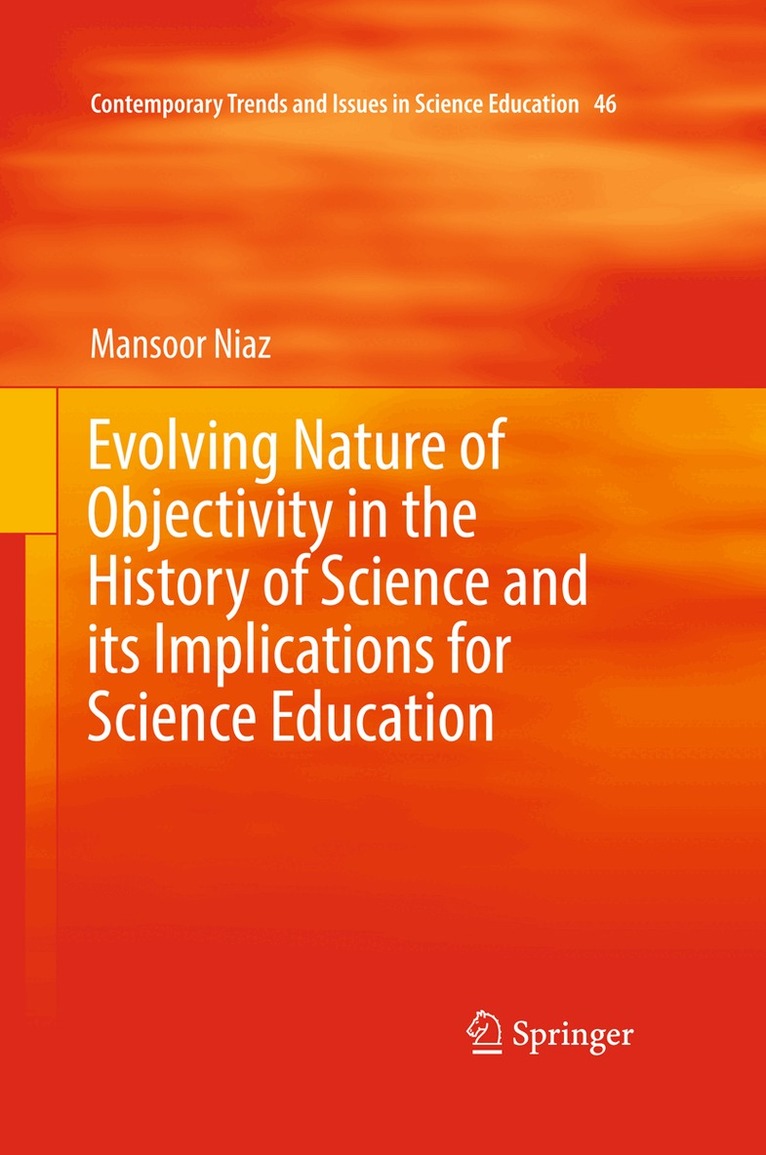
Del 46 - Contemporary Trends and Issues in Science Education
Evolving Nature of Objectivity in the History of Science and its Implications for Science Education
Inbunden, Engelska, 2017
545 kr
Skickas inom 10-15 vardagar
This book explores the evolving nature of objectivity in the history of science and its implications for science education. It is generally considered that objectivity, certainty, truth, universality, the scientific method and the accumulation of experimental data characterize both science and science education. Such universal values associated with science may be challenged while studying controversies in their original historical context. The scientific enterprise is not characterized by objectivity or the scientific method, but rather controversies, alternative interpretations of data, ambiguity, and uncertainty. Although objectivity is not synonymous with truth or certainty, it has eclipsed other epistemic virtues and to be objective is often used as a synonym for scientific. Recent scholarship in history and philosophy of science has shown that it is not the experimental data (Baconian orgy of quantification) but rather the diversity / plurality in a scientificdiscipline that contributes toward understanding objectivity. History of science shows that objectivity and subjectivity can be considered as the two poles of a continuum and this dualism leads to a conflict in understanding the evolving nature of objectivity.The history of objectivity is nothing less than the history of science itself and the evolving and varying forms of objectivity does not mean that one replaced the other in a sequence but rather each form supplements the others.This book is remarkable for its insistence that the philosophy of science, and in particular that discipline’s analysis of objectivity as the supposed hallmark of the scientific method, is of direct value to teachers of science. Meticulously, yet in a most readable way, Mansoor Niaz looks at the way objectivity has been dealt with over the years in influential educational journals and in textbooks; it’s fascinating how certain perspectives fade, while basic questions show no sign of going away. There are few books that take both philosophy and education seriously – this one does!Roald Hoffmann, Cornell University, chemist, writer and Nobel Laureate in Chemistry
Häftad, Engelska, 2018
1 190 kr
Skickas inom 10-15 vardagar
This book explores the relationship between the content of chemistry education and the history and philosophy of science (HPS) framework that underlies such education. It discusses the need to present an image that reflects how chemistry developed and progresses. It proposes that chemistry should be taught the way it is practiced by chemists: as a human enterprise, at the interface of scientific practice and HPS. Finally, it sets out to convince teachers to go beyond the traditional classroom practice and explore new teaching strategies. The importance of HPS has been recognized for the science curriculum since the middle of the 20th century. The need for teaching chemistry within a historical context is not difficult to understand as HPS is not far below the surface in any science classroom. A review of the literature shows that the traditional chemistry classroom, curricula, and textbooks while dealing with concepts such as law, theory, model, explanation, hypothesis, observation, evidence and idealization, generally ignore elements of the history and philosophy of science. This book proposes that the conceptual understanding of chemistry requires knowledge and understanding of the history and philosophy of science.“Professor Niaz’s book is most welcome, coming at a time when there is an urgently felt need to upgrade the teaching of science. The book is a huge aid for adding to the usual way - presenting science as a series of mere facts - also the necessary mandate: to show how science is done, and how science, through its history and philosophy, is part of the cultural development of humanity.”Gerald Holton, Mallinckrodt Professor of Physics & Professor of History of Science, Harvard University“In this stimulating and sophisticated blend of history of chemistry, philosophy of science, and science pedagogy, Professor Mansoor Niaz has succeeded in offering a promising new approach to theteaching of fundamental ideas in chemistry. Historians and philosophers of chemistry --- and above all, chemistry teachers --- will find this book full of valuable and highly usable new ideas”Alan Rocke, Case Western Reserve University “This book artfully connects chemistry and chemistry education to the human context in which chemical science is practiced and the historical and philosophical background that illuminates that practice. Mansoor Niaz deftly weaves together historical episodes in the quest for scientific knowledge with the psychology of learning and philosophical reflections on the nature of scientific knowledge and method. The result is a compelling case for historically and philosophically informed science education. Highly recommended!”Harvey Siegel, University of Miami “Books that analyze the philosophy and history of science in Chemistry are quite rare. ‘Chemistry Education and Contributions from History and Philosophy of Science’ by Mansoor Niaz is one of the rare books on the history and philosophy of chemistry and their importance in teaching this science. The book goes through all the main concepts of chemistry, and analyzes the historical and philosophical developments as well as their reflections in textbooks.Closest to my heart is Chapter 6, which is devoted to the chemical bond, the glue that holds together all matter in our earth. The chapter emphasizes the revolutionary impact of the concept of the ‘covalent bond’ on the chemical community and the great novelty of the idea that was conceived 11 years before quantum mechanics was able to offer the mechanism of electron pairing and covalent bonding. The author goes then to describe the emergence of two rival theories that explained the nature of the chemical bond in terms of quantum mechanics; these are valence bond (VB) and molecular orbital (MO) theories. He emphasizes the importance of having rival theories and interpretations in science and its advancement. He further argues that this VB-MO rivalry is still alive and together the two conceptual frames serve as the tool kit for thinking and doing chemistry in creative manners. The author surveys chemistry textbooks in the light of the how the books preserve or not the balance between the two theories in describing various chemical phenomena. This Talmudic approach of conceptual tension is a universal characteristic of any branch of evolving wisdom. As such, Mansoor’s book would be of great utility for chemistry teachers to examine how can they become more effective teachers by recognizing the importance of conceptual tension”. Sason ShaikSaeree K. and Louis P. Fiedler Chair in ChemistryDirector, The Lise Meitner-Minerva Center for Computational Quantum Chemistry, The Hebrew University of Jerusalem, ISRAEL
Del 46 - Contemporary Trends and Issues in Science Education
Evolving Nature of Objectivity in the History of Science and its Implications for Science Education
Häftad, Engelska, 2018
545 kr
Skickas inom 10-15 vardagar
This book explores the evolving nature of objectivity in the history of science and its implications for science education. It is generally considered that objectivity, certainty, truth, universality, the scientific method and the accumulation of experimental data characterize both science and science education. Such universal values associated with science may be challenged while studying controversies in their original historical context. The scientific enterprise is not characterized by objectivity or the scientific method, but rather controversies, alternative interpretations of data, ambiguity, and uncertainty. Although objectivity is not synonymous with truth or certainty, it has eclipsed other epistemic virtues and to be objective is often used as a synonym for scientific. Recent scholarship in history and philosophy of science has shown that it is not the experimental data (Baconian orgy of quantification) but rather the diversity / plurality in a scientificdiscipline that contributes toward understanding objectivity. History of science shows that objectivity and subjectivity can be considered as the two poles of a continuum and this dualism leads to a conflict in understanding the evolving nature of objectivity.The history of objectivity is nothing less than the history of science itself and the evolving and varying forms of objectivity does not mean that one replaced the other in a sequence but rather each form supplements the others.This book is remarkable for its insistence that the philosophy of science, and in particular that discipline’s analysis of objectivity as the supposed hallmark of the scientific method, is of direct value to teachers of science. Meticulously, yet in a most readable way, Mansoor Niaz looks at the way objectivity has been dealt with over the years in influential educational journals and in textbooks; it’s fascinating how certain perspectives fade, while basic questions show no sign of going away. There are few books that take both philosophy and education seriously – this one does!Roald Hoffmann, Cornell University, chemist, writer and Nobel Laureate in Chemistry
Häftad, Engelska, 2010
1 405 kr
Skickas inom 10-15 vardagar
It is generally believed that doing science means accumulating empirical data with no or little reference to the interpretation of the data based on the scientist’s th- retical framework or presuppositions. Holton (1969a) has deplored the widely accepted myth (experimenticism) according to which progress in science is presented as the inexorable result of the pursuit of logically sound conclusions from un- biguous experimental data. Surprisingly, some of the leading scientists themselves (Millikan is a good example) have contributed to perpetuate the myth with respect to modern science being essentially empirical, that is carefully tested experim- tal facts (free of a priori conceptions), leading to inductive generalizations. Based on the existing knowledge in a field of research a scientist formulates the guiding assumptions (Laudan et al. , 1988), presuppositions (Holton, 1978, 1998) and “hard core” (Lakatos, 1970) of the research program that constitutes the imperative of presuppositions, which is not abandoned in the face of anomalous data. Laudan and his group consider the following paraphrase of Kant by Lakatos as an important guideline: philosophy of science without history of science is empty. Starting in the 1960s, this “historical school” has attempted to redraw and replace the positivist or logical empiricist image of science that dominated for the first half of the twentieth century. Among other aspects, one that looms large in these studies is that of “guiding assumptions” and has considerable implications for the main thesis of this monograph (Chapter 2).
Häftad, Engelska, 2011
544 kr
Skickas inom 10-15 vardagar
Research in science education has recognized the importance of history and philosophy of science (HPS). Nature of science (NOS) is considered to be an essential part of HPS with important implications for teaching science. The role played by textbooks in developing students’ informed conceptions of NOS has been a source of considerable interest for science educators. In some parts of the world, textbooks become the curriculum and determine to a great extent what is taught and learned in the classroom. Given this background and interest, this monograph has evaluated NOS in university level general chemistry textbooks published in U.S.A. Most textbooks in this study provided little insight with respect to the nine criteria used for evaluating NOS. Some of the textbooks, however, inevitably refer to HPS and thus provide guidelines for future textbooks. A few of the textbooks go into considerable detail to present the atomic models of Dalton, Thomson, Rutherford, Bohr and wave mechanical to illustrate the tentative nature of scientific theories --- an important NOS aspect. These results lead to the question: Are we teaching science as practiced by scientists? An answer to this question can help us to understand the importance of NOS, by providing students an HPS-based environment, so that they too (just like the scientists) feel the thrill and excitement of discovering new things. This monograph provides students and teachers guidelines for introducing various aspects of NOS, based on historical episodes.
Häftad, Engelska, 2012
544 kr
Skickas inom 10-15 vardagar
It goes without saying that atomic structure, including its dual wave-particle nature, cannot be demonstrated in the classroom. Thus, for most science teachers, especially those in physics and chemistry, the textbook is their key resource and their students’ core source of information. Science education historiography recognizes the role played by the history and philosophy of science in developing the content of our textbooks, and with this in mind, the authors analyze more than 120 general chemistry textbooks published in the USA, based on criteria derived from a historical reconstruction of wave-particle duality. They come to some revealing conclusions, including the fact that very few textbooks discussed issues such as the suggestion, by both Einstein and de Broglie, and before conclusive experimental evidence was available, that wave-particle duality existed. Other large-scale omissions included de Broglie’s prescription for observing this duality, and the importance of the Davisson-Germer experiments, as well as the struggle to interpret the experimental data they were collecting. Also untouched was the background to the role played by Schrödinger in developing de Broglie’s ideas. The authors argue that rectifying these deficiencies will arouse students’ curiosity by giving them the opportunity to engage creatively with the content of science curricula. They also assert that it isn’t just the experimental data in science that matters, but the theoretical insights and unwonted inspirations, too. In addition, the controversies and discrepancies in the theoretical and experimental record are key drivers in understanding the development of science as we know it today.