• Fri frakt över 249 kr
  • •
  • Snabba leveranser
  • •
  • Billiga böcker
Kundservice

Du är på sajten för privatpersoner.

Företag, bibliotek eller offentlig verksamhet?

Du handlar på classic.bokus.com, där alla dina funktioner finns intakta.
Till classic.bokus.com
Bokus logotyp. Gå till startsidan.
  • Erbjudanden
  • Nyheter
  • Student
  • Topplistor
  • Barn & ungdom
  • Bokus Play
  • E-böcker
  • Pocketböcker
  • Spel & pussel

10% rabatt på allt med kod: NYSTART10 →

Sidfot

Mina sidor

    Hjälp

    • Kundservice
    • Vanliga frågor och svar
    • Frakt och leverans
    • Retur vid ångerrätt
    • Reklamera vara
    • Betalning
    • Köpvillkor
    • Allmänna villkor
    • Information om webbplatsens tillgänglighet

    Om Bokus

    • Om oss
    • Pressrum
    • För studenter
    • För företag
    • För bibliotek och offentlig verksamhet
    • För leverantörer
    • Hållbarhet

    Populärt

    • Aktuella erbjudanden
    • Presentkort
    • Studentlitteratur
    • Nya böcker
    • Topplistor
    • Signerade böcker
    • Engelska böcker

    Inspiration

    • Boktips
    • BookTok
    • Populära bokserier
    • Barnbokskaraktärer
    • Populära författare
    Logotyp för Bokus
    Följ oss på Facebook (extern länk)Följ oss på Instagram (extern länk)Följ oss på YouTube (extern länk)Följ oss på TikTok (extern länk)
    bokus @ CookiesAnpassa cookiesIntegritetspolicyKöpvillkor
    Till Citymail hemsida (extern länk)Till Budbee hemsida (extern länk)Till Postnord hemsida (extern länk)Till Schenker hemsida (extern länk)Till Early Bird hemsida (extern länk)Till Walleys hemsida (extern länk)
    1. Psykologi och pedagogik
    2. Pedagogik
    3. Pedagogisk psykologi

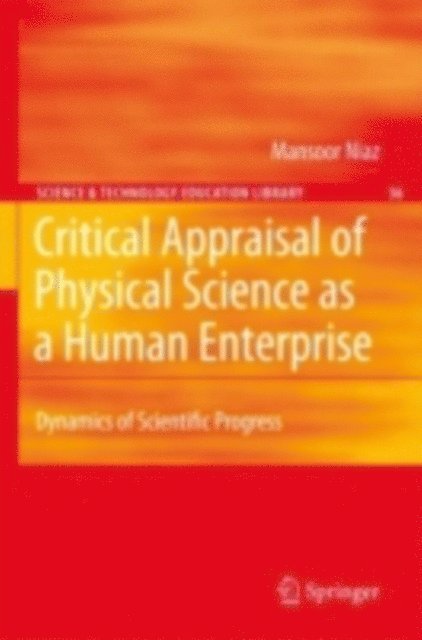
    Critical Appraisal of Physical Science as a Human Enterprise

    Dynamics of Scientific Progress

    AvMansoor Niaz

    Inbunden, Engelska, 2009

    Del i serien Contemporary Trends and Issues in Science Education

    1 410 kr

    Beställningsvara. Skickas inom 10-15 vardagar. Fri frakt över 249 kr.

    Fler format och utgåvor

    E-bok

    1 728 kr

    Häftad

    1 410 kr

    Beskrivning

    It is generally believed that doing science means accumulating empirical data with no or little reference to the interpretation of the data based on the scientist’s th- retical framework or presuppositions. Holton (1969a) has deplored the widely accepted myth (experimenticism) according to which progress in science is presented as the inexorable result of the pursuit of logically sound conclusions from un- biguous experimental data. Surprisingly, some of the leading scientists themselves (Millikan is a good example) have contributed to perpetuate the myth with respect to modern science being essentially empirical, that is carefully tested experim- tal facts (free of a priori conceptions), leading to inductive generalizations. Based on the existing knowledge in a field of research a scientist formulates the guiding assumptions (Laudan et al. , 1988), presuppositions (Holton, 1978, 1998) and “hard core” (Lakatos, 1970) of the research program that constitutes the imperative of presuppositions, which is not abandoned in the face of anomalous data. Laudan and his group consider the following paraphrase of Kant by Lakatos as an important guideline: philosophy of science without history of science is empty. Starting in the 1960s, this “historical school” has attempted to redraw and replace the positivist or logical empiricist image of science that dominated for the first half of the twentieth century. Among other aspects, one that looms large in these studies is that of “guiding assumptions” and has considerable implications for the main thesis of this monograph (Chapter 2).

    Produktinformation

    • Utgivningsdatum:2009-02-03
    • Mått:155 x 235 x 21 mm
    • Vikt:494 g
    • Format:Inbunden
    • Språk:Engelska
    • Serie:Contemporary Trends and Issues in Science Education
    • Antal sidor:216
    • Upplaga:2009
    • Förlag:Springer-Verlag New York Inc.
    • ISBN:9781402096259

    Utforska kategorier

    • Pedagogisk psykologi inom Psykologi och pedagogik
    • Undervisning i specifika ämnen inom Psykologi och pedagogik
    • Naturvetenskap:allmänt inom Naturvetenskap och teknik

    Recensioner i media

    From the reviews: "The book is organized in 14 chapters and includes references, an author index and a subject index. ... The book does an excellent job in brining to the foreground the complexity that surrounds the development of ideas in science. ... Overall, the book is a valuable contribution in illustrating a face of science that is often ignored. ... The book will be useful for academics, researchers and students in history, philosophy and education of science." (Sibel Erduran, Science & Education, June, 2010) "This 14-chapter book devotes 10 chapters to historical episodes of scientific discovery and theory development in the physical sciences. ... for students of history and philosophy of science (HPS) and science education, this volume reports on important physical science episodes in the application of HPS to science education. ... Niaz's monograph is a good source for gaining insights into how history of science influenced philosophy of science." (Richard A. Duschl, Studies in Science Education, Vol. 47 (1), March, 2011)

    Innehållsförteckning

    • Quantitative Imperative Versus the Imperative of Presuppositions.- Understanding Scientific Progress: From Duhem to Lakatos.- Kinetic Theory: Maxwell's Presuppositions.- Periodic Table of the Chemical Elements: From Mendeleev to Moseley.- Foundations of Modern Atomic Theory: Thomson, Rutherford, and Bohr.- Determination of the Elementary Electrical Charge: Millikan and Ehrenhaft.- Paradox of the Photoelectric Effect: Einstein and Millikan.- Bending of Light in the 1919 Eclipse Experiments: Einstein and Eddington.- Lewis's Covalent Bond: From Transfer of Electrons to Sharing of Electrons.- Quantum Mechanics: From Bohr to Bohm.- Wave–Particle Duality: De Broglie, Einstein, and Schrödinger.- Searching for Quarks: Perl's Philosophy of Speculative Experiments.- Conclusion: Inductive Method as a Chimera.