Manthos G. Papadopoulos - Böcker
Visar alla böcker från författaren Manthos G. Papadopoulos. Handla med fri frakt och snabb leverans.
5 produkter
5 produkter
2 110 kr
Skickas inom 10-15 vardagar
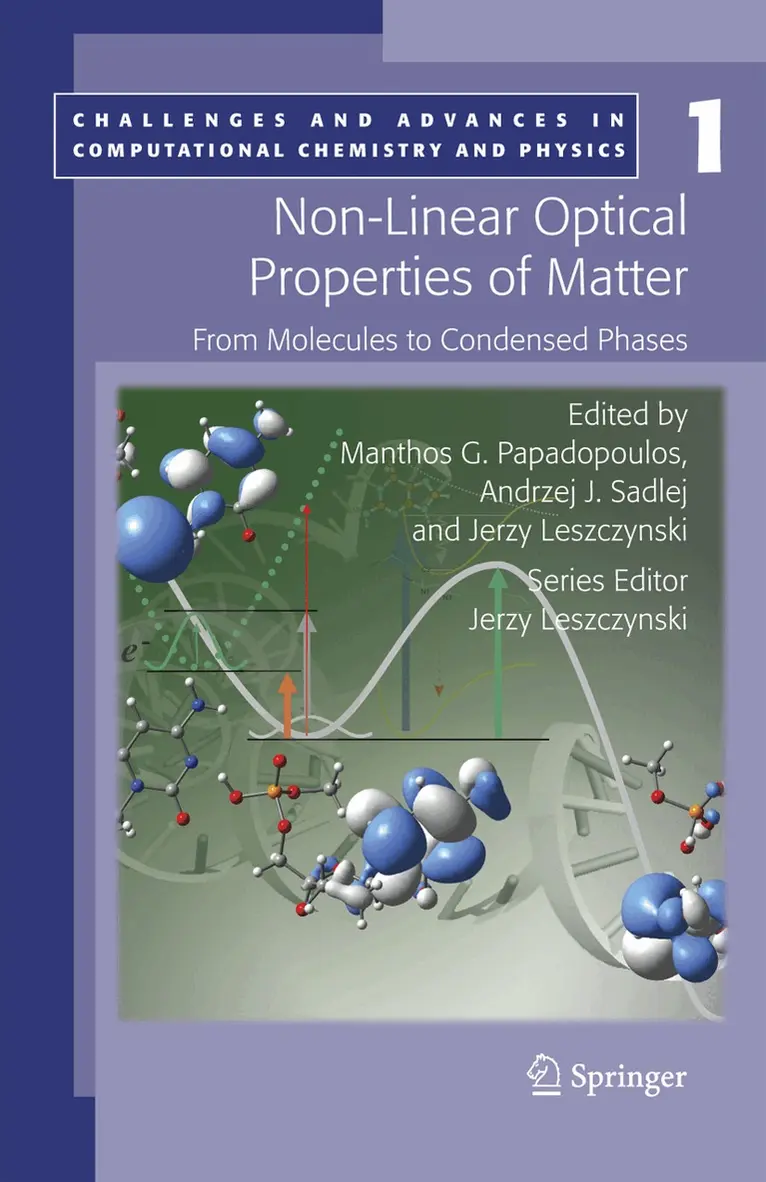
Non-Linear Optical Properties of Matter: From Molecules to Condensed Phases attempts to draw together both theory and application in this field. As such it will be of interest to both experimentalists and theoreticians alike. Divided into two parts, Part 1 is concerned with the theory and computing of non-linear optical (NLO) properties while Part 2 reviews the latest developments in experimentation.Part 1: Surveys the current advances in the computation of the NLO properties of molecules, crystalline solids and nano-particles. It examines the methods employed to compute the properties of both microscopic and macroscopic forms of matter.Part 2: Covers the recent advances on the NLO properties of organometallic compounds, rotaxanes, glasses, Langmuir-Blodget films, gold and silver nano-particles etc. Strategies to develop novel NLO materials are also discussed along with the Hyper-Rayleigh scattering technique.
15 819 kr
Skickas inom 10-15 vardagar
The first part briefly describes different methods used in computational chemistry without going into exhaustive details of theory. Basic assumptions common to the majority of computational methods based on either quantum or statistical mechanics are outlined. Particular attention is paid to the limits of their applicability. The second part consists of a series of sections exemplifying the various, most important applications of computational chemistry. Molecular structures, modeling of various properties of molecules and chemical reactions are discussed. Both ground and excited state properties are covered in the gas phase as well as in solutions. Solid state materials and nanomaterials are described in part three. Amongst the topics covered are clusters, periodic structures, and nano-systems. Special emphasis is placed on the environmental effects of nanostructures. Part four is devoted to an important class of materials – biomolecules. It focuses on interesting models for biological systems that are studied by computational chemists. RNA, DNA, and proteins are discussed in detail. Examples are given for calculations of their properties and interactions. The role of solvents in biologically significant reactions is revealed, as well as the relationship between molecular structure and function of various classes of biomolecules. Part five features new bonus material devoted to Chemoinformatics. This area is vital for many applications of computational methods. The section includes a discussion of basic ideas such as molecular structure, molecular descriptors and chemical similarity. Additionally, QSAR techniques and screening methods are covered. Also, available open source chemoinformatics software is presented and discussed.
Linear-Scaling Techniques in Computational Chemistry and Physics
Methods and Applications
Inbunden, Engelska, 2011
3 444 kr
Skickas inom 10-15 vardagar
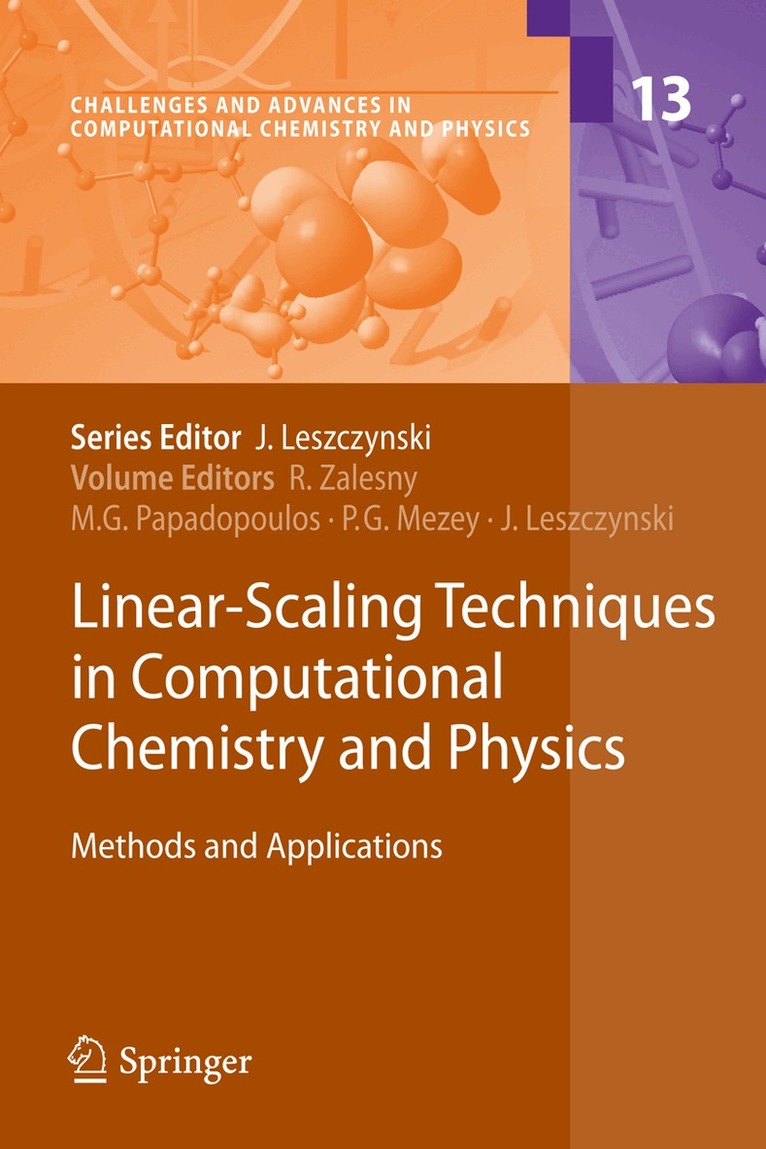
"Linear-Scaling Techniques in Computational Chemistry and Physics" summarizes recent progresses in linear-scaling techniques and their applications in chemistry and physics. In order to meet the needs of a broad community of chemists and physicists, the book focuses on recent advances that extended the scope of possible exploitations of the theory. The first chapter provides an overview of the present state of the linear-scaling methodologies and their applications, outlining hot topics in this field, and pointing to expected developments in the near future. This general introduction is then followed by several review chapters written by experts who substantially contributed to recent developments in this field.The purpose of this book is to review, in a systematic manner, recent developments in linear-scaling methods and their applications in computational chemistry and physics. Great emphasis is put on the theoretical aspects of linear-scaling methods. This book serves as a handbook for theoreticians, who are involved in the development of new efficient computational methods as well as for scientists, who are using the tools of computational chemistry and physics in their research.
2 110 kr
Skickas inom 10-15 vardagar
Non-Linear Optical Properties of Matter: From Molecules to Condensed Phases attempts to draw together both theory and application in this field. As such it will be of interest to both experimentalists and theoreticians alike. Divided into two parts, Part 1 is concerned with the theory and computing of non-linear optical (NLO) properties while Part 2 reviews the latest developments in experimentation.Part 1: Surveys the current advances in the computation of the NLO properties of molecules, crystalline solids and nano-particles. It examines the methods employed to compute the properties of both microscopic and macroscopic forms of matter.Part 2: Covers the recent advances on the NLO properties of organometallic compounds, rotaxanes, glasses, Langmuir-Blodget films, gold and silver nano-particles etc. Strategies to develop novel NLO materials are also discussed along with the Hyper-Rayleigh scattering technique.
Linear-Scaling Techniques in Computational Chemistry and Physics
Methods and Applications
Häftad, Engelska, 2013
3 444 kr
Skickas inom 10-15 vardagar
"Linear-Scaling Techniques in Computational Chemistry and Physics" summarizes recent progresses in linear-scaling techniques and their applications in chemistry and physics. In order to meet the needs of a broad community of chemists and physicists, the book focuses on recent advances that extended the scope of possible exploitations of the theory. The first chapter provides an overview of the present state of the linear-scaling methodologies and their applications, outlining hot topics in this field, and pointing to expected developments in the near future. This general introduction is then followed by several review chapters written by experts who substantially contributed to recent developments in this field.The purpose of this book is to review, in a systematic manner, recent developments in linear-scaling methods and their applications in computational chemistry and physics. Great emphasis is put on the theoretical aspects of linear-scaling methods. This book serves as a handbook for theoreticians, who are involved in the development of new efficient computational methods as well as for scientists, who are using the tools of computational chemistry and physics in their research.