• Fri frakt över 249 kr
  • •
  • Snabba leveranser
  • •
  • Billiga böcker
Kundservice

Du är på sajten för privatpersoner.

Företag, bibliotek eller offentlig verksamhet?

Du handlar på classic.bokus.com, där alla dina funktioner finns intakta.
Till classic.bokus.com
Bokus logotyp. Gå till startsidan.
  • Erbjudanden
  • Nyheter
  • Student
  • Topplistor
  • Barn & ungdom
  • Bokus Play
  • E-böcker
  • Pocketböcker
  • Spel & pussel

10% rabatt på allt med kod: NYSTART10 →

Sidfot

Mina sidor

    Hjälp

    • Kundservice
    • Vanliga frågor och svar
    • Frakt och leverans
    • Retur vid ångerrätt
    • Reklamera vara
    • Betalning
    • Köpvillkor
    • Allmänna villkor
    • Information om webbplatsens tillgänglighet

    Om Bokus

    • Om oss
    • Pressrum
    • För studenter
    • För företag
    • För bibliotek och offentlig verksamhet
    • För leverantörer
    • Hållbarhet

    Populärt

    • Aktuella erbjudanden
    • Presentkort
    • Studentlitteratur
    • Nya böcker
    • Topplistor
    • Signerade böcker
    • Engelska böcker

    Inspiration

    • Boktips
    • BookTok
    • Populära bokserier
    • Barnbokskaraktärer
    • Populära författare
    Logotyp för Bokus
    Följ oss på Facebook (extern länk)Följ oss på Instagram (extern länk)Följ oss på YouTube (extern länk)Följ oss på TikTok (extern länk)
    bokus @ CookiesAnpassa cookiesIntegritetspolicyKöpvillkor
    Till Citymail hemsida (extern länk)Till Budbee hemsida (extern länk)Till Postnord hemsida (extern länk)Till Schenker hemsida (extern länk)Till Early Bird hemsida (extern länk)Till Walleys hemsida (extern länk)
    1. Naturvetenskap och teknik
    2. Matematik och naturvetenskap
    3. Kemi

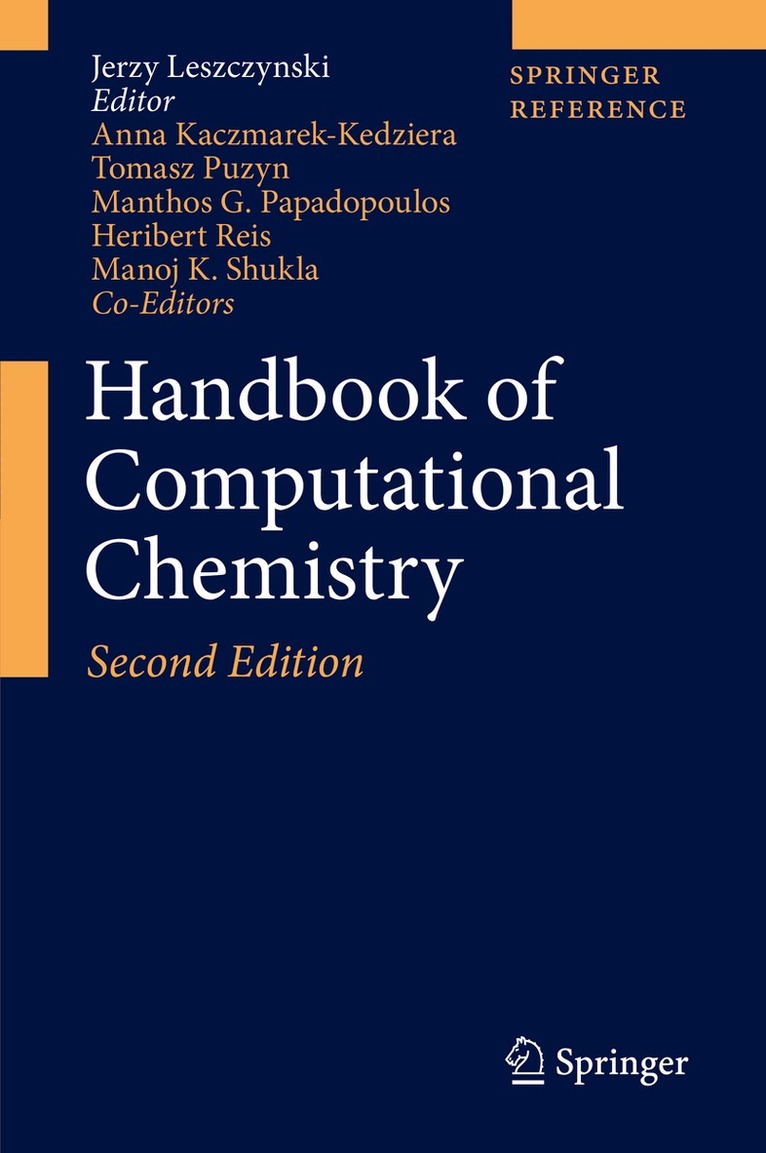
    Handbook of Computational Chemistry

    AvJerzy Leszczynski,Anna Kaczmarek-Kedziera

    Springer International Publishing AG

    2017

    16 552 kr

    Beställningsvara. Skickas inom 10-15 vardagar. Fri frakt över 249 kr.

    Beskrivning

    The first part briefly describes different methods used in computational chemistry without going into exhaustive details of theory. Basic assumptions common to the majority of computational methods based on either quantum or statistical mechanics are outlined. Particular attention is paid to the limits of their applicability. The second part consists of a series of sections exemplifying the various, most important applications of computational chemistry. Molecular structures, modeling of various properties of molecules and chemical reactions are discussed. Both ground and excited state properties are covered in the gas phase as well as in solutions. Solid state materials and nanomaterials are described in part three. Amongst the topics covered are clusters, periodic structures, and nano-systems. Special emphasis is placed on the environmental effects of nanostructures. Part four is devoted to an important class of materials – biomolecules. It focuses on interesting models for biological systems that are studied by computational chemists. RNA, DNA, and proteins are discussed in detail. Examples are given for calculations of their properties and interactions. The role of solvents in biologically significant reactions is revealed, as well as the relationship between molecular structure and function of various classes of biomolecules. Part five features new bonus material devoted to Chemoinformatics. This area is vital for many applications of computational methods. The section includes a discussion of basic ideas such as molecular structure, molecular descriptors and chemical similarity. Additionally, QSAR techniques and screening methods are covered. Also, available open source chemoinformatics software is presented and discussed.

    Produktinformation

    • Märke:Springer International Publishing AG
    • Utgivningsdatum:2017-02-10
    • Höjd:155 x 235 x undefined mm
    • Språk:Engelska
    • Antal sidor:2 381
    • Upplaga:2
    • Förlag:Springer International Publishing AG
    • EAN:9783319272818

    Utforska kategorier

    • Kemi inom Naturvetenskap och teknik
    • Naturvetenskap:allmänt inom Naturvetenskap och teknik

    Mer om författaren

    Jerzy Leszczynski - Professor of Chemistry and President’s Distinguished Fellow at the Jackson State University (JSU) joined the faculty of the JSU Department of Chemistry in 1990. Dr. Leszczynski attended the Technical University of Wroclaw (TUW) in Wroclaw, Poland obtaining his M.S (1972) and Ph.D. (1975) degrees. During the period 1976 –1986 he served as a faculty member at the TUW. In 1986 he moved to USA, initially as a visiting scientist at the University of Florida, Quantum Theory Project (1986-88) and as a research associate at the University of Alabama at Birmingham (1988-1990). During the period 1998 – 2008 Dr. Leszczynski had served as the director for the Computational Center for Molecular Structure and Interactions (NSF-CREST Center). Since October 2008 he directs new Interdisciplinary Nanotoxicity CREST Center at JSU. Dr. Leszczynski is a computational quantum chemist whose vast areas of interest include: nature of chemical bonds, theoretical predictions of molecularpotential energy surfaces and vibrational spectra, structures and properties of molecules with heavy elements, properties and structure of DNA fragments, and characteristics of nanomaterials. He also applies computational chemistry methods to environmental problems, surface chemistry and atmospheric chemistry. Two areas of his research contributions are the most noticeable: investigations of DNA fragments and development of novel techniques for investigation of properties and toxicity of nanomaterials.

    Recensioner i media

    “Highlight the modern state of art of computational chemistry which ‘has become an important indeed sometimes essential auxiliary to experimental work’ … . the necessary attributes on the desks of all computational chemists and physicists, PhD students of these disciplines, and applied mathematicians.” (Eugene Kryachko, zbMATH, Vol. 1366.81020, 2017)

    Innehållsförteckning

    • From the Contents: From Quantum Theory to Computational Chemistry.- Exceptional status of chemistry.- The Position of the Clamped Nuclei Electronic Hamiltonian in Quantum Mechanics.- Remarks on Wave Function Theory and Methods.