Margie Berns - Böcker
Visar alla böcker från författaren Margie Berns. Handla med fri frakt och snabb leverans.
5 produkter
5 produkter
1 703 kr
Skickas inom 7-10 vardagar
Concise Encyclopedia of Applied Linguistics formalizes, organizes and analyzes the relation of knowledge about language to decision-making in practice. It synthesizes research in psycholinguistics, educational linguistics and sociolinguistics, freely crossing subject fields to establish innovative and expert responses to some of the key debates in the field. Authored and compiled by leaders in their various specialties and collated and extensively re-edited from the award-winning Encyclopedia of Language and Linguistics, Second Edition, this collection will be an ideal one-stop desk reference solution for any linguistics professional and researcher interested in how language operates at the leading edge. Authoritative review of this dynamic field placed in an interdisciplinary context Over 100 articles by leaders in the field Compact and affordable single-volume format
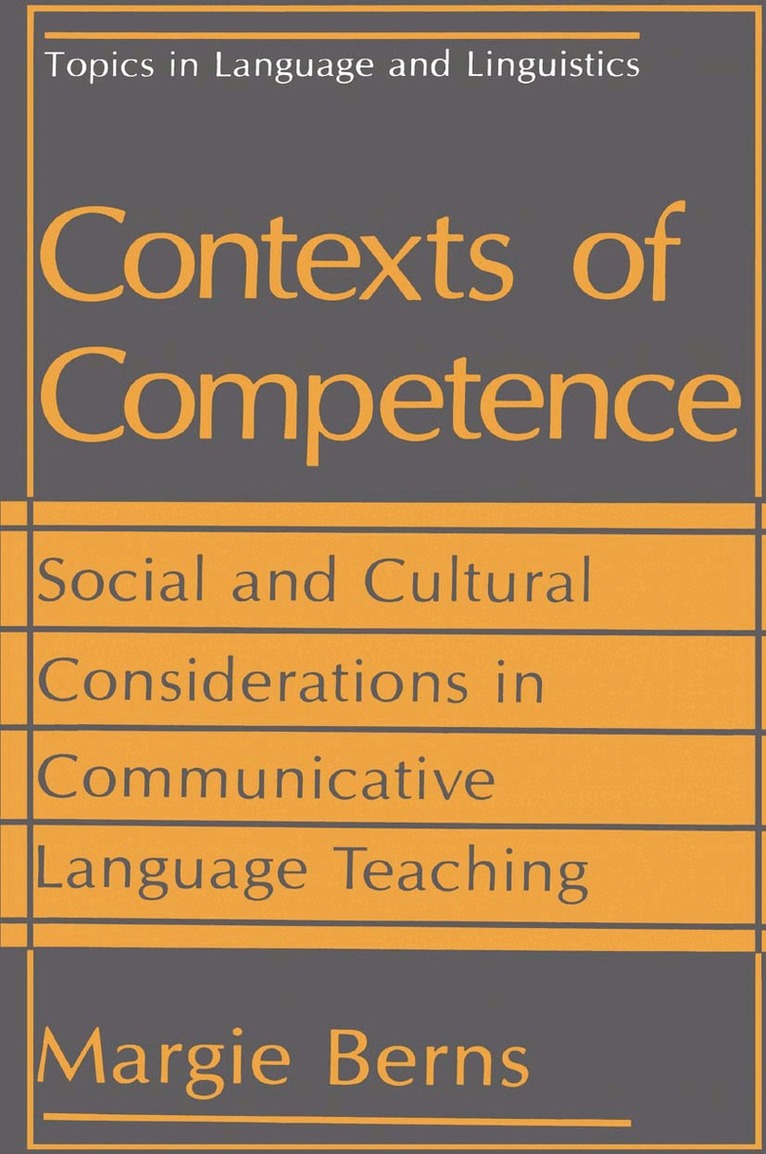
Contexts of Competence
Social and Cultural Considerations in Communicative Language Teaching
Inbunden, Engelska, 1990
1 095 kr
Skickas inom 10-15 vardagar
The introduction of communicative competence as the goal of second and for eign language teaching has led to recognition of the role of context in language learning and use. As communicative competence is defined by the social and cultural contexts in which it is used, no single communicative competence can serve as the goal and model for all learners. This recognition has had an impact on program design and materials development. One significant change is that the choice of a teaching method is no longer the primary concern. Instead, the first step for the program designer is becoming familiar with the social and cultural features of the context of the language being taught. This includes a consideration of the uses speakers make of the language, their reasons for using it, and their attitudes toward it. Contexts of Competence: Social and Cultural Considerations in Commu nicative Language Teaching explores the relationship between context and com petence from a theoretical and practical perspective. Its audience is applied linguists in general and language teaching practitioners in particular. The overall aim of its five chapters is to provide a framework for consideration of various contexts of language learning and use and to guide the implementation and development of models of communicative language teaching that are responsive to the context-specific needs of learners.
1 064 kr
Skickas inom 10-15 vardagar
In the Presence of English: Media and European Youth is the realization of a project first conceived in 1991 in Hamburg, Germany where Uwe Hasebrink, Ewart Skinner, and Margie Berns, with their respective specializations in media studies, international communication, and world Englishes, met and discovered intersecting interests. In that meeting they sketched out plans for a questionnaire survey to be distributed in Hamburg schools that would investigate secondary school pupils access to and use of media, their access to and use of English, and their attitudes concerning these and related topics. A year later several hundred young people in selected schools completed the questionnaire. The findings from this initial investigation appeared in a book chapter by Hasebrink, Berns, and Skinner (1997) and were reported on at conferences in North America and Europe. Eventually Kees de Bot (The Netherlands) was inspired to join Berns and Hasebrink (Ewart Skinner had moved on to other projects). Eventually we decided to extend and refine the project by building upon its interdisciplinary and international potential. From this point on the study gained increasing momentum and scope and individual team members contributed variously to what became a major undertaking. The size and complexity of the project made it not only time intensive, but time extensive as well. With limited sources of financial support, progress was slow, at times arduous, and the gap between data collection and finished manuscript was greater than anticipated. Distribution of labor among us kept the task manageable.
1 275 kr
Skickas inom 10-15 vardagar
In the Presence of English: Media and European Youth is the realization of a project first conceived in 1991 in Hamburg, Germany where Uwe Hasebrink, Ewart Skinner, and Margie Berns, with their respective specializations in media studies, international communication, and world Englishes, met and discovered intersecting interests. In that meeting they sketched out plans for a questionnaire survey to be distributed in Hamburg schools that would investigate secondary school pupils access to and use of media, their access to and use of English, and their attitudes concerning these and related topics. A year later several hundred young people in selected schools completed the questionnaire. The findings from this initial investigation appeared in a book chapter by Hasebrink, Berns, and Skinner (1997) and were reported on at conferences in North America and Europe. Eventually Kees de Bot (The Netherlands) was inspired to join Berns and Hasebrink (Ewart Skinner had moved on to other projects). Eventually we decided to extend and refine the project by building upon its interdisciplinary and international potential. From this point on the study gained increasing momentum and scope and individual team members contributed variously to what became a major undertaking. The size and complexity of the project made it not only time intensive, but time extensive as well. With limited sources of financial support, progress was slow, at times arduous, and the gap between data collection and finished manuscript was greater than anticipated. Distribution of labor among us kept the task manageable.
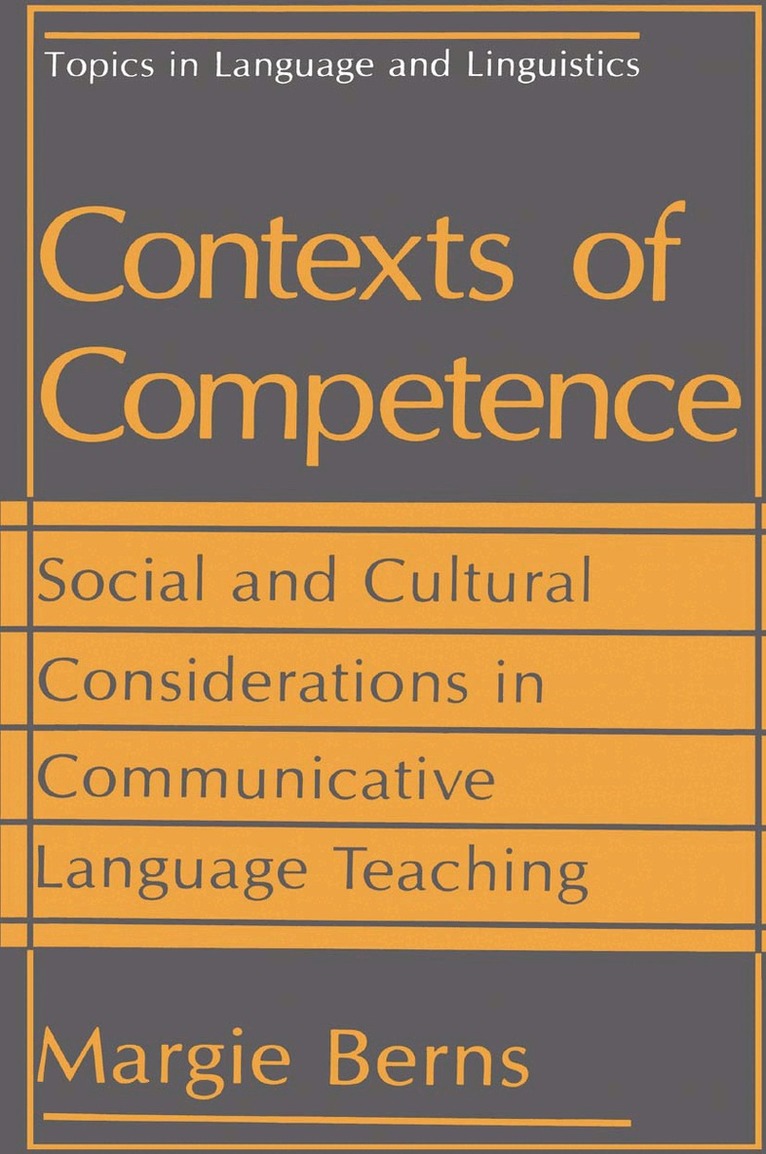
Contexts of Competence
Social and Cultural Considerations in Communicative Language Teaching
Häftad, Engelska, 2013
1 034 kr
Skickas inom 10-15 vardagar
The introduction of communicative competence as the goal of second and for eign language teaching has led to recognition of the role of context in language learning and use. As communicative competence is defined by the social and cultural contexts in which it is used, no single communicative competence can serve as the goal and model for all learners. This recognition has had an impact on program design and materials development. One significant change is that the choice of a teaching method is no longer the primary concern. Instead, the first step for the program designer is becoming familiar with the social and cultural features of the context of the language being taught. This includes a consideration of the uses speakers make of the language, their reasons for using it, and their attitudes toward it. Contexts of Competence: Social and Cultural Considerations in Commu nicative Language Teaching explores the relationship between context and com petence from a theoretical and practical perspective. Its audience is applied linguists in general and language teaching practitioners in particular. The overall aim of its five chapters is to provide a framework for consideration of various contexts of language learning and use and to guide the implementation and development of models of communicative language teaching that are responsive to the context-specific needs of learners.