Maria Gabriella Xibilia – författare
Visar alla böcker från författaren Maria Gabriella Xibilia. Handla med fri frakt och snabb leverans.
7 produkter
7 produkter
E-bok
PDF, Engelska, 2012687 kr
Läs direkt efter köp
In the last decade new artificial intelligence methods for the modelling and control of complex systems, namely neural networks, fuzzy logic and probabilistic reasoning have drawn the interest of researchers and engineers. Recently, the advantages achievable by using combinations of these methods, which have independent origin and evolution, have been pointed out, generating a new paradigm which is now termed "soft-computing". This new methodology subsumes the capabilities of neural networks for modelling non-linear systems and for solving classification problems, the power of fuzzy-logic to represent approximate or heuristic reasoning and the large capabilities of evolutionary computation for problem optimisation. The book presents a clear understanding of a new type of computation system, the cellular neural network (CNN), which has been successfully applied to the solution of many heavy computation problems, mainly in the fields of image processing and complex partial differential equations. CNNs'' computation-based systems represent new opportunities for improving the soft-computation toolbox. The application of soft computing to complex systems and in particular to chaotic systems with the generation of chaotic dynamics by using CNN is also described. These aspects are of particular interest owing to their growing interest for research and application purposes.Specific topics covered in the text include:- fuzzy logic, control and neural networks;- artificial neural networks and their application in the modelling and control of dynamical systems;- evolutionary optimisation algorithms;- complex dynamics and cellular neural networks;- applications in urban traffic noise monitoring, robot control and rapid thermal process systems.
Inbunden, Engelska, 2006
1 956 kr
Skickas inom 10-15 vardagar
focussed on the key steps in soft sensor design: data selection; model structure selection and model validation, respectively. Extensions to the basic steps of soft sensor design, namely soft sensor performance enhancement and the modifications needed to facilitate different industrial process applications follow in Chapter 7 and 8, respectively. Widening the applications range and role of soft sensors to fault detection and sensor validation configurations is dealt with in Chapter 9. A great strength of Soft Sensors for Monitoring and Control of Industrial Processes is the use, throughout the text, of a set of industrial case studies to demonstrate the successes and drawbacks of the different methods used to create soft sensor models. A number of different methods may be used in each separate step of the soft sensor design process and the industrial case studies are often used to provide explicit comparisons of the performance of these methods. The industrial control and process engineer will find these comparison exercises invaluable illustrations of the sort of results that might be found in industrial applications. The monograph also highlights the importance of using knowledge from industrial experts and from the existing industrial process literature. This is an important aspect of industrial control that is not very widely acknowledged or taught in control courses. Most industrial processes have already generated a significant experimental knowledge base and the control engineer should develop ways of tapping into this valuable resource when designing industrial control schemes.
E-bok
PDF, Engelska, 20072 457 kr
Läs direkt efter köp
focussed on the key steps in soft sensor design: data selection; model structure selection and model validation, respectively. Extensions to the basic steps of soft sensor design, namely soft sensor performance enhancement and the modifications needed to facilitate different industrial process applications follow in Chapter 7 and 8, respectively. Widening the applications range and role of soft sensors to fault detection and sensor validation configurations is dealt with in Chapter 9. A great strength of Soft Sensors for Monitoring and Control of Industrial Processes is the use, throughout the text, of a set of industrial case studies to demonstrate the successes and drawbacks of the different methods used to create soft sensor models. A number of different methods may be used in each separate step of the soft sensor design process and the industrial case studies are often used to provide explicit comparisons of the performance of these methods. The industrial control and process engineer will find these comparison exercises invaluable illustrations of the sort of results that might be found in industrial applications. The monograph also highlights the importance of using knowledge from industrial experts and from the existing industrial process literature. This is an important aspect of industrial control that is not very widely acknowledged or taught in control courses. Most industrial processes have already generated a significant experimental knowledge base and the control engineer should develop ways of tapping into this valuable resource when designing industrial control schemes.
Häftad, Engelska, 2010
1 694 kr
Skickas inom 5-8 vardagar
focussed on the key steps in soft sensor design: data selection; model structure selection and model validation, respectively. Extensions to the basic steps of soft sensor design, namely soft sensor performance enhancement and the modifications needed to facilitate different industrial process applications follow in Chapter 7 and 8, respectively. Widening the applications range and role of soft sensors to fault detection and sensor validation configurations is dealt with in Chapter 9. A great strength of Soft Sensors for Monitoring and Control of Industrial Processes is the use, throughout the text, of a set of industrial case studies to demonstrate the successes and drawbacks of the different methods used to create soft sensor models. A number of different methods may be used in each separate step of the soft sensor design process and the industrial case studies are often used to provide explicit comparisons of the performance of these methods. The industrial control and process engineer will find these comparison exercises invaluable illustrations of the sort of results that might be found in industrial applications. The monograph also highlights the importance of using knowledge from industrial experts and from the existing industrial process literature. This is an important aspect of industrial control that is not very widely acknowledged or taught in control courses. Most industrial processes have already generated a significant experimental knowledge base and the control engineer should develop ways of tapping into this valuable resource when designing industrial control schemes.
Del 234 - Lecture Notes in Control and Information Sciences
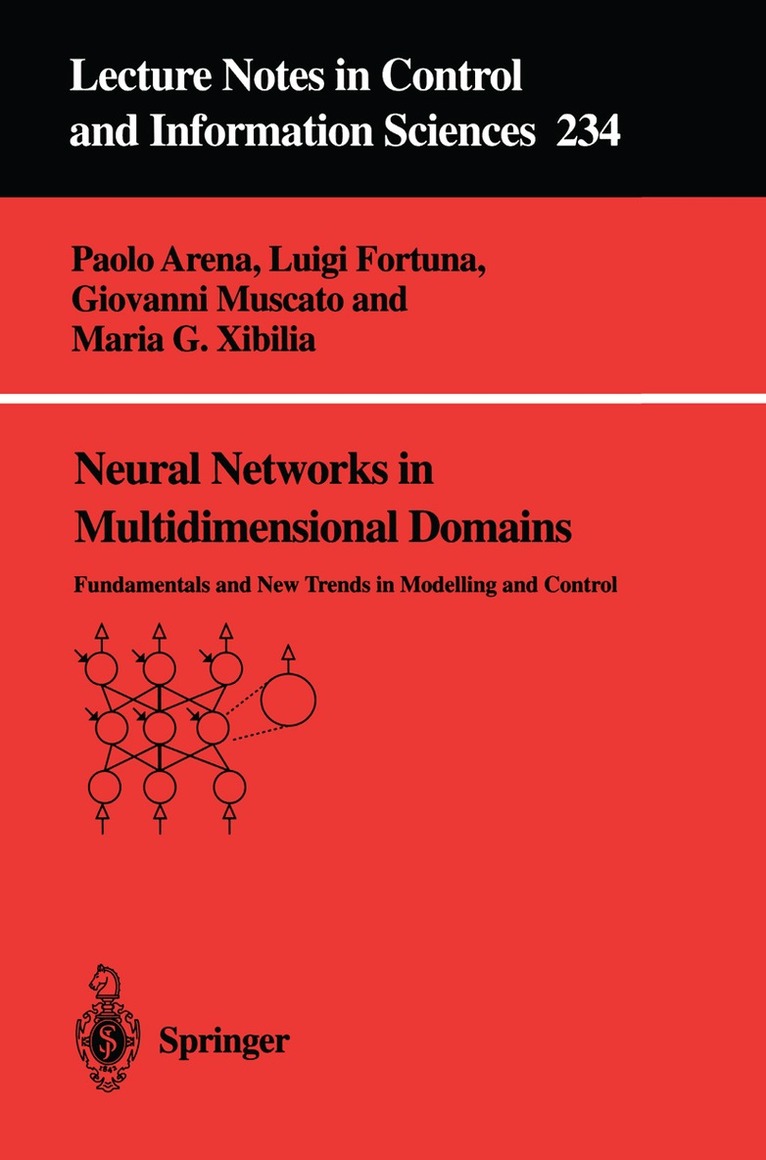
Neural Networks in Multidimensional Domains
Fundamentals and New Trends in Modelling and Control
Häftad, Engelska, 1998
565 kr
Skickas inom 10-15 vardagar
In this monograph, new structures of neural networks in multidimensional domains are introduced. These architectures are a generalization of the Multi-layer Perceptron (MLP) in Complex, Vectorial and Hypercomplex algebra. The approximation capabilities of these networks and their learning algorithms are discussed in a multidimensional context. The work includes the theoretical basis to address the properties of such structures and the advantages introduced in system modelling, function approximation and control. Some applications, referring to attractive themes in system engineering and a MATLAB software tool, are also reported. The appropriate background for this text is a knowledge of neural networks fundamentals. The manuscript is intended as a research report, but a great effort has been performed to make the subject comprehensible to graduate students in computer engineering, control engineering, computer sciences and related disciplines.
666 kr
Skickas inom 10-15 vardagar
In the last decade new artificial intelligence methods for the modelling and control of complex systems, namely neural networks, fuzzy logic and probabilistic reasoning have drawn the interest of researchers and engineers. Recently, the advantages achievable by using combinations of these methods, which have independent origin and evolution, have been pointed out, generating a new paradigm which is now termed "soft-computing". This new methodology subsumes the capabilities of neural networks for modelling non-linear systems and for solving classification problems, the power of fuzzy-logic to represent approximate or heuristic reasoning and the large capabilities of evolutionary computation for problem optimisation. The book presents a clear understanding of a new type of computation system, the cellular neural network (CNN), which has been successfully applied to the solution of many heavy computation problems, mainly in the fields of image processing and complex partial differential equations. CNNs' computation-based systems represent new opportunities for improving the soft-computation toolbox. The application of soft computing to complex systems and in particular to chaotic systems with the generation of chaotic dynamics by using CNN is also described. These aspects are of particular interest owing to their growing interest for research and application purposes.Specific topics covered in the text include:- fuzzy logic, control and neural networks;- artificial neural networks and their application in the modelling and control of dynamical systems;- evolutionary optimisation algorithms;- complex dynamics and cellular neural networks;- applications in urban traffic noise monitoring, robot control and rapid thermal process systems.
Del 65 - World Scientific Series on Nonlinear Science Series A
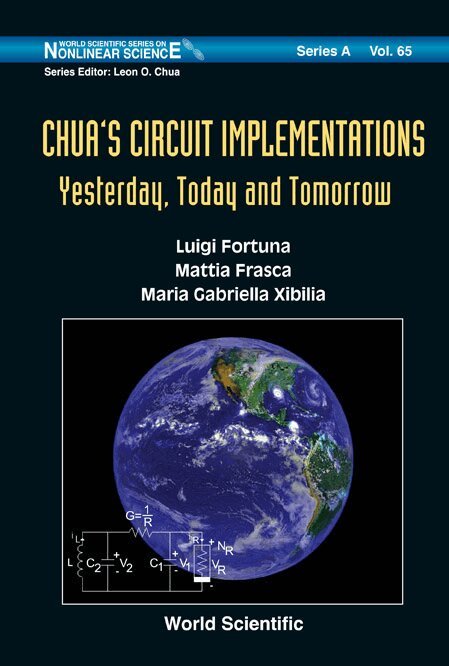
Chua's Circuit Implementations: Yesterday, Today And Tomorrow
Inbunden, Engelska, 2009
1 251 kr
Skickas inom 5-8 vardagar
Since the birth of the Chua circuit in 1983, a considerable number of fruitful, fascinating and relevant research topics have arisen. In honor of the 25th anniversary of the invention of Chua's circuit, this book presents the 25 years of research on the implementation of Chua's circuit, and also discusses future directions and emerging applications of recent results.The purpose of the book is to provide researchers, PhD students, and undergraduate students a research monograph containing both fundamentals on the topics and advanced results that have been recently obtained. With about 60 illustrations included in the book, it also shows the detailed schematics of several different implementations that can be easily reproduced with a low-cost experimental setup and PC-based measurement instrumentation.