Marie E. Rognes – författare
Visar alla böcker från författaren Marie E. Rognes. Handla med fri frakt och snabb leverans.
4 produkter
4 produkter
Häftad, Engelska, 2020
438 kr
Skickas inom 10-15 vardagar
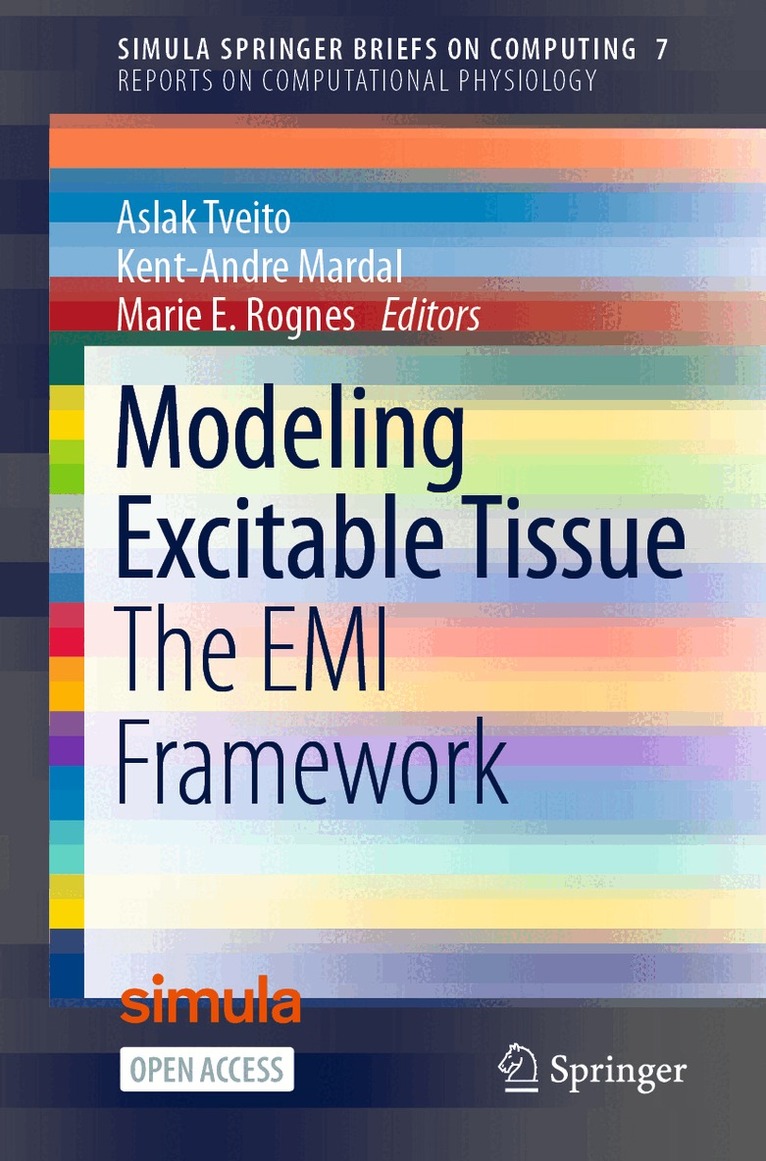
This open access volume presents a novel computational framework for understanding how collections of excitable cells work. The key approach in the text is to model excitable tissue by representing the individual cells constituting the tissue. This is in stark contrast to the common approach where homogenization is used to develop models where the cells are not explicitly present. The approach allows for very detailed analysis of small collections of excitable cells, but computational challenges limit the applicability in the presence of large collections of cells.
Del 10 - Simula SpringerBriefs on Computing
Mathematical Modeling of the Human Brain
From Magnetic Resonance Images to Finite Element Simulation
Häftad, Engelska, 2022
340 kr
Skickas inom 10-15 vardagar
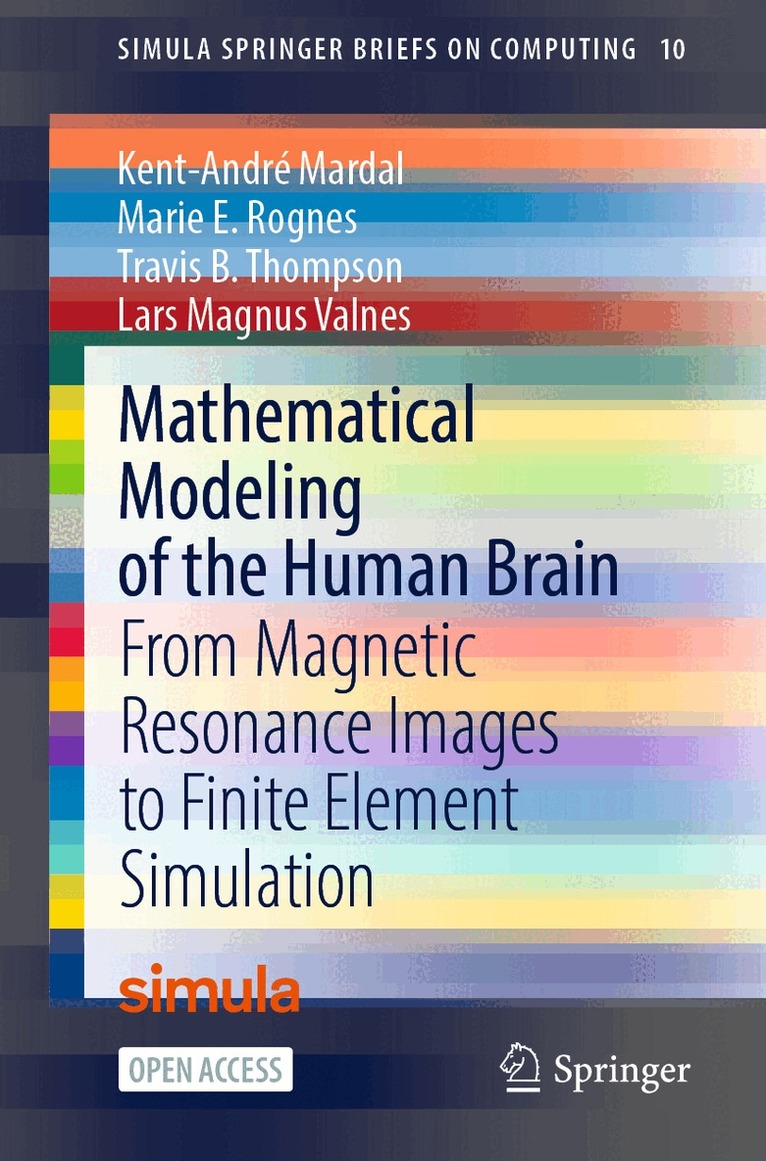
This open access book bridges common tools in medical imaging and neuroscience with the numerical solution of brain modelling PDEs. The connection between these areas is established through the use of two existing tools, FreeSurfer and FEniCS, and one novel tool, the SVM-Tk, developed for this book. The reader will learn the basics of magnetic resonance imaging and quickly proceed to generating their first FEniCS brain meshes from T1-weighted images. The book's presentation concludes with the reader solving a simplified PDE model of gadobutrol diffusion in the brain that incorporates diffusion tensor images, of various resolution, and complex, multi-domain, variable-resolution FEniCS meshes with detailed markings of anatomical brain regions. After completing this book, the reader will have a solid foundation for performing patient-specific finite element simulations of biomechanical models of the human brain.
Del 18 - Simula SpringerBriefs on Computing
Mathematical Modelling of the Human Brain II
From Glymphatics to Deep Learning
Häftad, Engelska, 2025
330 kr
Skickas inom 10-15 vardagar
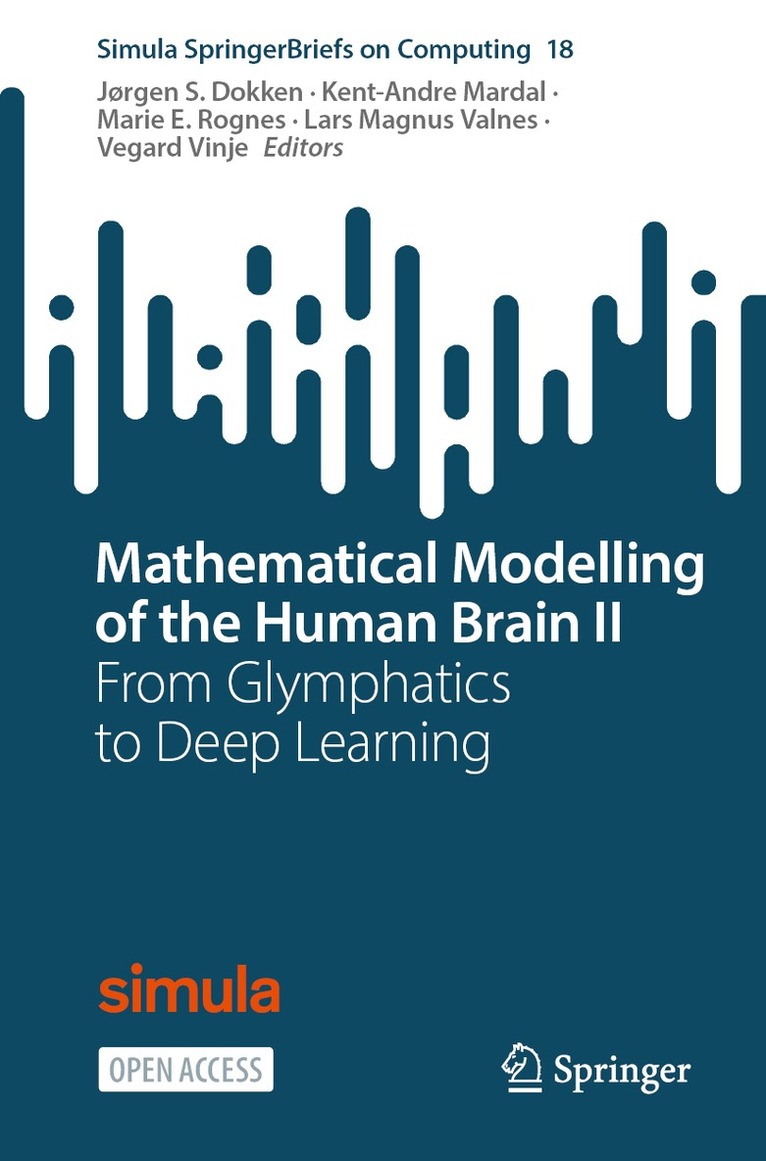
This open access book revolves around predictive mathematical modelling and simulation of brain multiphysics with an emphasis on cerebrospinal fluid flow and solute transport in and around the human brain. The book consists of 10 self-contained and relatively short chapters, each offering a rapid introduction to a key problem or topic, supported by open source software. Readers will gain insights into state-of-the-art mathematical tools and techniques for modelling and simulation of brain multiphysics ranging from classical finite element approaches, network-based modelling techniques and deep neural networks. The target audiences are researchers in applied mathematics, scientific computing, biophysics, bioengineering or computational neuroscience interested in a compact introduction to image-based computational modeling of brain multiphysics and cutting-edge available tools.
Del 19 - Simula SpringerBriefs on Computing
FEniCS Project
The FEniCS 2024 Conference
Häftad, Engelska, 2026
330 kr
Skickas inom 10-15 vardagar
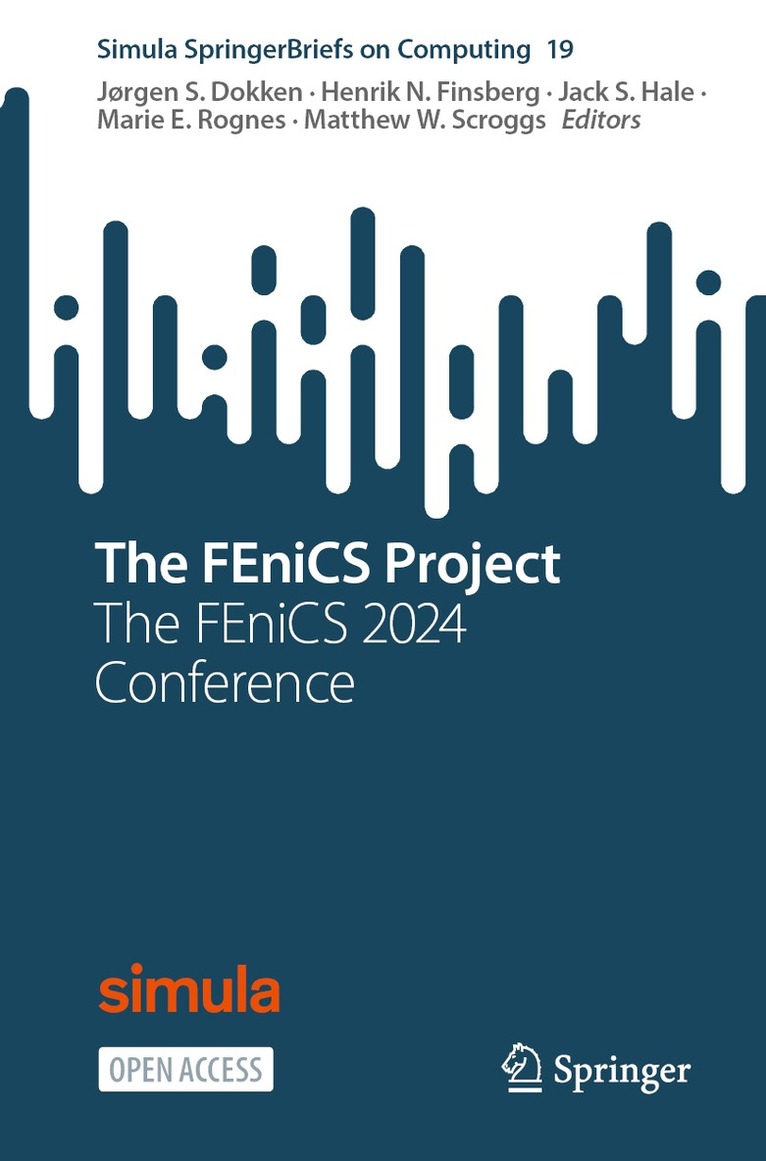
This open access book provides the reader with a snapshot of the cutting-edge research being undertaken by the members of the FEniCS community, as presented at the FEniCS Conference at Simula Research Laboratory, Oslo, Norway, in June 2024. The conference—and this book—features contributions from both the developers and users of the library, and includes applications of the software to a wide range of application areas spread throughout engineering, physics and biology. This book highlights topics in all these areas, many of which could not be simulated as efficiently—or even simulated at all—until recently. The FEniCS Project is an open-source finite element library developed by an international network of researchers. FEniCS gives its users easy access to powerful and scalable numerical tools for solving a great number of problems based on partial differential equations. Its contributions from academia and cutting-edge research mean that many recent algorithmic advances in the area are available in the library. Its open-source nature allows users to freely build their own developments into and on top of the core library, leading to some truly remarkable research. The topics presented in this book are backed up by openly available code examples, to enhance the reproducibility of the results presented within and further development. The target audience of this book is the researcher with an interest in numerical methods, their implementation and application, and the latest up-and-coming areas in which they are being applied.