• Fri frakt över 249 kr
  • •
  • Snabba leveranser
  • •
  • Billiga böcker
Kundservice

Du är på sajten för privatpersoner.

Företag, bibliotek eller offentlig verksamhet?

Du handlar på classic.bokus.com, där alla dina funktioner finns intakta.
Till classic.bokus.com
Bokus logotyp. Gå till startsidan.
  • Erbjudanden
  • Student
  • Topplistor
  • Barn & ungdom
  • Bokus Play
  • E-böcker
  • Ljudböcker
  • Pocketböcker
  • Spel & pussel

10% rabatt på allt med kod NYSTART10 →

Sidfot

Mina sidor

    Hjälp

    • Kundservice
    • Vanliga frågor och svar
    • Frakt och leverans
    • Retur vid ångerrätt
    • Reklamera vara
    • Betalning
    • Köpvillkor
    • Allmänna villkor
    • Information om webbplatsens tillgänglighet

    Om Bokus

    • Om oss
    • Pressrum
    • För studenter
    • För företag
    • För bibliotek och offentlig verksamhet
    • För leverantörer
    • Hållbarhet

    Populärt

    • Aktuella erbjudanden
    • Presentkort
    • Studentlitteratur
    • Nya böcker
    • Topplistor
    • Signerade böcker
    • Engelska böcker

    Inspiration

    • Boktips
    • BookTok
    • Populära bokserier
    • Barnbokskaraktärer
    • Populära författare
    Logotyp för Bokus
    Följ oss på Facebook (extern länk)Följ oss på Instagram (extern länk)Följ oss på YouTube (extern länk)Följ oss på TikTok (extern länk)
    bokus @ CookiesAnpassa cookiesIntegritetspolicyKöpvillkor
    Till Citymail hemsida (extern länk)Till Budbee hemsida (extern länk)Till Postnord hemsida (extern länk)Till Schenker hemsida (extern länk)Till Early Bird hemsida (extern länk)Till Walleys hemsida (extern länk)
    1. Naturvetenskap och teknik
    2. Matematik och naturvetenskap
    3. Matematik
    4. Tillämpad matematik

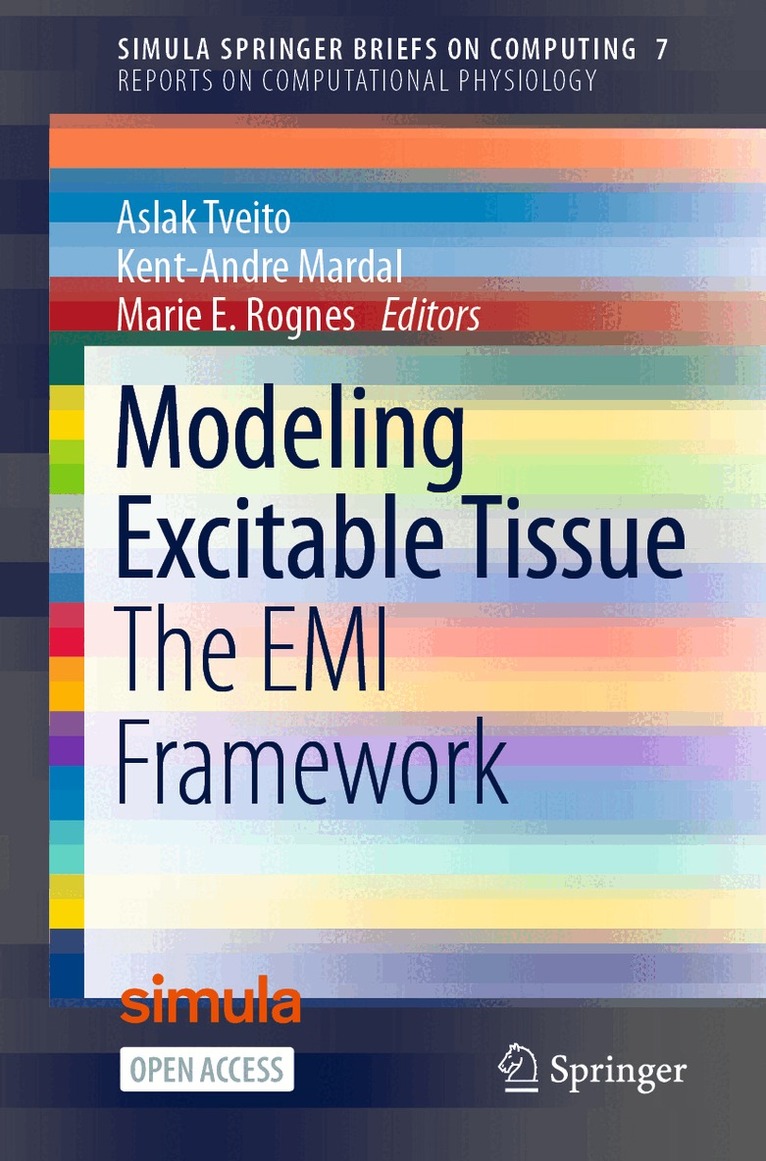
    Modeling Excitable Tissue

    The EMI Framework

    AvAslak Tveito,Kent-Andre Mardal

    Häftad, Engelska, 2020

    Del i serien Simula SpringerBriefs on Computing

    438 kr

    Beställningsvara. Skickas inom 10-15 vardagar. Fri frakt över 249 kr.

    Beskrivning

    This open access volume presents a novel computational framework for understanding how collections of excitable cells work. The key approach in the text is to model excitable tissue by representing the individual cells constituting the tissue. This is in stark contrast to the common approach where homogenization is used to develop models where the cells are not explicitly present. The approach allows for very detailed analysis of small collections of excitable cells, but computational challenges limit the applicability in the presence of large collections of cells.

    Produktinformation

    • Utgivningsdatum:2020-10-31
    • Mått:155 x 235 x 9 mm
    • Vikt:194 g
    • Format:Häftad
    • Språk:Engelska
    • Serie:Simula SpringerBriefs on Computing
    • Antal sidor:100
    • Förlag:Springer Nature Switzerland AG
    • ISBN:9783030611569

    Utforska kategorier

    • Tillämpad matematik inom Naturvetenskap och teknik
    • Teknik: allmänt inom Naturvetenskap och teknik
    • Biovetenskap inom Naturvetenskap och teknik

    Mer om författaren

    Kent-Andre Mardal is a professor of mechanics at the University of Oslo and an adjunct research scientist at Simula Research Laboratory. He has published more than 90 scientific publications, including journal papers, two co-authored books and the co-edited the book about the FEniCS project, for which he was a core developer for many years.  Research interests include computational modeling of various life science applications and robust, stable and accurate numerical schemes.Marie E. Rognes is a research professor at Simula Research Laboratory and a founding member of the Young Academy of Norway. She has over 50 scientific publications and has delivered numerous keynote addresses and invited talks, including a TEDx talk. Her research is primarily focused on mathematical and computational modelling of fluid flow in the brain, and this work has been partially funded by an ERC starting grant.Aslak Tveito is a professor of scientific computing at the University of Oslo,and the CEO of Simula Research Laboratory. He has co-authored three text books, one research monograph and many journal papers on computational physiology. His research interests are related to the use of computational methods to understand the dynamics of collections of excitable cells.

    Innehållsförteckning

    • Derivation of a cell-based mathematical model of excitable cells.- A cell-based model for ionic electrodiffusion in excitable tissue.- Modeling cardiac mechanics on a subcellular scale.- Operator splitting and finite difference schemes for solving the EMI model.- Solving the EMI equations using finite element methods.- Iterative solvers for EMI models.- Improving neural simulations with the EMI model.- Index.