Marie-Laure Djelic - Böcker
Visar alla böcker från författaren Marie-Laure Djelic. Handla med fri frakt och snabb leverans.
10 produkter
10 produkter
Exporting the American Model
The Post-War Transformation of European Business
Inbunden, Engelska, 1998
1 656 kr
Skickas inom 3-6 vardagar
Marie-Laure Djelic explores the convergent and divergent trends in the evolution of business systems and organization in Western Europe in the post-war period. She examines in particular the influence of a large-scale, cross-national transfer of the American corporate model, including the Marshall Plan and the involvement of American business in European reconstruction. She focuses on France, West Germany, and Italy, looking in turn at the physical, ownership, organizational, and governance structure of each after 1945. Her core argument is that the model had varying degrees of success in each of those three countries and, in some areas, encountered significant resistance. The book underscores the socially constructed and historically contingent nature of structural arrangements shaping conditions of industrial production in capitalist countries today. National systems of industrial production are not given and necessary; they are made and shaped through time by actors with particular interests, often in direct confrontation with other groups. This shaping is taking place within particular institutional contexts, in peculiar political and geopolitical conditions. Foreign actors, in geopolitical power positions, can, it is argued, play a particularly significant role in such processes.
817 kr
Skickas inom 7-10 vardagar
Exporting the American Model places in historical perspective the apparently universal appeal of the model of corporate capitalism. Marie-Laure Djelic explores the patterns of evolution that have characterized Western European business systems in the postwar period. She identifies two seemingly conflicting trends -- one leading to convergence, the other perpetuating national differentiation. To account for this apparent contradiction, she first documents the large-scale transfer to Western Eruope of a model of corporate capitalism with clear American origins, showing the key role in the process of the Marshall Plan administration. Focusing on France, West Germany, and Italy, she then looks at the specific conditions in which the transfer took place in each case. One key finding is that this transfer had varying degrees of success in each of the three countries and that the American model was partially adapted to national conditions when it was not strongly resisted. The book underscores the socially constructed and historically contingent nature of structural arrangements shaping conditions of industiral production in capitalist countries today. National systems of industrial production are not given or necessary; they are constructed through time by economic but also political actors with particular goals and resources, often in direct confrontation with other intersts. This shaping is embedded within specific national institutional contexts but it also takes place in unique geopolitical conditions. Thus foreign actors, it is argued, can have in certain circumstances a significant impact on the process of definition of a given national system of industial production.
712 kr
Skickas inom 7-10 vardagar
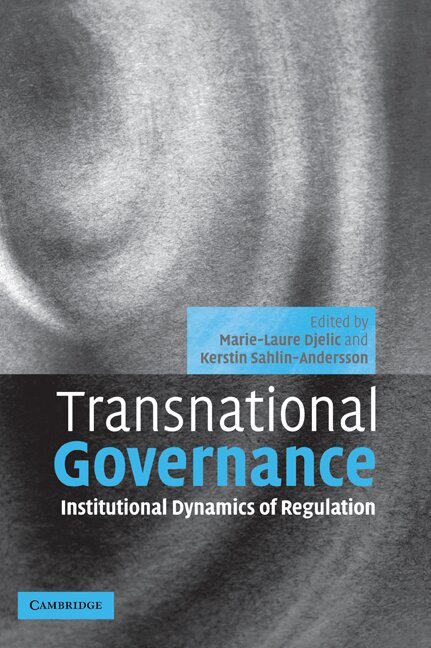
Globalization involves a profound re-ordering of our world with the proliferation everywhere of rules and transnational modes of governance. This book examines how this governance is formed, changes and stabilizes. Building on a rich and varied set of empirical cases, it explores transnational rules and regulations and the organizing, discursive and monitoring activities that frame, sustain and reproduce them. Beginning from an understanding of the powerful structuring forces that embed and form the context of transnational regulatory activities, the book scrutinizes the actors involved, how they are organized, how they interact and how they transform themselves to adapt to this new regulatory landscape. A powerful analysis of the modes and logics of transnational rule-making and rule-monitoring closes the book. This authoritative resource offers ideal reading for all academic researchers and graduate students of governance and regulation.
943 kr
Skickas inom 7-10 vardagar
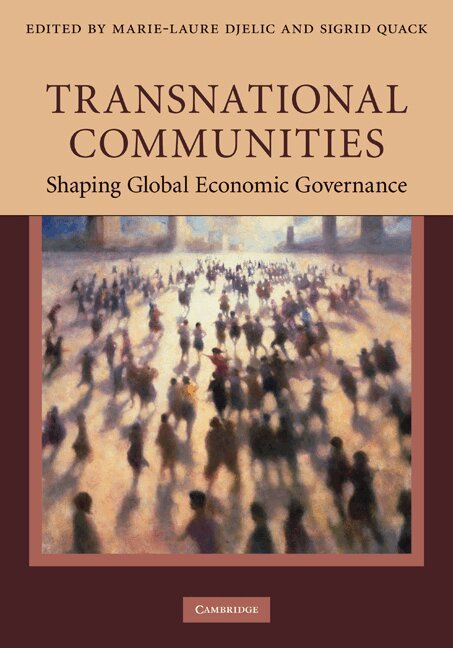
Transnational communities are social groups that emerge from mutual interaction across national boundaries, oriented around a common project or 'imagined' identity. This common project or identity is constructed and sustained through the active engagement and involvement of at least some of its members. Such communities can overlap in different ways with formal organizations but, in principle, they do not need formal organization to be sustained. This book explores the role of transnational communities in relation to the governance of business and economic activity. It does so by focusing on a wide range of empirical terrains, including discussions of the Laleli market in Istanbul, the institutionalization of private equity in Japan, the transnational movement for open content licenses, and the mobilization around environmental certification. These studies show that transnational communities can align the cognitive and normative orientations of their members over time and thereby influence emergent transnational governance arrangements.
1 719 kr
Skickas inom 7-10 vardagar
Globalization involves a profound re-ordering of our world with the proliferation everywhere of rules and transnational modes of governance. This book examines how this governance is formed, changes and stabilizes. Building on a rich and varied set of empirical cases, it explores transnational rules and regulations and the organizing, discursive and monitoring activities that frame, sustain and reproduce them. Beginning from an understanding of the powerful structuring forces that embed and form the context of transnational regulatory activities, the book scrutinizes the actors involved, how they are organized, how they interact and how they transform themselves to adapt to this new regulatory landscape. A powerful analysis of the modes and logics of transnational rule-making and rule-monitoring closes the book. This authoritative resource offers ideal reading for all academic researchers and graduate students of governance and regulation.
631 kr
Skickas inom 7-10 vardagar
Transnational communities are social groups that emerge from mutual interaction across national boundaries, oriented around a common project or 'imagined' identity. This common project or identity is constructed and sustained through the active engagement and involvement of at least some of its members. Such communities can overlap in different ways with formal organizations but, in principle, they do not need formal organization to be sustained. This book explores the role of transnational communities in relation to the governance of business and economic activity. It does so by focusing on a wide range of empirical terrains, including discussions of the Laleli market in Istanbul, the institutionalization of private equity in Japan, the transnational movement for open content licenses, and the mobilization around environmental certification. These studies show that transnational communities can align the cognitive and normative orientations of their members over time and thereby influence emergent transnational governance arrangements.
2 187 kr
Skickas inom 7-10 vardagar
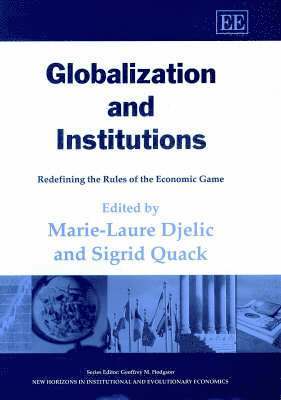
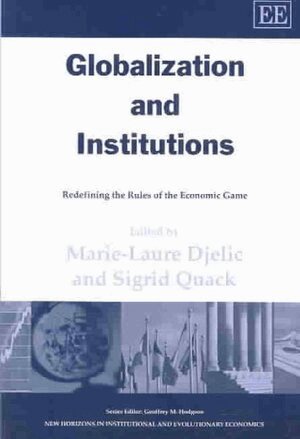
This volume investigates the relationship between economic globalization and institutions, or global governance, challenging the common assumption that globalization and institutionalization are essentially processes which exclude each other. Instead, the contributors to this book show that globalization is better perceived as a dual process of institutional change at the national level, and institution building at the transnational level. Rich, supporting empirical evidence is provided along with a theoretical conceptualization of the main actors, mechanisms and conditions involved in trickle-up and trickle-down trajectories through which national institutional systems are being transformed and transnational rules emerge.The book collectively argues that transnational institution building is one of the most striking features of the current period of internationalization. As a consequence, debates concerning globalization and global governance have to be reformulated. The authors posit that globalization is not threatening governance, but in fact globalization reflects a particular type of governance. The dilemma, therefore, is not between globalization and institutions, but between different meanings of governance and the balance that should be reached between them.Globalization and Institutions will be of special interest to academics and scholars of institutional economics, globalization and management. However, with its focus on two key debates for which there is clearly rising interest, many social scientists will find the book of interest.
854 kr
Skickas inom 7-10 vardagar
This volume investigates the relationship between economic globalization and institutions, or global governance, challenging the common assumption that globalization and institutionalization are essentially processes which exclude each other. Instead, the contributors to this book show that globalization is better perceived as a dual process of institutional change at the national level, and institution building at the transnational level. Rich, supporting empirical evidence is provided along with a theoretical conceptualization of the main actors, mechanisms and conditions involved in trickle-up and trickle-down trajectories through which national institutional systems are being transformed and transnational rules emerge.The book collectively argues that transnational institution building is one of the most striking features of the current period of internationalization. As a consequence, debates concerning globalization and global governance have to be reformulated. The authors posit that globalization is not threatening governance, but in fact globalization reflects a particular type of governance. The dilemma, therefore, is not between globalization and institutions, but between different meanings of governance and the balance that should be reached between them.Globalization and Institutions will be of special interest to academics and scholars of institutional economics, globalization and management. However, with its focus on two key debates for which there is clearly rising interest, many social scientists will find the book of interest.
2 053 kr
Skickas inom 7-10 vardagar
This book sheds light on 'hidden' aspects of management theory by questioning its moral foundations: ethical and moral principles tend to become over time, deeply embedded, if not buried, in the intellectual and disciplinary subfields of management, particularly when the latter vie for scientific status. In the process, they often become invisible or indecipherable both to those who advance and diffuse knowledge as well as to those who receive, interpret and apply it. The contributors to this book explore in various subfields of management thought a number of important moral and ethical issues. What is the definition of 'good behaviour' - and hence of 'bad behaviour' - implicit behind the theories we use and produce? Can we find, historically, a trace of moral and ethical dilemmas and debates in those intellectual subfields that tend to posture today as morally neutral? What is the conception of human nature and social reality embedded in modern management thought and theories? How do those implicit and hidden cognitive schemes influence the development of research and knowledge in those various subfields? How do they prevent certain issues from emerging? How do they shape debates, practices and beliefs - leaving little room to approach the world differently and to depart from mainstream perspectives?This unique treatment of the moral foundations of knowledge management will provide a stimulating read for academics, students and professionals focusing on business and management, business administration, sociology, organizational behaviour and moral philosophy.
880 kr
Skickas inom 7-10 vardagar
This book sheds light on 'hidden' aspects of management theory by questioning its moral foundations: ethical and moral principles tend to become over time, deeply embedded, if not buried, in the intellectual and disciplinary subfields of management, particularly when the latter vie for scientific status. In the process, they often become invisible or indecipherable both to those who advance and diffuse knowledge as well as to those who receive, interpret and apply it. The contributors to this book explore in various subfields of management thought a number of important moral and ethical issues. What is the definition of 'good behaviour' - and hence of 'bad behaviour' - implicit behind the theories we use and produce? Can we find, historically, a trace of moral and ethical dilemmas and debates in those intellectual subfields that tend to posture today as morally neutral? What is the conception of human nature and social reality embedded in modern management thought and theories? How do those implicit and hidden cognitive schemes influence the development of research and knowledge in those various subfields? How do they prevent certain issues from emerging? How do they shape debates, practices and beliefs - leaving little room to approach the world differently and to depart from mainstream perspectives?This unique treatment of the moral foundations of knowledge management will provide a stimulating read for academics, students and professionals focusing on business and management, business administration, sociology, organizational behaviour and moral philosophy.