Sigrid Quack - Böcker
Visar alla böcker från författaren Sigrid Quack. Handla med fri frakt och snabb leverans.
8 produkter
8 produkter
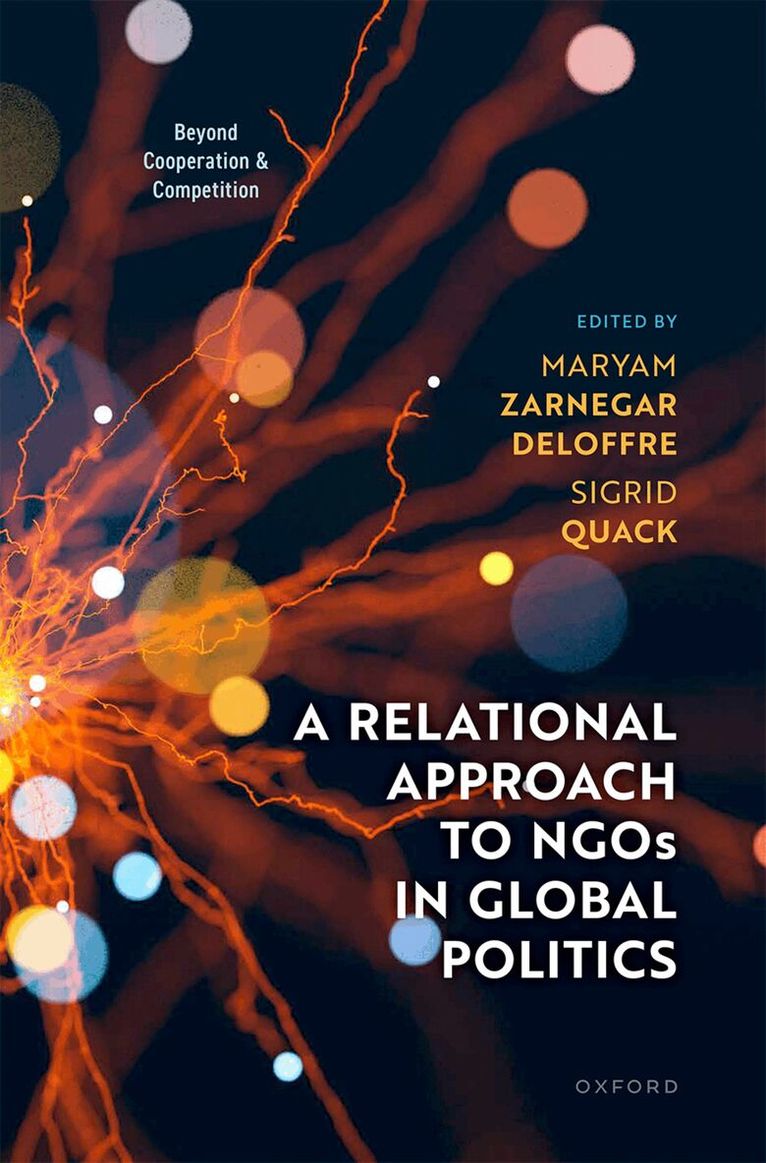
A Relational Approach to NGOs in Global Politics
Beyond Cooperation and Competition
Inbunden, Engelska, 2025
1 349 kr
Skickas inom 5-8 vardagar
This is an open access title available under the terms of a CC BY-NC-ND 4.0 International licence. It is free to read at Oxford Scholarship Online and offered as a free PDF download from OUP and selected open access locations.How do non-governmental organizations (NGOs) create the spaces in which they act, despite all the odds that are stacked against them? How do NGOs meet the requirements of the moment, often being in the right place at the right time? Why is the sum of NGO activity frequently greater than the parts? To answer these questions, A Relational Approach to NGOs in Global Politics analyses the ways in which NGOs relate to each other as well as with states, intergovernmental organizations, businesses, and other actors. It considers NGOs as living organizations - flexible, adaptive, creative - to examine the various NGO relationships and how they are built to surmount challenges, manage complexity, and make progress. In doing so, it sheds light on their power and agency in global politics.Maryam Zarnegar Deloffre and Sigrid Quack develop core conceptual building blocks, such as NGOing and typologies of social interactions and relational power, which are explored in empirical studies of NGOs on a range of topics. These include legal environmental conflicts, humanitarian assistance, and counterterrorism, as well as analyses of relational forms such as super-networks, meta-associations, and mergers and acquisitions.With a broad conceptualization of NGO-NGO relationships and in-depth analysis of the forms and processes of NGO interactions, this volume expands the understanding of NGOing, promotes synthetic knowledge about the power and effects of NGO interactions, and reveals new perspectives on processes of global governing.
943 kr
Skickas inom 7-10 vardagar
Transnational communities are social groups that emerge from mutual interaction across national boundaries, oriented around a common project or 'imagined' identity. This common project or identity is constructed and sustained through the active engagement and involvement of at least some of its members. Such communities can overlap in different ways with formal organizations but, in principle, they do not need formal organization to be sustained. This book explores the role of transnational communities in relation to the governance of business and economic activity. It does so by focusing on a wide range of empirical terrains, including discussions of the Laleli market in Istanbul, the institutionalization of private equity in Japan, the transnational movement for open content licenses, and the mobilization around environmental certification. These studies show that transnational communities can align the cognitive and normative orientations of their members over time and thereby influence emergent transnational governance arrangements.
631 kr
Skickas inom 7-10 vardagar
Transnational communities are social groups that emerge from mutual interaction across national boundaries, oriented around a common project or 'imagined' identity. This common project or identity is constructed and sustained through the active engagement and involvement of at least some of its members. Such communities can overlap in different ways with formal organizations but, in principle, they do not need formal organization to be sustained. This book explores the role of transnational communities in relation to the governance of business and economic activity. It does so by focusing on a wide range of empirical terrains, including discussions of the Laleli market in Istanbul, the institutionalization of private equity in Japan, the transnational movement for open content licenses, and the mobilization around environmental certification. These studies show that transnational communities can align the cognitive and normative orientations of their members over time and thereby influence emergent transnational governance arrangements.
1 642 kr
Skickas inom 7-10 vardagar
In 2008, the world entered a new period of turmoil. Financial markets collapsed, banks and other financial institutions went in to crisis; credit dried up, consumption reduced and firms started to cut back and reduce investment in the light of uncertainty. Unemployment increased and welfare payments increased. States that borrowed to save their banks and to maintain their spending found the financial markets and the international institutions condemning their profligacy and urging austerity policies. This book is concerned with what happens when elites are challenged by such a crisis; in our terms, elites are 'on trial' firstly for their role in the past and shaping the context for the crisis, secondly in terms of how they responded to the crisis and finally in terms of what role they are playing in the aftermath. Can they reestablish their legitimacy or will they fail this trial and find themselves replaced by other groups with different objectives? This collection draws together a variety of studies and approaches to these issues from a group of international authors which helps us understand 'elites on trial' in the contemporary period.
1 655 kr
Skickas inom 7-10 vardagar
This book examines the role of imagination in initiating, contesting, and changing the pathways of global cooperation. Building on carefully contextualized empirical cases from diverse policy fields, regions, and historical periods, it highlights the agency of a wide range of actors in reflecting on past and present experiences and imagining future ways of collective problem solving.Chapters analyse the mobilizing, identity, cognitive, emotional, and normative effects through which imaginations shape pathways for global cooperation. Expert contributors consider the ways in which actors combine multiple layers of meaning-making through practices of staging the past and present as well as in their circulation. Exploring the contingency and open-endedness of processes of global cooperation, the book challenges more systemic and output-oriented perspectives of global governance. Its synthesis of ways in which imaginations inform processes of creating, contesting, and changing pathways for global cooperation provides a novel conceptual approach to the study of global cooperation.Interdisciplinary in approach, this authoritative book offers new ways of thinking about global cooperation to scholars and students of international relations, development studies, law and politics, international theory, global sociology, and global history as well as practitioners and policy-makers across various policy fields.
2 187 kr
Skickas inom 7-10 vardagar
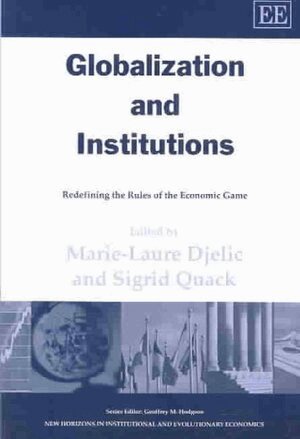
This volume investigates the relationship between economic globalization and institutions, or global governance, challenging the common assumption that globalization and institutionalization are essentially processes which exclude each other. Instead, the contributors to this book show that globalization is better perceived as a dual process of institutional change at the national level, and institution building at the transnational level. Rich, supporting empirical evidence is provided along with a theoretical conceptualization of the main actors, mechanisms and conditions involved in trickle-up and trickle-down trajectories through which national institutional systems are being transformed and transnational rules emerge.The book collectively argues that transnational institution building is one of the most striking features of the current period of internationalization. As a consequence, debates concerning globalization and global governance have to be reformulated. The authors posit that globalization is not threatening governance, but in fact globalization reflects a particular type of governance. The dilemma, therefore, is not between globalization and institutions, but between different meanings of governance and the balance that should be reached between them.Globalization and Institutions will be of special interest to academics and scholars of institutional economics, globalization and management. However, with its focus on two key debates for which there is clearly rising interest, many social scientists will find the book of interest.
862 kr
Skickas inom 7-10 vardagar
This volume investigates the relationship between economic globalization and institutions, or global governance, challenging the common assumption that globalization and institutionalization are essentially processes which exclude each other. Instead, the contributors to this book show that globalization is better perceived as a dual process of institutional change at the national level, and institution building at the transnational level. Rich, supporting empirical evidence is provided along with a theoretical conceptualization of the main actors, mechanisms and conditions involved in trickle-up and trickle-down trajectories through which national institutional systems are being transformed and transnational rules emerge.The book collectively argues that transnational institution building is one of the most striking features of the current period of internationalization. As a consequence, debates concerning globalization and global governance have to be reformulated. The authors posit that globalization is not threatening governance, but in fact globalization reflects a particular type of governance. The dilemma, therefore, is not between globalization and institutions, but between different meanings of governance and the balance that should be reached between them.Globalization and Institutions will be of special interest to academics and scholars of institutional economics, globalization and management. However, with its focus on two key debates for which there is clearly rising interest, many social scientists will find the book of interest.
455 kr
Skickas inom 10-15 vardagar
Die Beiträge in diesem Band entwickeln eine neuartige Perspektive auf Arbeit und Arbeitsmärkte, welche den nationalstaatlichen Referenzrahmen überschreitet. Drei Phänomene sind für die Transnationalisierung von Arbeit von besonderer Bedeutung: (1) die grenzüberschreitende Mobilität von Arbeitskräften, (2) die grenzüberschreitende Mobilität von Arbeitstätigkeiten und Wissen, die teilweise, aber nicht zwangsläufig mit einer Verlagerung der Produktionsstandorte verbunden ist, und (3) die Herausbildung europäischer, transnationaler und globaler Institutionen, in welche die grenzüberschreitende Mobilität von Arbeitskräften, Arbeitstätigkeiten und Wissen zunehmend eingebettet ist.