Mark B. N. Hansen – författare
Visar alla böcker från författaren Mark B. N. Hansen. Handla med fri frakt och snabb leverans.
16 produkter
Feed-Forward
On the Future of Twenty-First-Century Media
Häftad, 2015
299 kr
Lägg i varukorg
Even as media in myriad forms increasingly saturate our lives, we nonetheless tend to describe our relationship to it in terms from the twentieth century: we are consumers of media, choosing to engage with it. In Feed-Forward, Mark B. N. Hansen shows just how outmoded that way of thinking is: media …
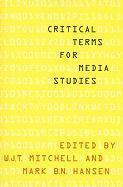
Critical Terms for Media Studies
Av W. J. T. Mitchell, Mark B. N. Hansen
Häftad, 2010
342 kr
Lägg i varukorg
Communications, philosophy, film and video, digital culture: media studies straddles an astounding array of fields and disciplines and produces a vocabulary that is in equal parts rigorous and intuitive. "Critical Terms for Media Studies" defines, and at times redefines, what this new and hybrid …
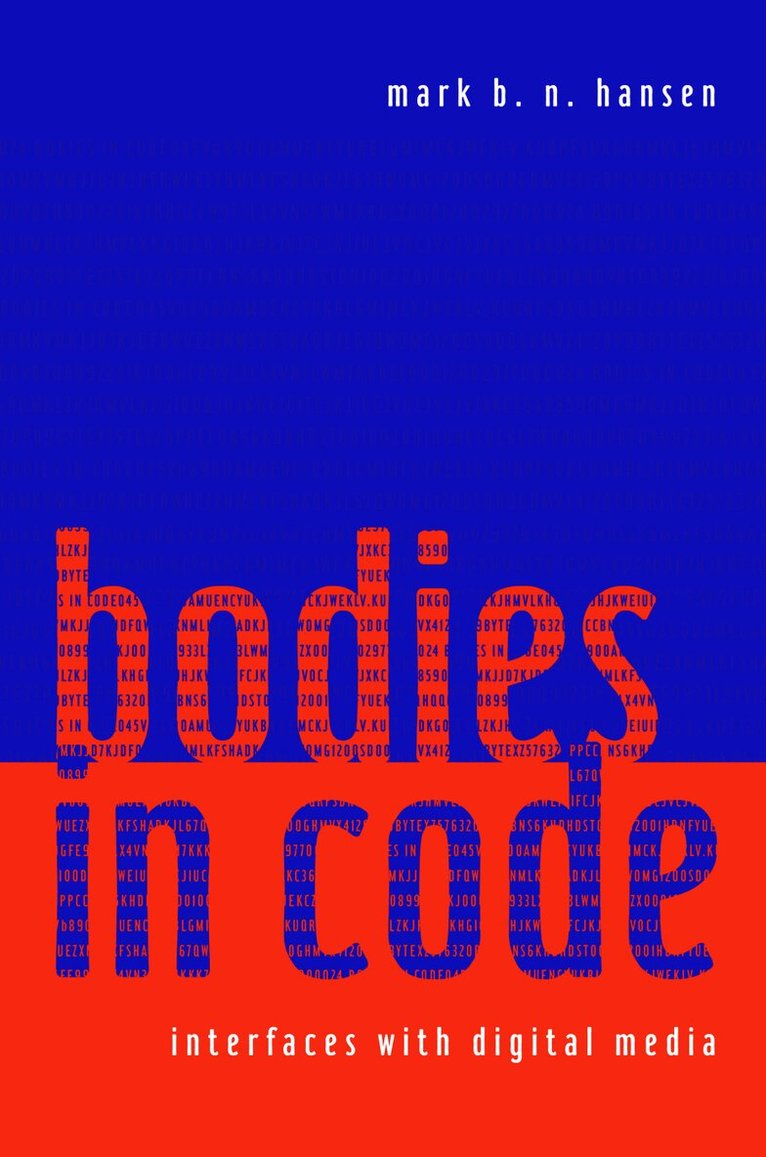
Bodies in Code
Interfaces with Digital Media
Inbunden, 2006
2588 kr
Lägg i varukorg
Bodies in Code explores how our bodies experience and adapt to digital environments. Cyberculture theorists have tended to overlook biological reality when talking about virtual reality, and Mark B. N. Hansen's book shows what they've been missing. Cyberspace is anchored in the body, he argues, and …
Bodies in Code
Interfaces with Digital Media
Häftad, 2006
652 kr
Lägg i varukorg
Bodies in Code explores how our bodies experience and adapt to digital environments. Cyberculture theorists have tended to overlook biological reality when talking about virtual reality, and Mark B. N. Hansen's book shows what they've been missing. Cyberspace is anchored in the body, he argues, and …
Cambridge Companion to Merleau-Ponty
Av Mark B. N. Hansen, Taylor Carman
E-bok, 2004
522 kr
Lägg i varukorg
Maurice Merleau-Ponty (1908–61) was described by Paul Ricoeur as ''the greatest of the French phenomenologists''. The essays in this volume examine the full scope of Merleau-Ponty''s philosophy, from his central and abiding concern with the nature of perception and the bodily constitution of …
The Cambridge Companion to Merleau-Ponty
Av Taylor Carman, Mark B. N. Hansen
Häftad, 2004
536 kr
Lägg i varukorg
Maurice Merleau-Ponty (1908-61) was described by Paul Ricoeur as 'the greatest of the French phenomenologists'. The essays in this volume examine the full scope of Merleau-Ponty's philosophy, from his central and abiding concern with the nature of perception and the bodily constitution of …
The Cambridge Companion to Merleau-Ponty
Av Taylor Carman, Mark B. N. Hansen
Inbunden, 2004
1514 kr
Lägg i varukorg
Maurice Merleau-Ponty (1908-61) was described by Paul Ricoeur as 'the greatest of the French phenomenologists'. The essays in this volume examine the full scope of Merleau-Ponty's philosophy, from his central and abiding concern with the nature of perception and the bodily constitution of …
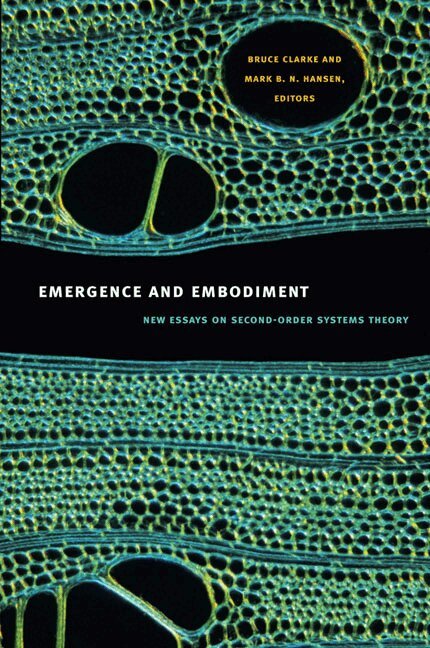
Emergence and Embodiment
New Essays on Second-Order Systems Theory
Av Bruce Clarke, Mark B. N. Hansen
Häftad, 2009
579 kr
Lägg i varukorg
Emerging in the 1940s, the first cybernetics-the study of communication and control systems-was mainstreamed under the names artificial intelligence and computer science and taken up by the social sciences, the humanities, and the creative arts. In Emergence and Embodiment, Bruce Clarke and Mark B. …
Emergence and Embodiment
New Essays on Second-Order Systems Theory
Av Mark B. N. Hansen, Bruce Clarke
E-bok, 2009
587 kr
Lägg i varukorg
Emerging in the 1940s, the first cybernetics—the study of communication and control systems—was mainstreamed under the names artificial intelligence and computer science and taken up by the social sciences, the humanities, and the creative arts. In Emergence and Embodiment , Bruce Clarke and Mark …
Bodies in Code
Interfaces with Digital Media
E-bok, 2012
658 kr
Lägg i varukorg
Bodies in Code explores how our bodies experience and adapt to digital environments. Cyberculture theorists have tended to overlook biological reality when talking about virtual reality, and Mark B. N. Hansen''s book shows what they''ve been missing. Cyberspace is anchored in the body, he argues, …
Bodies in Code
Interfaces with Digital Media
E-bok, 2012
658 kr
Lägg i varukorg
Bodies in Code explores how our bodies experience and adapt to digital environments. Cyberculture theorists have tended to overlook biological reality when talking about virtual reality, and Mark B. N. Hansen''s book shows what they''ve been missing. Cyberspace is anchored in the body, he argues, …
Cambridge Companion to Merleau-Ponty
Av Mark B. N. Hansen, Taylor Carman
E-bok, 2004
522 kr
Lägg i varukorg
Maurice Merleau-Ponty (1908–61) was described by Paul Ricoeur as ''the greatest of the French phenomenologists''. The essays in this volume examine the full scope of Merleau-Ponty''s philosophy, from his central and abiding concern with the nature of perception and the bodily constitution of …
Feed-Forward
On the Future of Twenty-First-Century Media
Inbunden, 2015
854 kr
Tillfälligt slut
Even as media in myriad forms increasingly saturate our lives, we nonetheless tend to describe our relationship to it in terms from the twentieth century: we are consumers of media, choosing to engage with it. In Feed-Forward, Mark B. N. Hansen shows just how outmoded that way of thinking is: media …
Critical Terms for Media Studies
Av W. J. T. Mitchell, Mark B. N. Hansen
Inbunden, 2010
871 kr
Tillfälligt slut
Communications, philosophy, film and video, digital culture: media studies straddles an astounding array of fields and disciplines and produces a vocabulary that is in equal parts rigorous and intuitive. "Critical Terms for Media Studies" defines, and at times redefines, what this new and hybrid …
Emergence and Embodiment
New Essays on Second-Order Systems Theory
Av Bruce Clarke, Mark B. N. Hansen
Inbunden, 2009
1304 kr
Tillfälligt slut
Emerging in the 1940s, the first cybernetics-the study of communication and control systems-was mainstreamed under the names artificial intelligence and computer science and taken up by the social sciences, the humanities, and the creative arts. In Emergence and Embodiment, Bruce Clarke and Mark B. …