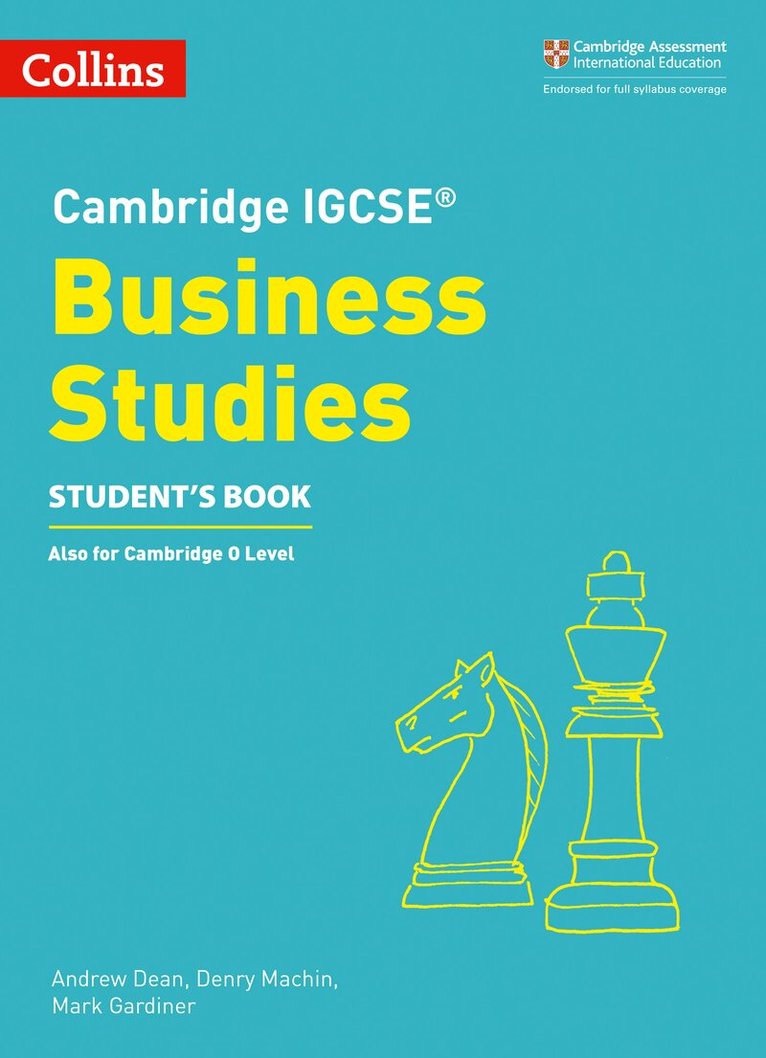
Written by experienced IGCSE Business Studies teachers from around the world, this textbook provides full coverage of the skills and knowledge in Cambridge IGCSE® Business Studies 0450 syllabus, for first teaching from 2018 and examination from 2020, to help your students succeed.Exam Board: Cambridge Assessment International EducationFirst teaching: 2018 First examination: 2020This Student’s Book also provides coverage for Cambridge O Level Business Studies 7115 and Cambridge Business Studies (9-1) 0986 syllabuses. This title is endorsed by Cambridge Assessment International Education. Deliver a course that reflects the modern business world with up to date examples and data.Put Business Studies in context with engaging, up-to-date, real-life case studies from around the world for every topic.Enable students to access the syllabus content with a fresh, visual design and language tailored to English as a Second Language learners.Build students’ skills in application, analysis and evaluation with targeted skills activities and skills builders.Develop students’ exam skills with Paper 1 exam-style questions, and Paper 2 exam-style case studies with supporting questions for every section, including some examples from Cambridge past papers.Encourage students to check their understanding with Knowledge check questions for every topic.Support students in assessing their grasp of the content through a progression checklist at the end of every chapter.Improve students’ vocabulary and understanding of key terms and concepts with the extensive Glossary.This title is endorsed by Cambridge Assessment International Education.
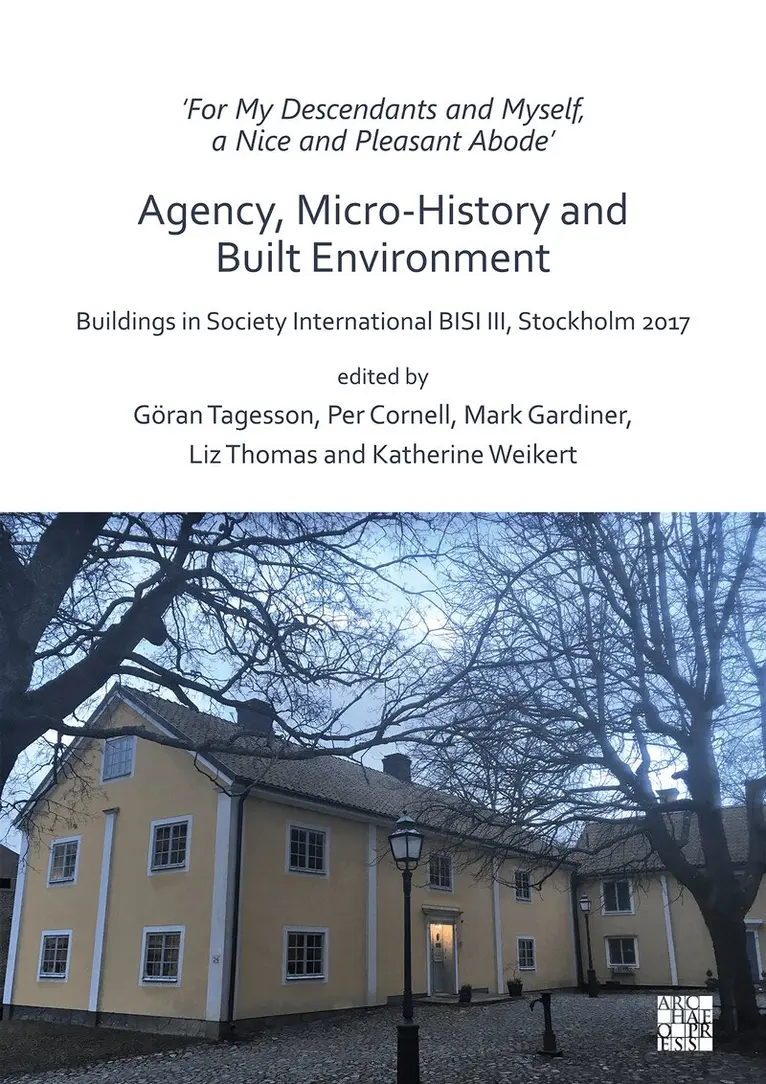
Agency, Micro-History and Built Environment examines how people have been making, using and transforming buildings and built environments in general, and how the buildings have been perceived. It also considers a diversity of built constructions – including dwellings and public buildings, sheds and manor houses, secular and sacral structures. Comparisons between different regions and parts of the globe, important when addressing buildings from a social perspective, are presented with studies from the UK, the Netherlands, Norway, Sweden, Germany and Mexico. The chronological framework spans from the classical Byzantine period, over the Middle Ages and the Early Modern period and ends in 20th century Belfast.
Written by experienced IGCSE Business Studies teachers from around the world, this textbook provides full coverage of the skills and knowledge in Cambridge IGCSE® Business Studies 0450 syllabus, for first teaching from 2018 and examination from 2020, to help your students succeed.Exam Board: Cambridge Assessment International EducationFirst teaching: 2018 First examination: 2020This Student’s Book also provides coverage for Cambridge O Level Business Studies 7115 and Cambridge Business Studies (9-1) 0986 syllabuses. This title is endorsed by Cambridge Assessment International Education. Deliver a course that reflects the modern business world with up to date examples and data.Put Business Studies in context with engaging, up-to-date, real-life case studies from around the world for every topic.Enable students to access the syllabus content with a fresh, visual design and language tailored to English as a Second Language learners.Build students’ skills in application, analysis and evaluation with targeted skills activities and skills builders.Develop students’ exam skills with Paper 1 exam-style questions, and Paper 2 exam-style case studies with supporting questions for every section, including some examples from Cambridge past papers.Encourage students to check their understanding with Knowledge check questions for every topic.Support students in assessing their grasp of the content through a progression checklist at the end of every chapter.Improve students’ vocabulary and understanding of key terms and concepts with the extensive Glossary.This title is endorsed by Cambridge Assessment International Education.
Agency, Micro-History and Built Environment examines how people have been making, using and transforming buildings and built environments in general, and how the buildings have been perceived. It also considers a diversity of built constructions – including dwellings and public buildings, sheds and manor houses, secular and sacral structures. Comparisons between different regions and parts of the globe, important when addressing buildings from a social perspective, are presented with studies from the UK, the Netherlands, Norway, Sweden, Germany and Mexico. The chronological framework spans from the classical Byzantine period, over the Middle Ages and the Early Modern period and ends in 20th century Belfast.