Mark R. Sanderson – författare
Visar alla böcker från författaren Mark R. Sanderson. Handla med fri frakt och snabb leverans.
3 produkter
3 produkter
E-bok
PDF, Engelska, 2007499 kr
Läs direkt efter köp
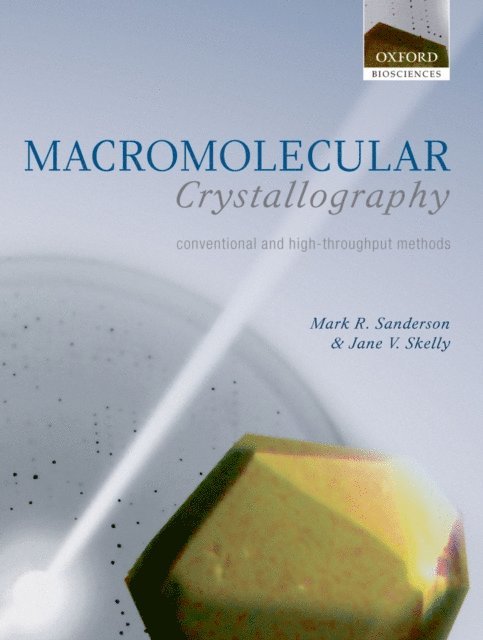
Macromolecular Crystallography is the study of macromolecules (proteins and nucleic acids) using X-ray crystallographic techniques in order to determine their molecular structure. The knowledge of accurate molecular structures is a pre-requisite for rational drug design, and for structure-based function studies to aid the development of effective therapeutic agents and drugs.The successful determination of the complete genome (genetic sequence) of several species (including humans) has recently directed scientific attention towards identifying the structure and function of the complete complement of proteins that make up that species; a new and rapidly growing field of study called ''structural genomics''. There are now several important and well-funded global initiatives in operation to identify all of the proteins of key model species. One of the main requirementsfor these initiatives is a high-throughput crystallization facility to speed-up the protein identification process. The extent to which these technologies have advanced, calls for an updated review of current crystallographic theory and practice.This practical reference book features the latest conventional and high-throughput methods, and includes contributions from a team of internationally recognized leaders and experts. It will be of relevance and use to graduate students, research scientists and professionals currently working in the field of conventional and high-throughput macromolecular crystallography.
Inbunden, Engelska, 2007
1 076 kr
Skickas inom 7-10 vardagar
Macromolecular Crystallography is the study of macromolecules (proteins and nucleic acids) using X-ray crystallographic techniques in order to determine their molecular structure. The knowledge of accurate molecular structures is a pre-requisite for rational drug design, and for structure-based function studies to aid the development of effective therapeutic agents and drugs. The successful determination of the complete genome (genetic sequence) of several species (including humans) has recently directed scientific attention towards identifying the structure and function of the complete complement of proteins that make up that species; a new and rapidly growing field of study called 'structural genomics'. There are now several important and well-funded global initiatives in operation to identify all of the proteins of key model species. One of the main requirements for these initiatives is a high-throughput crystallization facility to speed-up the protein identification process. The extent to which these technologies have advanced, calls for an updated review of current crystallographic theory and practice. This practical reference book features the latest conventional and high-throughput methods, and includes contributions from a team of internationally recognized leaders and experts. It will be of relevance and use to graduate students, research scientists and professionals currently working in the field of conventional and high-throughput macromolecular crystallography.
E-bok
Engelska, 20081 069 kr
Läs direkt efter köp
The volumes in the series, Methods in Molecular Biology, are conceived with the biochemist and molecular biologist in mind. The present book, Crystallographic Methods andProtocols, concentrates on the use of X-ray crystallography to solve the detailed three dimensional structuresofproteins, nucleic acids, andtheir complexes. Such a structure determination is a major undertaking, demands expertise in a range of skills, and requires considerable resources. The biologically trained worker will probably first become involved when identifying an important scientific problem whose solution would benefit from a full structure. The protein or nucleic acid at issue must be sequenced and prepared to high purity in appropriate quantities, probably by either chemical synthesis for nucleic acids or genetic engineering for proteins. CrystallographicMethods andPro tocols aims to give biologically trained workers an insight into the techniques used to crystallize their proteins, obtain the raw X-ray data, and solve and refine the structure. The aim ofa crystal structure determination is to provide infor mation that will solve biologically relevant problems; that process normally requires a high resolution structure. The preparationofsuit able crystals for a high resolution structure remains the major bottle neck in structure determination, and the effective application of appropriate genetic engineering and biochemical techniques in the initial stages pays ahandsome dividend later. The productionofsuit able proteins by recombinant methods and the preparationofcrystal line derivatives are covered by Skelly and Madden in Chapter 2. Before beginning the data collection required for a high resolution structure, a preliminary characterizationofthe crystals is carried out.