Markus K. Brunnermeier – författare
Visar alla böcker från författaren Markus K. Brunnermeier. Handla med fri frakt och snabb leverans.
6 produkter
6 produkter
Asset Pricing under Asymmetric Information
Bubbles, Crashes, Technical Analysis, and Herding
Inbunden, Engelska, 2001
1 603 kr
Skickas inom 5-8 vardagar
Asset prices are driven by public news and information that is often dispersed among many market participants. These agents try to infer each other's information by analyzing price processes. In the past two decades, theoretical research in financial economics has significantly advanced our understanding of the informational aspects of price processes. This book provides a detailed and up-to-date survey of this important body of literature.The book begins by demonstrating how to model asymmetric information and higher-order knowledge. It then contrasts competitive and strategic equilibrium concepts under asymmetric information. It also illustrates the dependence of information efficiency and allocative efficiency on the security structure and the linkage between both efficiency concepts. No-Trade theorems and market breakdowns due to asymmetric information are then explained, and the existence of bubbles under symmetric and asymmetric information is investigated.The remainder of the survey is devoted to contrasting different market microstructure models that demonstrate how asymmetric information affects asset prices and traders' information , which provide a theoretical explanation for technical analysis and illustrate why some investors "chase the trend." The reader is then introduced to herding models and informational cascades, which can arise in a setting where agents' decision-making is sequential. The insights derived from herding models are used to provide rational explanations for stock market crashes. Models in which all traders are induced to search for the same piece of information are then presented to provide a deeper insight into Keynes' comparison of the stock market with a beauty contest. The book concludes with a brief summary of bank runs and their connection to financial crises.
327 kr
Kommande
An acclaimed economist’s fully revised and expanded guide to how resilient thinking helps us face a world of unknownsThe world is becoming more dangerous and complex. In The Resilient Society, Markus K. Brunnermeier offers a unifying framework for meeting its demands: resilience—not the avoidance of risk, but the capacity to recover from shocks and emerge stronger. Through this single powerful lens, he illuminates challenges as varied as geopolitical rivalries in a world riddled with choke points and interdependencies, the ever-present specter of armed conflict, food insecurity across emerging and developing economies, pandemics, and increasingly severe weather.This fully revised edition of the award-winning The Resilient Society brings sharp new insight to the defining public-policy questions of our era—geoeconomics, global finance, sovereign debt, inflation, public health, climate change, and inequality. Written for business leaders, policymakers, economists, and engaged citizens alike, it shows how resilience can serve as a compass for the most urgent problems of our time.
292 kr
Skickas inom 5-8 vardagar
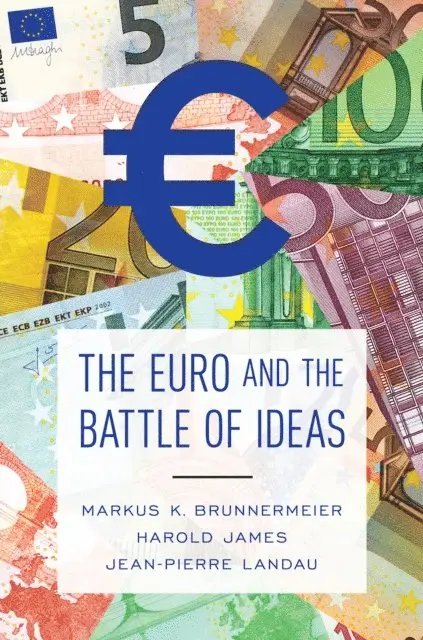
Why is Europe's great monetary endeavor, the Euro, in trouble? A string of economic difficulties in Greece, Ireland, Spain, Italy, and other Eurozone nations has left observers wondering whether the currency union can survive. In this book, Markus Brunnermeier, Harold James, and Jean-Pierre Landau argue that the core problem with the Euro lies in the philosophical differences between the founding countries of the Eurozone, particularly Germany and France. But the authors also show how these seemingly incompatible differences can be reconciled to ensure Europe's survival. As the authors demonstrate, Germany, a federal state with strong regional governments, saw the Maastricht Treaty, the framework for the Euro, as a set of rules. France, on the other hand, with a more centralized system of government, saw the framework as flexible, to be overseen by governments. The authors discuss how the troubles faced by the Euro have led its member states to focus on national, as opposed to collective, responses, a reaction explained by the resurgence of the battle of economic ideas: rules vs. discretion, liability vs. solidarity, solvency vs. liquidity, austerity vs. stimulus.Weaving together economic analysis and historical reflection, The Euro and the Battle of Ideas provides a forensic investigation and a road map for Europe's future.
210 kr
Skickas inom 5-8 vardagar
How philosophical differences between Eurozone nations led to the Euro crisis—and where to go from hereWhy is Europe’s great monetary endeavor, the Euro, in trouble? A string of economic difficulties in Eurozone nations has left observers wondering whether the currency union can survive. In this book, Markus Brunnermeier, Harold James, and Jean-Pierre Landau argue that the core problem with the Euro lies in the philosophical differences between the founding countries of the Eurozone, particularly Germany and France. But the authors also show how these seemingly incompatible differences can be reconciled to ensure Europe’s survival. Weaving together economic analysis and historical reflection, The Euro and the Battle of Ideas provides a forensic investigation and a road map for Europe’s future.
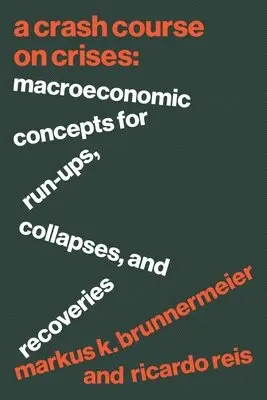
Crash Course on Crises
Macroeconomic Concepts for Run-Ups, Collapses, and Recoveries
Inbunden, Engelska, 2023
292 kr
Skickas inom 5-8 vardagar
An incisive overview of the macroeconomics of financial crises—essential reading for students and policy experts alikeWith alarming frequency, modern economies go through macro-financial crashes that arise from the financial sector and spread to the broader economy, inflicting deep and prolonged recessions. A Crash Course on Crises brings together the latest cutting-edge economic research to identify the seeds of these crashes, reveal their triggers and consequences, and explain what policymakers can do about them.Each of the book’s ten self-contained chapters introduces readers to a key economic force and provides case studies that illustrate how that force was dominant. Markus Brunnermeier and Ricardo Reis show how the run-up phase of a crisis often occurs in ways that are preventable but that may go unnoticed and discuss how debt contracts, banks, and a search for safety can act as triggers and amplifiers that drive the economy to crash. Brunnermeier and Reis then explain how monetary, fiscal, and exchange-rate policies can respond to crises and prevent them from becoming persistent.With case studies ranging from Chile in the 1970s to the COVID-19 pandemic, A Crash Course on Crises synthesizes a vast literature into ten simple, accessible ideas and illuminates these concepts using novel diagrams and a clear analytical framework.
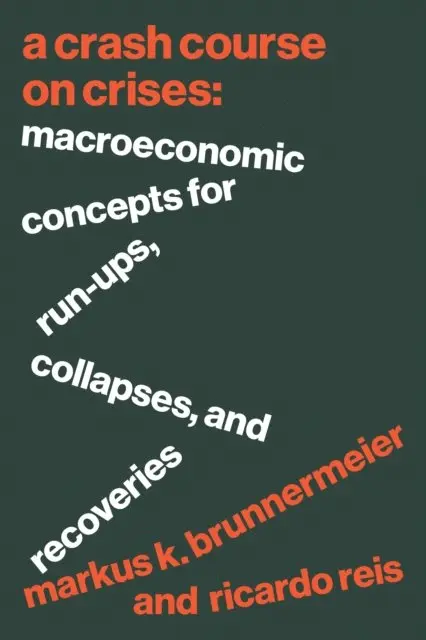
Crash Course on Crises
Macroeconomic Concepts for Run-Ups, Collapses, and Recoveries
Häftad, Engelska, 2025
210 kr
Skickas inom 5-8 vardagar
An incisive overview of the macroeconomics of financial crises—essential reading for students and policy experts alikeWith alarming frequency, modern economies go through macro-financial crashes that arise from the financial sector and spread to the broader economy, inflicting deep and prolonged recessions. A Crash Course on Crises brings together the latest cutting-edge economic research to identify the seeds of these crashes, reveal their triggers and consequences, and explain what policymakers can do about them.Each of the book’s ten self-contained chapters introduces readers to a key economic force and provides case studies that illustrate how that force was dominant. Markus Brunnermeier and Ricardo Reis show how the run-up phase of a crisis often occurs in ways that are preventable but that may go unnoticed and discuss how debt contracts, banks, and a search for safety can act as triggers and amplifiers that drive the economy to crash. Brunnermeier and Reis then explain how monetary, fiscal, and exchange-rate policies can respond to crises and prevent them from becoming persistent.With case studies ranging from Chile in the 1970s to the COVID-19 pandemic, A Crash Course on Crises synthesizes a vast literature into ten simple, accessible ideas and illuminates these concepts using novel diagrams and a clear analytical framework.