Martin Braschler – författare
Visar alla böcker från författaren Martin Braschler. Handla med fri frakt och snabb leverans.
13 produkter
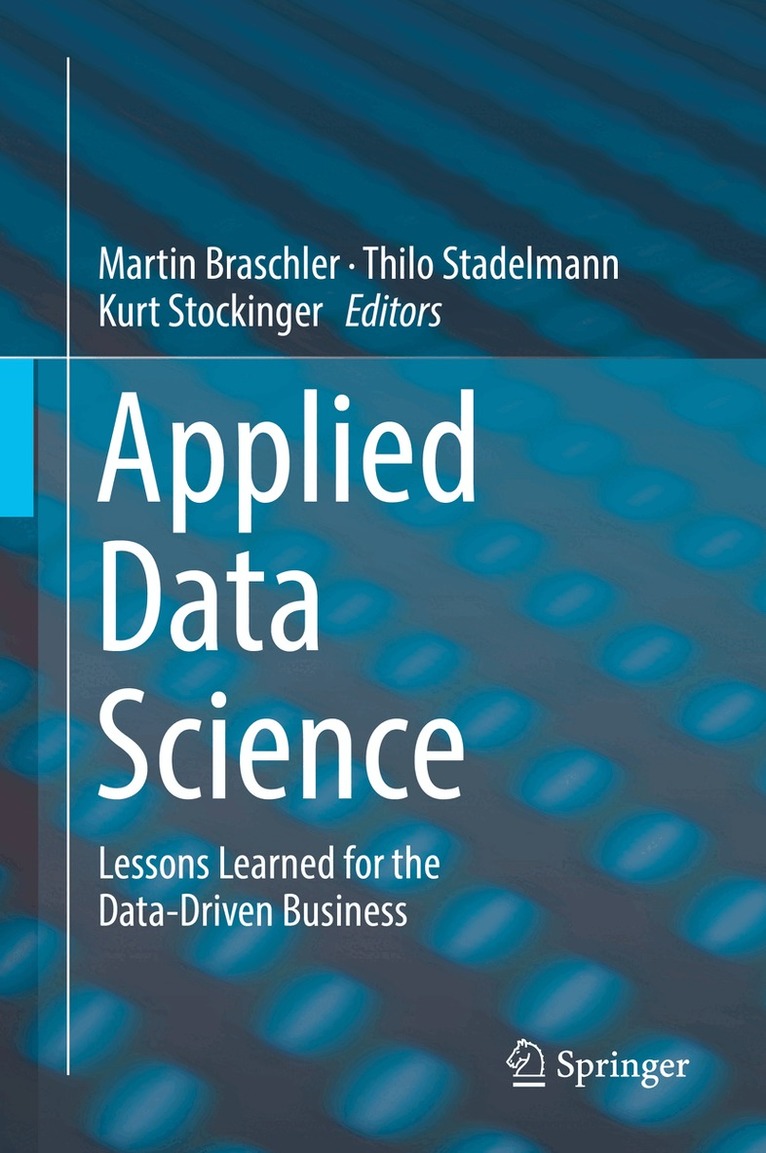
Applied Data Science
Lessons Learned for the Data-Driven Business
Av Martin Braschler, Thilo Stadelmann m. fl.
Inbunden, 2019
1799 kr
Lägg i varukorg
This book has two main goals: to define data science through the work of data scientists and their results, namely data products, while simultaneously providing the reader with relevant lessons learned from applied data science projects at the intersection of academia and industry. As such, it is …
Applied Data Science
Lessons Learned for the Data-Driven Business
Av Kurt Stockinger, Thilo Stadelmann m. fl.
E-bok, 2019
2341 kr
Lägg i varukorg
This book has two main goals: to define data science through the work of data scientists and their results, namely data products, while simultaneously providing the reader with relevant lessons learned from applied data science projects at the intersection of academia and industry. As such, it is …
Experimental IR Meets Multilinguality, Multimodality, and Interaction
10th International Conference of the CLEF Association, CLEF 2019, Lugano, Switzerland, September 9–12, 2019, Proceedings
Av Fabio Crestani, Martin Braschler m. fl.
Häftad, 2019
812 kr
Lägg i varukorg
This book constitutes the refereed proceedings of the 10th International Conference of the CLEF Association, CLEF 2019, held in Lugano, Switzerland, in September 2019.The conference has a clear focus on experimental information retrieval with special attention to the challenges of multimodality, …
Experimental IR Meets Multilinguality, Multimodality, and Interaction
10th International Conference of the CLEF Association, CLEF 2019, Lugano, Switzerland, September 9–12, 2019, Proceedings
Av Nicola Ferro, Linda Cappellato m. fl.
E-bok, 2019
1026 kr
Lägg i varukorg
This book constitutes the refereed proceedings of the 10th International Conference of the CLEF Association, CLEF 2019, held in Lugano, Switzerland, in September 2019. The conference has a clear focus on experimental information retrieval with special attention to the challenges of multimodality, …
Comparative Evaluation of Multilingual Information Access Systems
4th Workshop of the Cross-Language Evaluation Forum, CLEF 2003, Trondheim, Norway, August 21-22, 2003, Revised Selected Papers
Av Julio Gonzalo, Martin Braschler m. fl.
Häftad, 2004
1080 kr
Lägg i varukorg
The fourth campaign of the Cross-language Evaluation Forum (CLEF) for European languages was held from January to August 2003. Participation in this campaign showed a slight rise in the number of participants from the previous year, with 42 groups submitting results for one or more of the different …
Comparative Evaluation of Multilingual Information Access Systems
4th Workshop of the Cross-Language Evaluation Forum, CLEF 2003, Trondheim, Norway, August 21-22, 2003, Revised Selected Papers
Av Michael Kluck, Martin Braschler m. fl.
E-bok, 2004
1502 kr
Lägg i varukorg
The fourth campaign of the Cross-language Evaluation Forum (CLEF) for European languages was held from January to August 2003. Participation in this campaign showed a slight rise in the number of participants from the previous year, with 42 groups submitting results for one or more of the different …
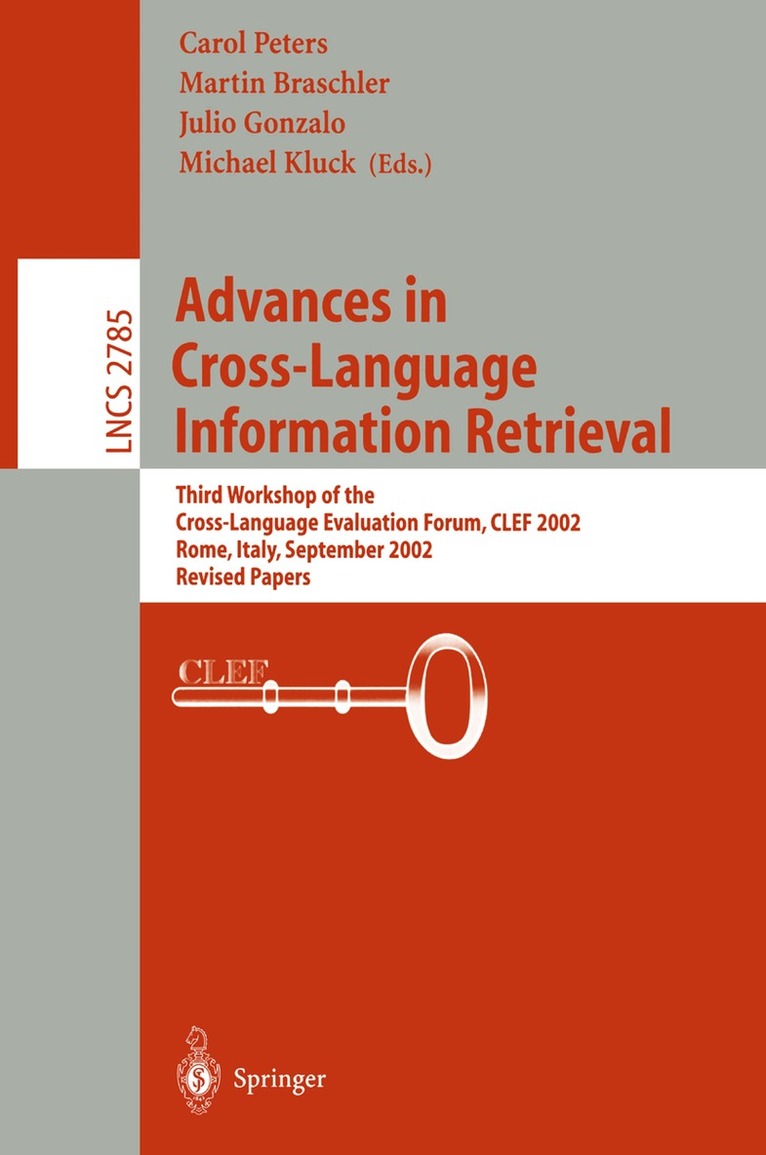
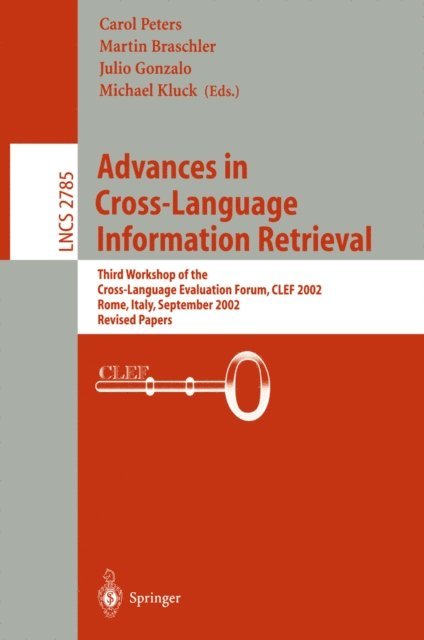
Advances in Cross-Language Information Retrieval
Third Workshop of the Cross-Language Evaluation Forum, CLEF 2002 Rome, Italy, September 19–20, 2002 Revised Papers
Av Martin Braschler, Julio Gonzalo m. fl.
2003
1274 kr
Lägg i varukorg
The third campaignof the Cross-LanguageEvaluation Forum (CLEF) for Eu- pean languages was held from January to September 2002. Participation in this campaignshowedaslightriseinthenumberofparticipantswith,37groupsfrom both academia and industry and a steep rise in the number of experiments they …
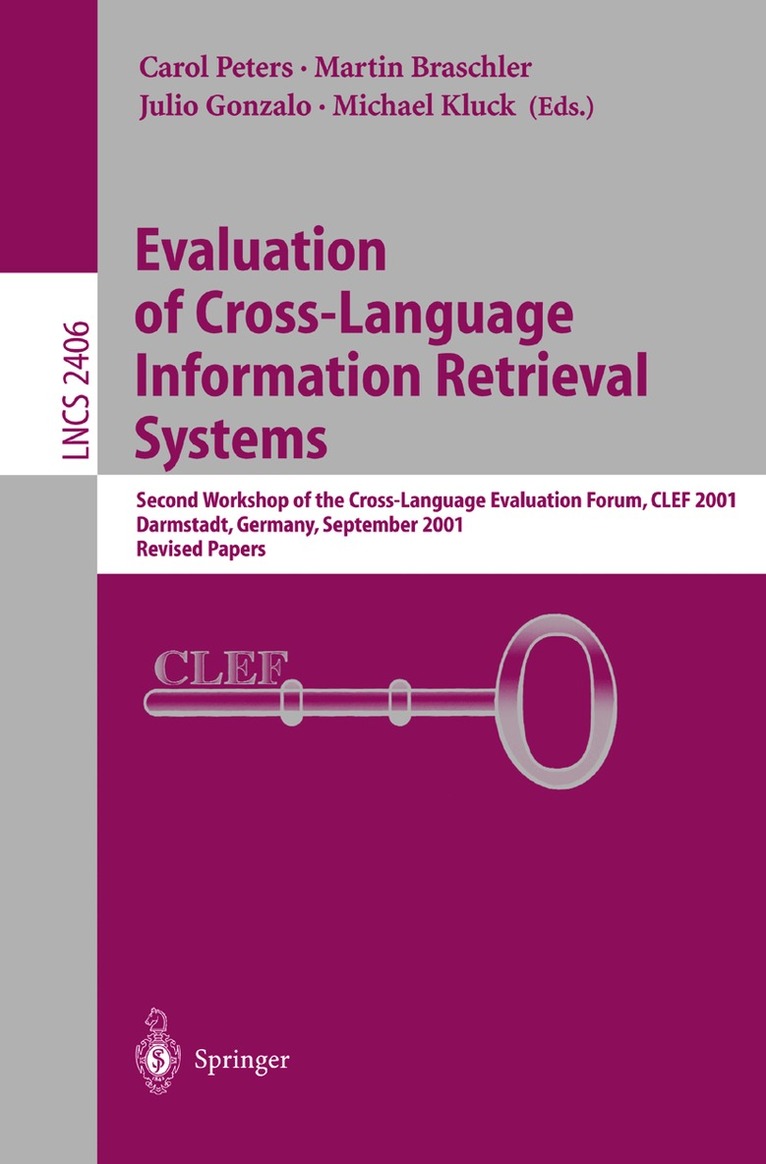
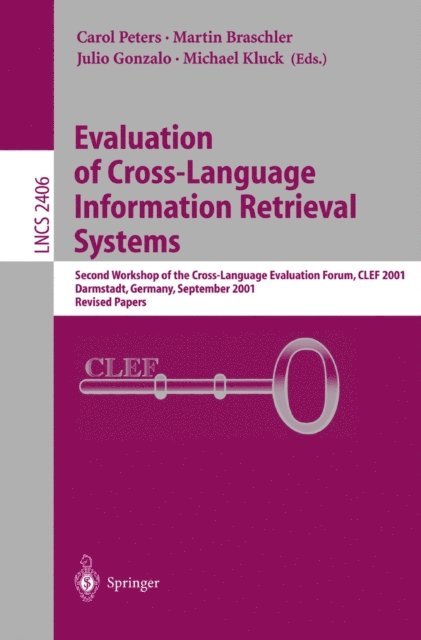
Evaluation of Cross-Language Information Retrieval Systems
Second Workshop of the Cross-Language Evaluation Forum, CLEF 2001, Darmstadt, Germany, September 3-4, 2001. Revised Papers
Av Martin Braschler, Julio Gonzalo m. fl.
Häftad, 2002
1129 kr
Lägg i varukorg
The second evaluation campaign of the Cross Language Evaluation Forum (CLEF) for European languages was held from January to September 2001. This campaign proved a great success, and showed an increase in participation of around 70% com pared with CLEF 2000. It culminated in a two day workshop in …
Advances in Cross-Language Information Retrieval
Third Workshop of the Cross-Language Evaluation Forum, CLEF 2002 Rome, Italy, September 19–20, 2002 Revised Papers
Av Martin Kluck, Julio Gonzalo m. fl.
E-bok, 2003
1502 kr
Lägg i varukorg
Evaluation of Cross-Language Information Retrieval Systems
Second Workshop of the Cross-Language Evaluation Forum, CLEF 2001, Darmstadt, Germany, September 3-4, 2001. Revised Papers
Av Michael Kluck, Julio Gonzalo m. fl.
E-bok, 2003
1502 kr
Lägg i varukorg
The second evaluation campaign of the Cross Language Evaluation Forum (CLEF) for European languages was held from January to September 2001. This campaign proved a great success, and showed an increase in participation of around 70% com pared with CLEF 2000. It culminated in a two day workshop in …
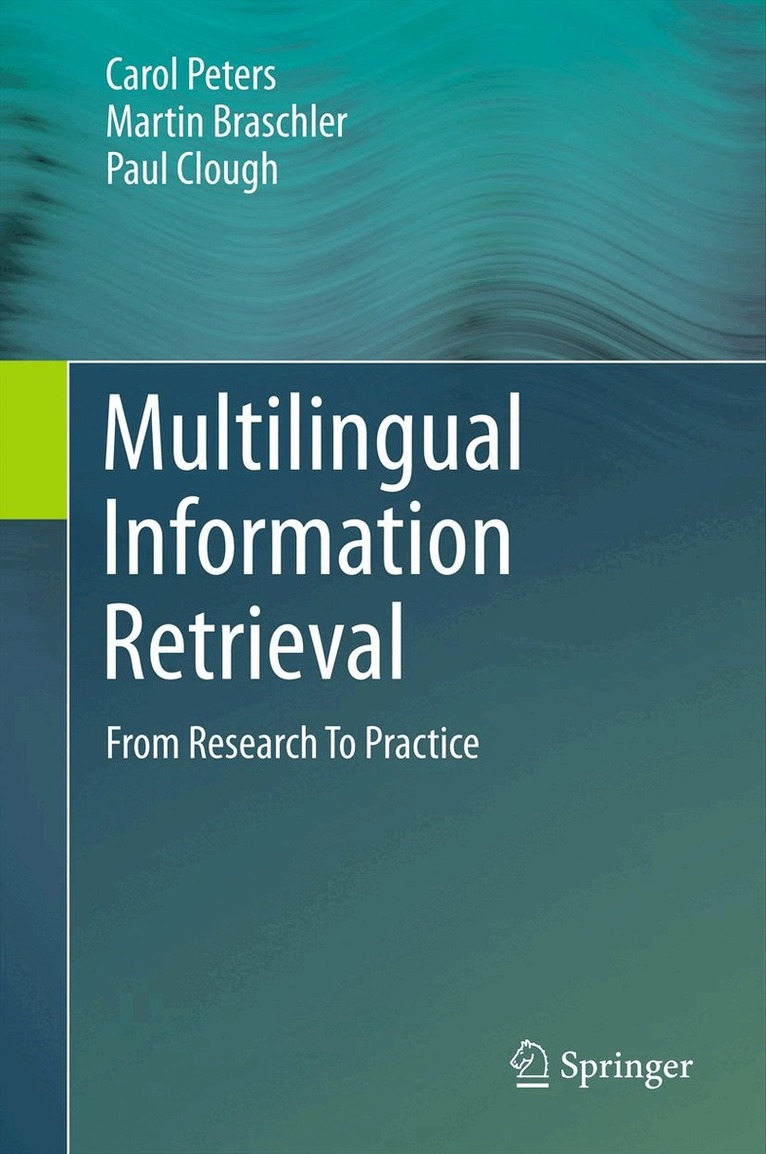
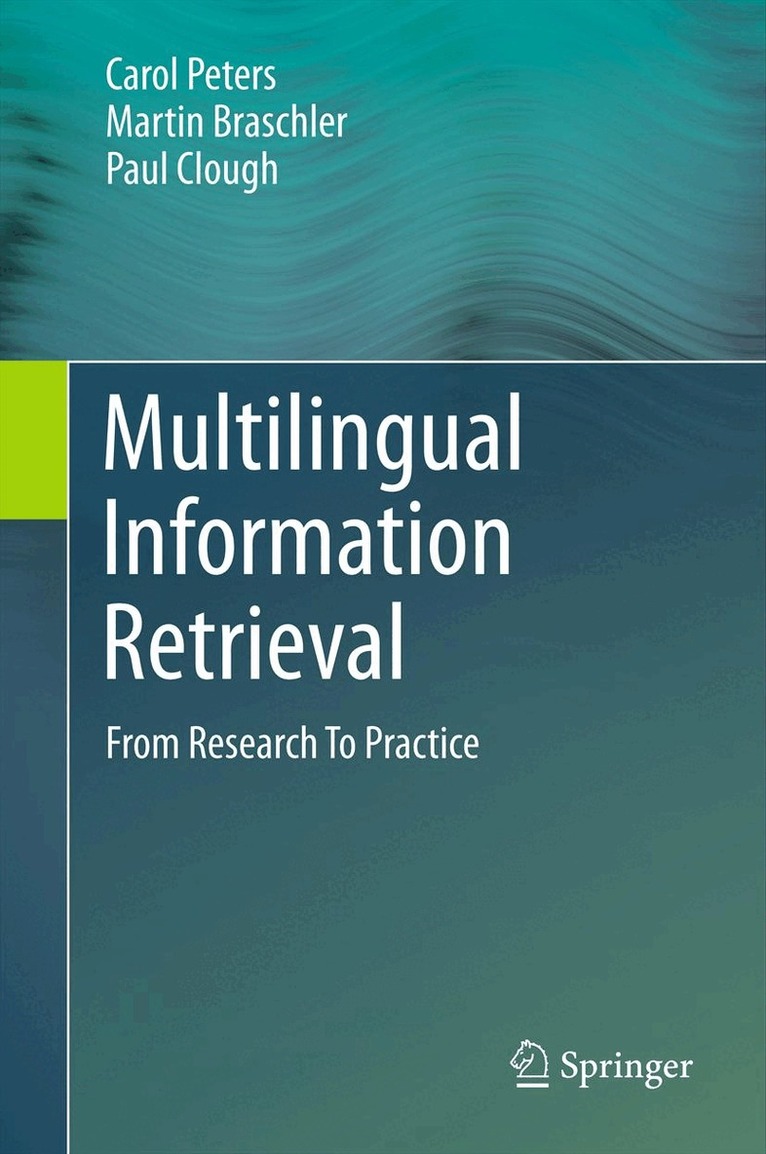
Multilingual Information Retrieval
From Research To Practice
Av Carol Peters, Martin Braschler m. fl.
Inbunden, 2012
568 kr
Lägg i varukorg
We are living in a multilingual world and the diversity in languages which are used to interact with information access systems has generated a wide variety of challenges to be addressed by computer and information scientists. The growing amount of non-English information accessible globally and …
Multilingual Information Retrieval
From Research To Practice
Av Paul Clough, Martin Braschler m. fl.
E-bok, 2012
755 kr
Lägg i varukorg
We are living in a multilingual world and the diversity in languages which are used to interact with information access systems has generated a wide variety of challenges to be addressed by computer and information scientists. The growing amount of non-English information accessible globally and …
Multilingual Information Retrieval
From Research To Practice
Av Carol Peters, Martin Braschler m. fl.
Häftad, 2014
568 kr
Lägg i varukorg
We are living in a multilingual world and the diversity in languages which are used to interact with information access systems has generated a wide variety of challenges to be addressed by computer and information scientists. The growing amount of non-English information accessible globally and …