Martin Marty – författare
Visar alla böcker från författaren Martin Marty. Handla med fri frakt och snabb leverans.
7 produkter
Varieties of Religious Experience
A Study in Human Nature
Av William James, Martin Marty
Häftad, 1983
147 kr
Lägg i varukorg
Standing at the crossroads of psychology and religion, this catalyzing work applied the scientific method to a field abounding in abstract theory. William James believed that individual religious experiences, rather than the precepts of organized religions, were the backbone of the world's …
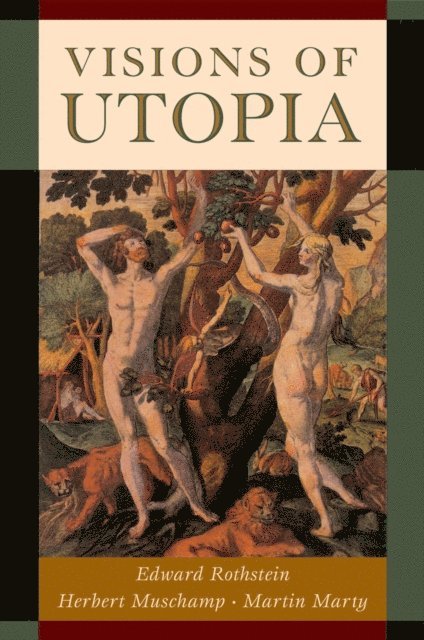
Visions of Utopia
Av Martin Marty, Herbert Muschamp m. fl.
E-bok, 2003
275 kr
Lägg i varukorg
From the sex-free paradise of the Shakers to the worker''s paradise of Marx, utopian ideas seem to have two things in common--they all are wonderfully plausible at the start and they all end up as disasters. In Visions of Utopia , three leading cultural critics--Edward Rothstein, Martin Marty, and …
Visions of Utopia
Av Edward Rothstein, Herbert Muschamp m. fl.
Inbunden, 2003
913 kr
Lägg i varukorg
From the sex-free paradise of the Shakers to the worker's paradise of Marx, utopian ideas seem to have two things in common--they all are wonderfully plausible at the start and they all end up as disasters. In Visions of Utopia, three leading cultural critics--Edward Rothstein, Martin Marty, and …
Visions of Utopia
Av Martin Marty, Herbert Muschamp m. fl.
E-bok, 2003
184 kr
Lägg i varukorg
From the sex-free paradise of the Shakers to the worker''s paradise of Marx, utopian ideas seem to have two things in common--they all are wonderfully plausible at the start and they all end up as disasters. In Visions of Utopia , three leading cultural critics--Edward Rothstein, Martin Marty, and …
Christian World
A Global History
Av Martin Marty
E-bok, 2008
147 kr
Lägg i varukorg
In this cogent volume, renowned Christian historian Martin Marty delivers a brief yet sweeping account of Christianity and how it spread from a few believers two thousand years ago to become the world’s largest religion. Comprising nearly one third of the world’s population–more than two billion …
Dr. Johann Martin Henni, erster Bischof und Erzbischof von Milwaukee
Ein Lebensbild aus der Pionierzeit von Ohio und Wisconsin
Av Martin Marty
Häftad, 2016
493 kr
Lägg i varukorg