Maschler Yael Maschler – författare
Visar alla böcker från författaren Maschler Yael Maschler. Handla med fri frakt och snabb leverans.
2 produkter
2 produkter
1 305 kr
Läs direkt efter köp
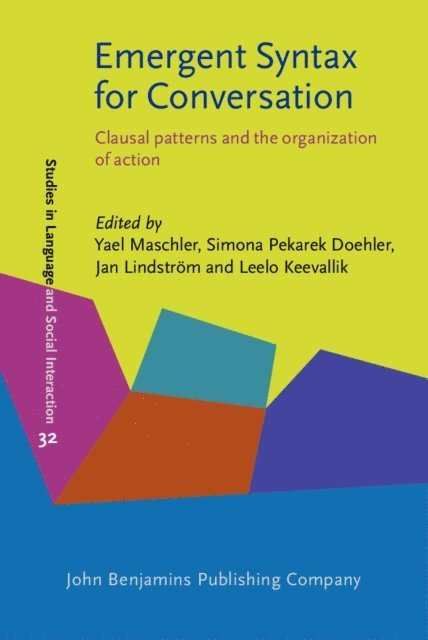
This volume explores how emergent patterns of complex syntax - that is, syntactic structures beyond a simple clause - relate to the local contingencies of action formation in social interaction. It examines both the on-line emergence of clause-combining patterns as they are 'patched together' on the fly, as well as their routinization and sedimentation into new grammatical patterns across a range of languages - English, Estonian, Finnish, French, German, Hebrew, Italian, Mandarin, and Swedish. The chapters investigate how the real-time organization of complex syntax relates to the unfolding of turns and actions, focusing on: (i) how complex syntactic patterns, or routinized fragments of 'canonical' patterns, serve as resources for projection, (ii) how complex syntactic patterns emerge incrementally, moment-by-moment, out of the real-time trajectories of action, (iii) how formal variants of such patterns relate to social action, and (iv) how all of these play out within the multimodal ecologies of action formation.The empirical findings presented in this volume lend support to a conception of syntax as fundamentally temporal, emergent, dialogic, sensitive to local interactional contingencies, and interwoven with other semiotic resources.
E-bok
PDF, Engelska, 20091 258 kr
Läs direkt efter köp
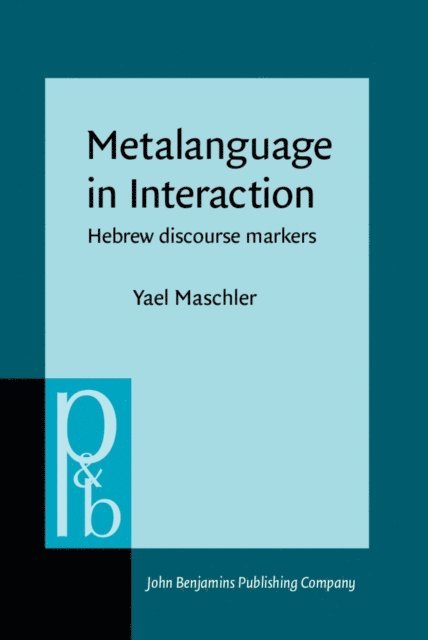
Metalanguage in Interaction is about the crystallization of metalanguage employed throughout interaction into the discourse markers which permeate talk. Based on close analysis of naturally-occurring Hebrew conversation, it is a synchronic study of the grammaticization of discourse markers, a phenomenon until now mostly studied from a diachronic perspective. It constitutes the first monograph in the fields of Hebrew interactional linguistics and Hebrew discourse markers. The book first presents what is unique to the present approach to discourse markers and gives them an operational definition. Discourse markers are explored as a system, illuminating their patterning in terms of function, structure, and the moments in interaction at which they are employed. Next, detailed analysis of four Hebrew discourse markers illuminates not only the functions and grammaticization patterns of these markers, but also what they reveal about quintessential aspects of Israeli society, identity, and culture. The conclusion discusses commonalities and differences in the grammaticization patterns of the four markers, and relates the grammaticization of discourse markers from interaction to projectability in discourse.