Matthew Foreman – författare
Visar alla böcker från författaren Matthew Foreman. Handla med fri frakt och snabb leverans.
3 produkter
3 produkter
10 582 kr
Skickas inom 10-15 vardagar
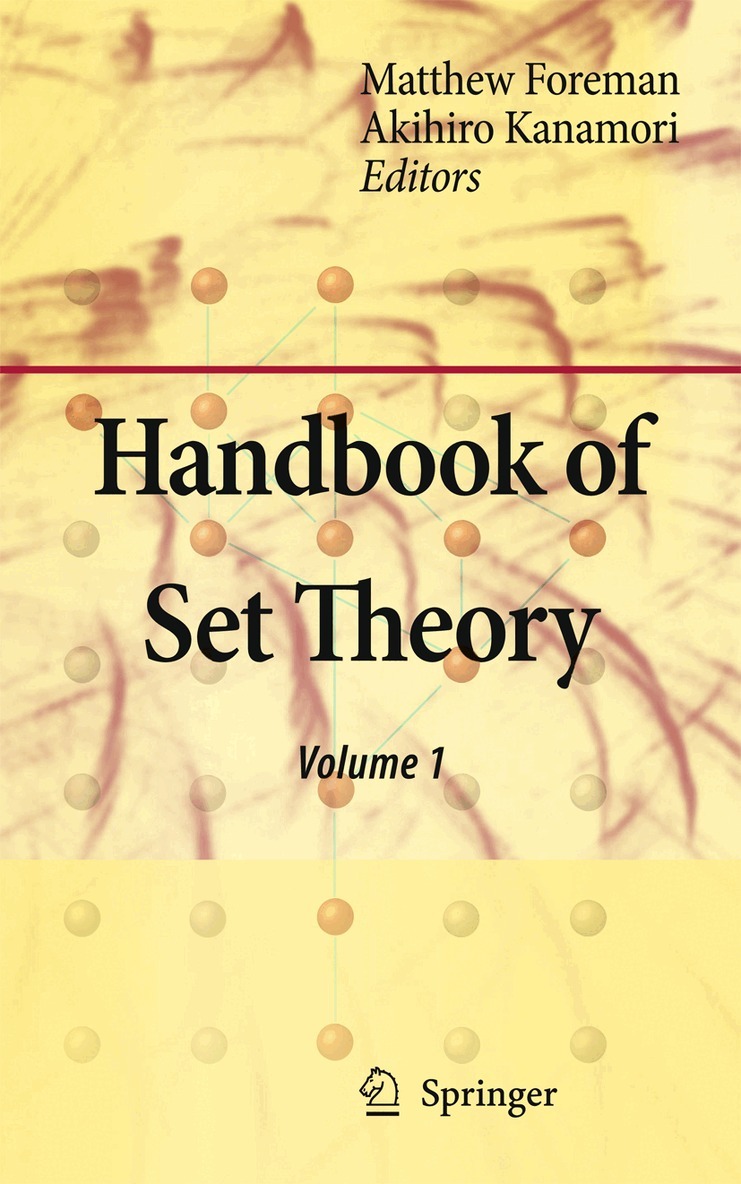
Numbers imitate space, which is of such a di?erent nature —Blaise Pascal It is fair to date the study of the foundation of mathematics back to the ancient Greeks. The urge to understand and systematize the mathematics of the time led Euclid to postulate axioms in an early attempt to put geometry on a ?rm footing. With roots in the Elements, the distinctive methodology of mathematics has become proof. Inevitably two questions arise: What are proofs? and What assumptions are proofs based on? The ?rst question, traditionally an internal question of the ?eld of logic, was also wrestled with in antiquity. Aristotle gave his famous syllogistic s- tems, and the Stoics had a nascent propositional logic. This study continued with ?ts and starts, through Boethius, the Arabs and the medieval logicians in Paris and London. The early germs of logic emerged in the context of philosophy and theology. The development of analytic geometry, as exempli?ed by Descartes, ill- tratedoneofthedi?cultiesinherentinfoundingmathematics. Itisclassically phrased as the question ofhow one reconciles the arithmetic with the geom- ric. Arenumbers onetypeofthingand geometricobjectsanother? Whatare the relationships between these two types of objects? How can they interact? Discovery of new types of mathematical objects, such as imaginary numbers and, much later, formal objects such as free groups and formal power series make the problem of ?nding a common playing ?eld for all of mathematics importunate. Several pressures made foundational issues urgent in the 19th century.
445 kr
Skickas inom 3-6 vardagar
The Modern AGE Basic Rulebook and its supplements present a hugely flexible toolkit that can handle anything from alternate history and gothic horror to urban fantasy and post-apocalyptic adventures. Now Modern AGE Powers is here with the definitive expansion of the game’s extraordinary abilities. Covering magic, psychic phenomena, mutations, exotic origins, and extraordinary items, this book provides support for everything from technologically superpowered heroes to cyberpunk post-humans. Though designed for Modern AGE, Powers is also useful for GMs of other Adventure Game Engine RPGs, like Fantasy AGE and Blue Rose.
10 582 kr
Skickas inom 10-15 vardagar
Numbers imitate space, which is of such a di?erent nature —Blaise Pascal It is fair to date the study of the foundation of mathematics back to the ancient Greeks. The urge to understand and systematize the mathematics of the time led Euclid to postulate axioms in an early attempt to put geometry on a ?rm footing. With roots in the Elements, the distinctive methodology of mathematics has become proof. Inevitably two questions arise: What are proofs? and What assumptions are proofs based on? The ?rst question, traditionally an internal question of the ?eld of logic, was also wrestled with in antiquity. Aristotle gave his famous syllogistic s- tems, and the Stoics had a nascent propositional logic. This study continued with ?ts and starts, through Boethius, the Arabs and the medieval logicians in Paris and London. The early germs of logic emerged in the context of philosophy and theology. The development of analytic geometry, as exempli?ed by Descartes, ill- tratedoneofthedi?cultiesinherentinfoundingmathematics. Itisclassically phrased as the question ofhow one reconciles the arithmetic with the geom- ric. Arenumbers onetypeofthingand geometricobjectsanother? Whatare the relationships between these two types of objects? How can they interact? Discovery of new types of mathematical objects, such as imaginary numbers and, much later, formal objects such as free groups and formal power series make the problem of ?nding a common playing ?eld for all of mathematics importunate. Several pressures made foundational issues urgent in the 19th century.