Matthew T. Page – författare
Visar alla böcker från författaren Matthew T. Page. Handla med fri frakt och snabb leverans.
6 produkter
6 produkter
Inbunden, Engelska, 2018
797 kr
Skickas inom 5-8 vardagar
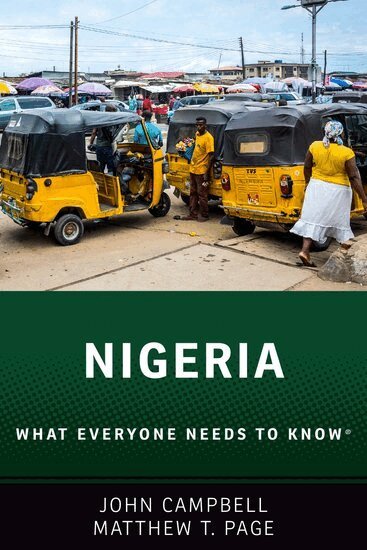
As the "Giant of Africa," Nigeria is home to about twenty percent of the population of Sub-Saharan Africa, serves as Africa's largest producer of oil and natural gas, comprises Africa's largest economy, and represents the cultural center of African literature, film, and music. Yet it is plagued by problems that keep it from realizing its potential as a world power. Boko Haram, a radical, Islamist insurrection centered in the northeast of the country, is a pervasive security challenge, as is the continuous restiveness in the Niger Delta, the heartland of Nigeria's petroleum wealth. The former seeks to destroy the secular Nigerian state; the latter reflects the popular sentiment in the region that the Nigerian people are entitled to a greater share of the wealth it produces. There is also persistent violence associated with land and water use, ethnicity, and religion.In Nigeria: What Everyone Needs to Know®, John Campbell and Matthew Page provide a rich contemporary overview of this crucial African country. Delving into Nigeria's recent history, politics, and culture, this volume tackles essential questions related to widening inequality stemming from Nigeria's oil wealth, its historic 2015 presidential election, the persistent security threat of Boko Haram, rampant government corruption, human rights concerns, and the continual conflicts that arise in a country that is roughly half Christian and half Muslim.With its continent-wide influence in a host of areas, Nigeria's success as a democracy is in the fundamental interest of its African neighbors, the United States, and the international community. This book will provide interested readers with an accessible, one-of-a-kind overview of this significant country.
Häftad, Engelska, 2018
124 kr
Skickas
As the "Giant of Africa," Nigeria is home to about twenty percent of the population of Sub-Saharan Africa, serves as Africa's largest producer of oil and natural gas, comprises Africa's largest economy, and represents the cultural center of African literature, film, and music. Yet it is plagued by problems that keep it from realizing its potential as a world power. Boko Haram, a radical, Islamist insurrection centered in the northeast of the country, is a pervasive security challenge, as is the continuous restiveness in the Niger Delta, the heartland of Nigeria's petroleum wealth. The former seeks to destroy the secular Nigerian state; the latter reflects the popular sentiment in the region that the Nigerian people are entitled to a greater share of the wealth it produces. There is also persistent violence associated with land and water use, ethnicity, and religion.In Nigeria: What Everyone Needs to Know, John Campbell and Matthew Page provide a rich contemporary overview of this crucial African country. Delving into Nigeria's recent history, politics, and culture, this volume tackles essential questions related to widening inequality stemming from Nigeria's oil wealth, its historic 2015 presidential election, the persistent security threat of Boko Haram, rampant government corruption, human rights concerns, and the continual conflicts that arise in a country that is roughly half Christian and half Muslim.With its continent-wide influence in a host of areas, Nigeria's success as a democracy is in the fundamental interest of its African neighbors, the United States, and the international community. This book will provide interested readers with an accessible, one-of-a-kind overview of this significant country.
E-bok
PDF, Engelska, 2018112 kr
Läs direkt efter köp
As the "Giant of Africa" Nigeria is home to about twenty percent of the population of Sub-Saharan Africa, serves as Africa''s largest producer of oil and natural gas, comprises Africa''s largest economy, and represents the cultural center of African literature, film, and music. Yet the country is plagued by problems that keep it from realizing its potential as a world power. Boko Haram, a radical Islamist insurrection centered in the northeast of the country, is an ongoing security challenge, as is the continuous unrest in the Niger Delta, the heartland of Nigeria''s petroleum wealth. There is also persistent violence associated with land and water use, ethnicity, and religion.In Nigeria: What Everyone Needs to Know®, John Campbell and Matthew Page provide a rich contemporary overview of this crucial African country. Delving into Nigeria''s recent history, politics, and culture, this volume tackles essential questions related to widening inequality, the historic 2015 presidential election, the persistent security threat of Boko Haram, rampant government corruption, human rights concerns, and the continual conflicts that arise in a country that is roughly half Christian and half Muslim.With its continent-wide influence in a host of areas, Nigeria''s success as a democracy is in the fundamental interest of its African neighbors, the United States, and the international community. This book will provide interested readers with an accessible, one-of-a-kind overview of the country.
E-bok
Engelska, 2018112 kr
Läs direkt efter köp
As the "Giant of Africa" Nigeria is home to about twenty percent of the population of Sub-Saharan Africa, serves as Africa''s largest producer of oil and natural gas, comprises Africa''s largest economy, and represents the cultural center of African literature, film, and music. Yet the country is plagued by problems that keep it from realizing its potential as a world power. Boko Haram, a radical Islamist insurrection centered in the northeast of the country, is an ongoing security challenge, as is the continuous unrest in the Niger Delta, the heartland of Nigeria''s petroleum wealth. There is also persistent violence associated with land and water use, ethnicity, and religion.In Nigeria: What Everyone Needs to Know®, John Campbell and Matthew Page provide a rich contemporary overview of this crucial African country. Delving into Nigeria''s recent history, politics, and culture, this volume tackles essential questions related to widening inequality, the historic 2015 presidential election, the persistent security threat of Boko Haram, rampant government corruption, human rights concerns, and the continual conflicts that arise in a country that is roughly half Christian and half Muslim.With its continent-wide influence in a host of areas, Nigeria''s success as a democracy is in the fundamental interest of its African neighbors, the United States, and the international community. This book will provide interested readers with an accessible, one-of-a-kind overview of the country.
Inbunden, Engelska, 2027
778 kr
Kommande
Kleptocracy is often invoked as shorthand for corruption, yet its meaning and impact are far more complex. In this book, Matthew Page unpacks the concept, tracing how regimes built on theft operate across political systems and continents. Exploring why kleptocracy matters for both foreign and domestic politics, Page reveals how it shapes global security, economic inequality, and democratic resilience. Using vivid case studies, from Romania under Ceausescu to South Sudan and Azerbaijan, and drawing on historical analysis and contemporary examples, Page shows how democracies have enabled kleptocratic networks and why these dynamics threaten governance worldwide. Accessible and deeply researched, it offers readers a framework for understanding kleptocracy’s evolution and practical steps to curb its influence.
Häftad, Engelska, 2027
268 kr
Kommande
Kleptocracy is often invoked as shorthand for corruption, yet its meaning and impact are far more complex. In this book, Matthew Page unpacks the concept, tracing how regimes built on theft operate across political systems and continents. Exploring why kleptocracy matters for both foreign and domestic politics, Page reveals how it shapes global security, economic inequality, and democratic resilience. Using vivid case studies, from Romania under Ceausescu to South Sudan and Azerbaijan, and drawing on historical analysis and contemporary examples, Page shows how democracies have enabled kleptocratic networks and why these dynamics threaten governance worldwide. Accessible and deeply researched, it offers readers a framework for understanding kleptocracy’s evolution and practical steps to curb its influence.