Maurizio Ferrera - Böcker
Visar alla böcker från författaren Maurizio Ferrera. Handla med fri frakt och snabb leverans.
9 produkter
9 produkter
1 871 kr
Skickas inom 5-8 vardagar
The starting point of this book is the 'civil war' of ideas that broke out during the early 2010s about the purpose and even the desirability of the European Union as a polity, with a number of right-wing populist formations openly advocating for exiting the Union. The sovereign debt crisis triggered a spiral of ideological decommunalization: national leaders seemed to have lost that sense of 'togetherness' and mutual bonds that had been laboriously developed over decades of integration. Politics and Social Visions explores this politically disruptive process from an ideational perspective, on the assumption that symbols and visions play a crucial role. In processes of polity formation, ideologies offer competing partisan views, but tend to converge along the 'communal' dimension, which defines the nature and boundaries of the emerging polity. This convergence has been a challenge for the EU since its origins, as it has required the construction of a coherent and acceptable image of Europe as a compound polity of nation-states with a divisive past. Maurizio Ferrera offers a reconstruction of how the main ideological currents have struggled - and often failed - to reconfigure their horizontal profiles (i.e. their images of the national within Europe) into a new vertical profile (i.e. an image of the European within the national). The challenge has been especially demanding for European left-wing parties, which have been largely unable to forge a shared and recognizable 'social vision' of the European Union. Only during the COVID pandemic have the seeds of a novel communal consensus emerged that might prove capable of defeating the anti-communal views of Eurosceptic ideologies and free market technocrats.
509 kr
Skickas inom 5-8 vardagar
The starting point of this book is the 'civil war' of ideas that broke out during the early 2010s about the purpose and even the desirability of the European Union as a polity, with a number of right-wing populist formations openly advocating for exiting the Union. The sovereign debt crisis triggered a spiral of ideological decommunalization: national leaders seemed to have lost that sense of 'togetherness' and mutual bonds that had been laboriously developed over decades of integration. Politics and Social Visions explores this politically disruptive process from an ideational perspective, on the assumption that symbols and visions play a crucial role. In processes of polity formation, ideologies offer competing partisan views, but tend to converge along the 'communal' dimension, which defines the nature and boundaries of the emerging polity. This convergence has been a challenge for the EU since its origins, as it has required the construction of a coherent and acceptable image of Europe as a compound polity of nation-states with a divisive past. Maurizio Ferrera offers a reconstruction of how the main ideological currents have struggled - and often failed - to reconfigure their horizontal profiles (i.e. their images of the national within Europe) into a new vertical profile (i.e. an image of the European within the national). The challenge has been especially demanding for European left-wing parties, which have been largely unable to forge a shared and recognizable 'social vision' of the European Union. Only during the COVID pandemic have the seeds of a novel communal consensus emerged that might prove capable of defeating the anti-communal views of Eurosceptic ideologies and free market technocrats.
The Boundaries of Welfare
European Integration and the New Spatial Politics of Social Protection
Inbunden, Engelska, 2005
1 122 kr
Skickas inom 3-6 vardagar
To what extent has the process of European integration re-drawn the boundaries of national welfare states? What are the effects of such re-drawing? Boundaries count: they are essential in bringing together individuals, groups, and territorial units, and for activating or strengthening shared ties between them. If the profile of boundaries changes over time, we might expect significant consequences on bonding dynamics, i.e. on the way solidarity is structured in a given political community. The book addresses these two questions in a broad historical and comparative perspective. The first chapter sets out a novel theoretical framework which re-conceptualizes the welfare state as a 'bounded space' characterized by a distinct spatial politics. This reconceptualization takes as a starting point the 'state-building tradition' in political science and in particular the work of Stein Rokkan. The second chapter briefly outlines the early emergence and expansion of European welfare states till World War II. Chapters 3 and 4 analyse the relationship between domestic welfare state developments and the formation of a supranational European Community between the 1960s and the 2000s, illustrating how the process of European integration has increasingly eroded the social sovereignty of the nation-state. Chapter 5 focuses on new emerging forms of sub-national and trans-national social protection, while Chapter 6 discusses current trends and future perspectives for a re-structuring of social protection at the EU level.While there is no doubt that European integration has significantly altered the boundaries of national welfare, de-stabilizing delicate political and institutional equilibria, the book concludes by offering some suggestions on how a viable system of multi-level social protection could possibly emerge within the new EU wide boundary configuration.
The Boundaries of Welfare
European Integration and the New Spatial Politics of Social Protection
Häftad, Engelska, 2005
751 kr
Skickas inom 5-8 vardagar
To what extent has the process of European integration re-drawn the boundaries of national welfare states? What are the effects of such re-drawing? Boundaries count: they are essential in bringing together individuals, groups, and territorial units, and for activating or strengthening shared ties between them. If the profile of boundaries changes over time, we might expect significant consequences on bonding dynamics, i.e. on the way solidarity is structured in a given political community. The book addresses these two questions in a broad historical and comparative perspective. The first chapter sets out a novel theoretical framework which re-conceptualizes the welfare state as a 'bounded space' characterized by a distinct spatial politics. This reconceptualization takes as a starting point the 'state-building tradition' in political science and in particular the work of Stein Rokkan. The second chapter briefly outlines the early emergence and expansion of European welfare states till World War II. Chapters 3 and 4 analyse the relationship between domestic welfare state developments and the formation of a supranational European Community between the 1960s and the 2000s, illustrating how the process of European integration has increasingly eroded the social sovereignty of the nation-state. Chapter 5 focuses on new emerging forms of sub-national and trans-national social protection, while Chapter 6 discusses current trends and future perspectives for a re-structuring of social protection at the EU level.While there is no doubt that European integration has significantly altered the boundaries of national welfare, de-stabilizing delicate political and institutional equilibria, the book concludes by offering some suggestions on how a viable system of multi-level social protection could possibly emerge within the new EU wide boundary configuration.
Welfare State Reform in Southern Europe
Fighting Poverty and Social Exclusion in Greece, Italy, Spain and Portugal
Inbunden, Engelska, 2005
2 021 kr
Skickas inom 10-15 vardagar
This new study delivers a detailed analysis of the efforts being made to reduce poverty and social exclusion in Portugal, Spain, Italy and Greece. After an initial discussion of the 'southern model' of the welfare state, the situation of each country is clearly illustrated. This book also discusses how the experience of southern Europe might bear upon the situation of the East European accession countries. This is excellent reading for those interested in social change across Europe and beyond.
Welfare State Reform in Southern Europe
Fighting Poverty and Social Exclusion in Greece, Italy, Spain and Portugal
Häftad, Engelska, 2008
807 kr
Skickas inom 10-15 vardagar
This new study delivers a detailed analysis of the efforts being made to reduce poverty and social exclusion in Portugal, Spain, Italy and Greece. After an initial discussion of the 'southern model' of the welfare state, the situation of each country is clearly illustrated. This book also discusses how the experience of southern Europe might bear upon the situation of the East European accession countries. This is excellent reading for those interested in social change across Europe and beyond.
1 369 kr
Skickas inom 10-15 vardagar
This volume presents research on the recasting of European welfare states from the European Forum on Welfare at the European University Institute in Florence. The chapters include both comparative analyses of topical issues, and in-depth studies of changes in the major European countries.
427 kr
Skickas inom 10-15 vardagar
This volume presents research on the recasting of European welfare states from the European Forum on Welfare at the European University Institute in Florence. The chapters include both comparative analyses of topical issues, and in-depth studies of changes in the major European countries.
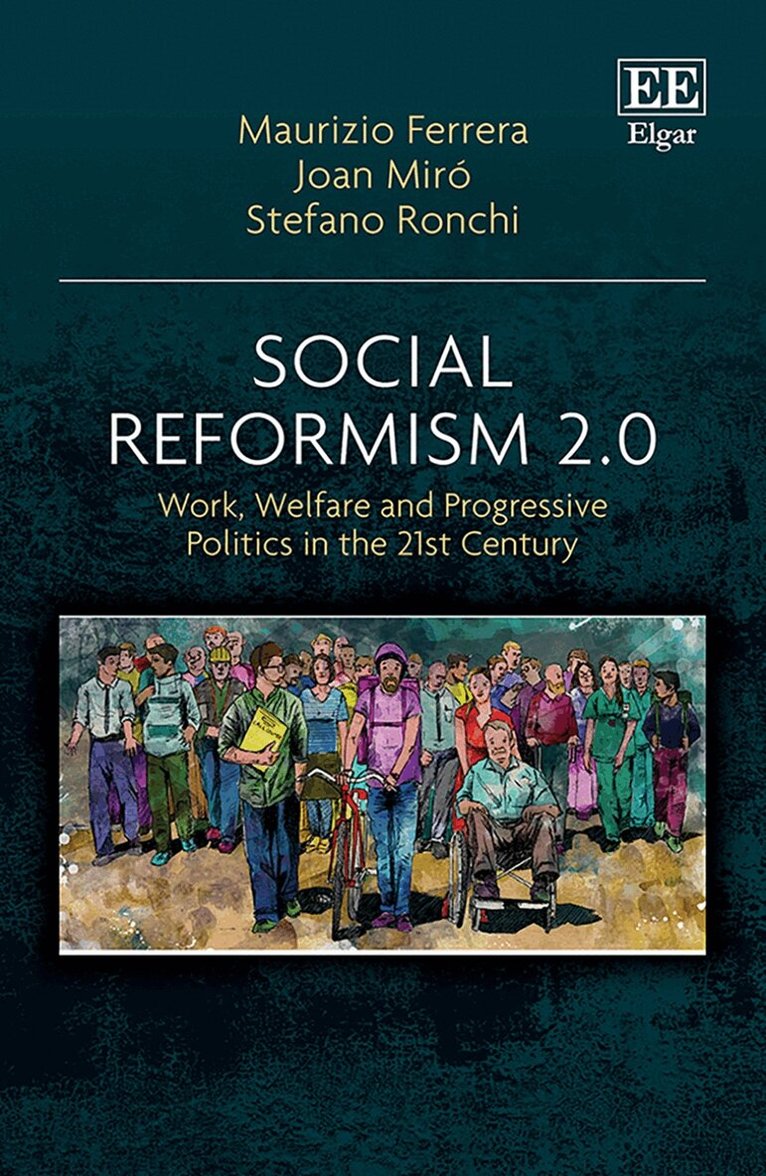
Social Reformism 2.0
Work, Welfare and Progressive Politics in the 21st Century
Inbunden, Engelska, 2024
1 431 kr
Skickas inom 7-10 vardagar
Automation, digitalisation, the post-industrial transition and climate change are creating new social risks which are not adequately supported by established welfare state institutions. In this timely book, Maurizio Ferrera, Joan Miró and Stefano Ronchi propose critical social and institutional policy reform in response to the nation state’s inability to maintain a balanced ecosystem between democracy, the market economy, welfare and the rule of law. Social Reformism 2.0 provides a diagnosis of the critical issues facing the welfare state, namely the transition to post-industrialisation, globalisation and European integration, and the fourth technological revolution. Situating the European social model within a multi-crisis context, this book surveys the current reform trends in social policy, addressing decades of global development, the COVID-19 pandemic, and the climate emergency, before proposing a number of strategic policy reforms. It ultimately champions a transition towards a greener economy and a realignment of progressive politics, highlighting the central role Europe plays in coordinating and stimulating change. Offering a highly detailed yet accessible critique, this socially pertinent study will strongly appeal to students and academics with an interest in political science, European studies, sociology, social and public policy analysis and welfare state research. It will also highly benefit policymakers, bureaucrats, practitioners and stakeholders involved in social governance processes at a national and European level.