Michael Edson – författare
Visar alla böcker från författaren . Handla med fri frakt och snabb leverans.
11 produkter
11 produkter
Häftad, Engelska, 2024
204 kr
Skickas inom 5-8 vardagar
Häftad, Engelska, 2020
153 kr
Skickas inom 5-8 vardagar
Häftad, Engelska, 2020
158 kr
Skickas inom 5-8 vardagar
Häftad, Engelska, 2021
386 kr
Skickas inom 5-8 vardagar
Häftad, Engelska, 2020
214 kr
Skickas inom 3-6 vardagar
Inbunden, Engelska, 2017
1 424 kr
Skickas inom 10-15 vardagar
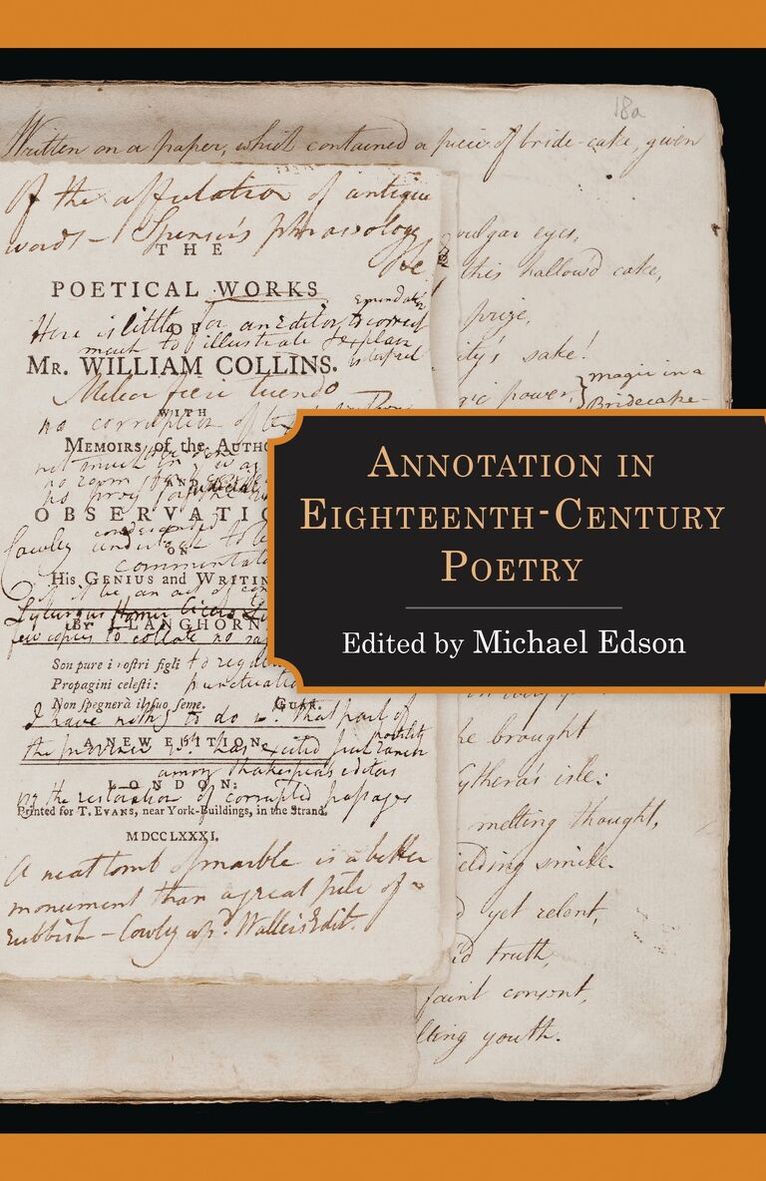
Recent years have witnessed a growing fascination with the printed annotations accompanying eighteenth-century texts. Previous studies of annotation have revealed the margins as dynamic textual spaces both shaping and shaped by diverse aesthetic, historical, and political sensibilities. Yet previous studies have also been restricted to notes by or for canonical figures; they have neglected annotation’s relation to developments in reading audiences and the book trade; and they have overlooked the interaction, even tension, between prose notes and poetry, a tension reflecting eighteenth-century views of poetry as aesthetically superior to prose. Annotation in Eighteenth-Century Poetry addresses these oversights through a substantial introduction and eleven essays analyzing the printed endnotes and footnotes accompanying poems written or annotated between 1700 and 1830. Drawing on methods and critical developments in book history and print culture studies, this collection explores the functions that annotation performed on and through the printed page. By analyzing the annotation specific to poetry, these essays clarify the functions of notes among the other paratexts, including illustrations, by which scholars have mapped poetry’s relation to the expanding book trade and the class-specific production of different formats. Because the reading and writing of poetry boasted social and pedagogical functions that predate the rise of the note as a print technology, studying the relation of notes to poetry also reveals how the evolving layout of the eighteenth-century book wrought significant changes not only on reading practices and reception, but on the techniques that booksellers used to make new poems, steady-sellers, and antiquarian discoveries legible to new readers. Above all, analyzing notes in poetry volumes contributes to larger inquiries into canon formation and the rise of literary studies as a discipline in the eighteenth century.
E-bok
Engelska, 2017660 kr
Läs direkt efter köp
Recent years have witnessed a growing fascination with the printed annotations accompanying eighteenth-century texts. Previous studies of annotation have revealed the margins as dynamic textual spaces both shaping and shaped by diverse aesthetic, historical, and political sensibilities. Yet previous studies have also been restricted to notes by or for canonical figures; they have neglected annotation’s relation to developments in reading audiences and the book trade; and they have overlooked the interaction, even tension, between prose notes and poetry, a tension reflecting eighteenth-century views of poetry as aesthetically superior to prose. Annotation in Eighteenth-Century Poetry addresses these oversights through a substantial introduction and eleven essays analyzing the printed endnotes and footnotes accompanying poems written or annotated between 1700 and 1830. Drawing on methods and critical developments in book history and print culture studies, this collection explores the functions that annotation performed on and through the printed page. By analyzing the annotation specific to poetry, these essays clarify the functions of notes among the other paratexts, including illustrations, by which scholars have mapped poetry’s relation to the expanding book trade and the class-specific production of different formats. Because the reading and writing of poetry boasted social and pedagogical functions that predate the rise of the note as a print technology, studying the relation of notes to poetry also reveals how the evolving layout of the eighteenth-century book wrought significant changes not only on reading practices and reception, but on the techniques that booksellers used to make new poems, steady-sellers, and antiquarian discoveries legible to new readers. Above all, analyzing notes in poetry volumes contributes to larger inquiries into canon formation and the rise of literary studies as a discipline in the eighteenth century.
Häftad, Engelska, 2020
606 kr
Skickas inom 10-15 vardagar
Recent years have witnessed a growing fascination with the printed annotations accompanying eighteenth-century texts. Previous studies of annotation have revealed the margins as dynamic textual spaces both shaping and shaped by diverse aesthetic, historical, and political sensibilities. Yet previous studies have also been restricted to notes by or for canonical figures; they have neglected annotation’s relation to developments in reading audiences and the book trade; and they have overlooked the interaction, even tension, between prose notes and poetry, a tension reflecting eighteenth-century views of poetry as aesthetically superior to prose. Annotation in Eighteenth-Century Poetry addresses these oversights through a substantial introduction and eleven essays analyzing the printed endnotes and footnotes accompanying poems written or annotated between 1700 and 1830. Drawing on methods and critical developments in book history and print culture studies, this collection explores the functions that annotation performed on and through the printed page. By analyzing the annotation specific to poetry, these essays clarify the functions of notes among the other paratexts, including illustrations, by which scholars have mapped poetry’s relation to the expanding book trade and the class-specific production of different formats. Because the reading and writing of poetry boasted social and pedagogical functions that predate the rise of the note as a print technology, studying the relation of notes to poetry also reveals how the evolving layout of the eighteenth-century book wrought significant changes not only on reading practices and reception, but on the techniques that booksellers used to make new poems, steady-sellers, and antiquarian discoveries legible to new readers. Above all, analyzing notes in poetry volumes contributes to larger inquiries into canon formation and the rise of literary studies as a discipline in the eighteenth century.
Inbunden, Engelska, 2015
1 582 kr
Skickas inom 10-15 vardagar
Publishing, Editing, and Reception is a collection of twelve essays honoring Professor Donald H. Reiman, who moved to the University of Delaware in 1992. The essays, written by friends, students, and collaborators, reflect the scholarly interests that defined Reiman’s long career. Mirroring the focus of Reiman’s work during his years at Carl H. Pforzheimer Library in New York and as lead editor of Shelley and his Circle, 1773–1822 (Harvard University Press), the essays in this collection explore authors such as Mary Shelley, William Hazlitt, Lord Byron and Percy Bysshe Shelley; moreover, they confirm the continuing influence of Reiman’s writings in the fields of editing and British Romanticism. Ranging from topics such as Byron’s relationship with his publisher John Murray and the reading practices in the Shelley circle to Rudyard Kipling’s response to Shelley’s politics, these essays draw on a dazzling variety of published and manuscript sources while engaging directly with many of Reiman’s most influential theories and arguments.
E-bok
Engelska, 20151 735 kr
Läs direkt efter köp
Publishing, Editing, and Reception is a collection of twelve essays honoring Professor Donald H. Reiman, who moved to the University of Delaware in 1992. The essays, written by friends, students, and collaborators, reflect the scholarly interests that defined Reiman’s long career. Mirroring the focus of Reiman’s work during his years at Carl H. Pforzheimer Library in New York and as lead editor of Shelley and his Circle, 1773–1822 (Harvard University Press), the essays in this collection explore authors such as Mary Shelley, William Hazlitt, Lord Byron and Percy Bysshe Shelley; moreover, they confirm the continuing influence of Reiman’s writings in the fields of editing and British Romanticism. Ranging from topics such as Byron’s relationship with his publisher John Murray and the reading practices in the Shelley circle to Rudyard Kipling’s response to Shelley’s politics, these essays draw on a dazzling variety of published and manuscript sources while engaging directly with many of Reiman’s most influential theories and arguments.
Inbunden, Engelska, 2023
2 299 kr
Skickas inom 5-8 vardagar
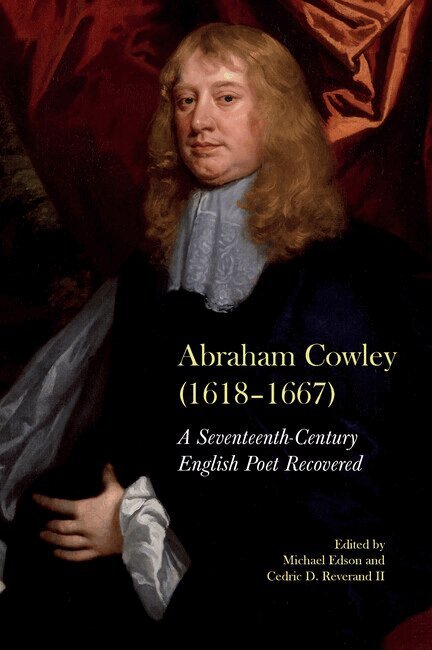
Featuring nine chapters by a group of internationally renowned scholars, this book recovers Cowley’s unique achievement as a poet working across and between the genres and disciplines of his time and of our own. When Cowley died, he was the most famous poet in England, and his popularity continued throughout the eighteenth century; for instance, he was much more widely published than Donne, Herbert, Marvell, or Crashaw. Yet Cowley has virtually disappeared from the canon today, even from collections of metaphysical poetry, although it was Cowley who occasioned Samuel Johnson’s famous definition of metaphysical poetry in the first place. What circumstances led to Cowley’s sudden, precipitous fall? This book argues that Cowley’s initial popularity and later fall in reputation have a similar origin: the experimental qualities, and the range, of his poetry. Cowley’s works bridge disciplines (science, poetry), modes (prose, verse), and genres (lyric, ode, epic) in unexpected ways. The same mixed, eccentric, digressive, and unfinished qualities that endeared Cowley’s poetry to his contemporaries doomed his reputation for later readers unable to deal with his idiosyncratic style and defiance of recognized categories. Arguing that he mixed neoclassical and baroque, metaphysical and baroque, cavalier and metaphysical, poetry and prose, epic and history, science and verse, the contributors to this book reveal Cowley as a kaleidoscopic mind whose challenging writings fell between established categories and therefore fell through the cracks of literary history.