Michael Greenacre – författare
Visar alla böcker från författaren Michael Greenacre. Handla med fri frakt och snabb leverans.
18 produkter
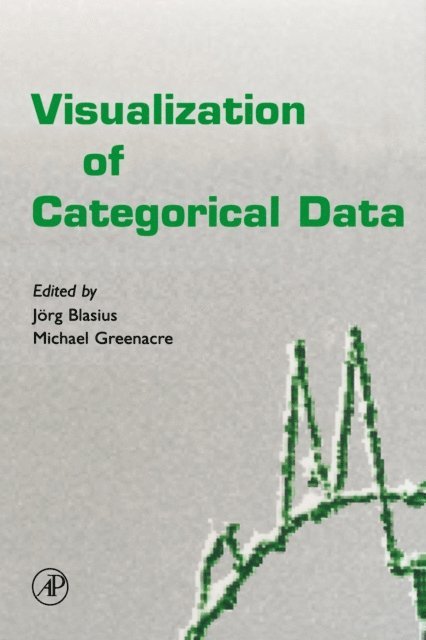
Visualization of Categorical Data
Av Michael Greenacre, Jorg Blasius
E-bok, 1998
1119 kr
Lägg i varukorg
A unique and timely monograph, Visualization of Categorical Data contains a useful balance of theoretical and practical material on this important new area. Top researchers in the field present the books four main topics: visualization, correspondence analysis, biplots and multidimensional scaling, …
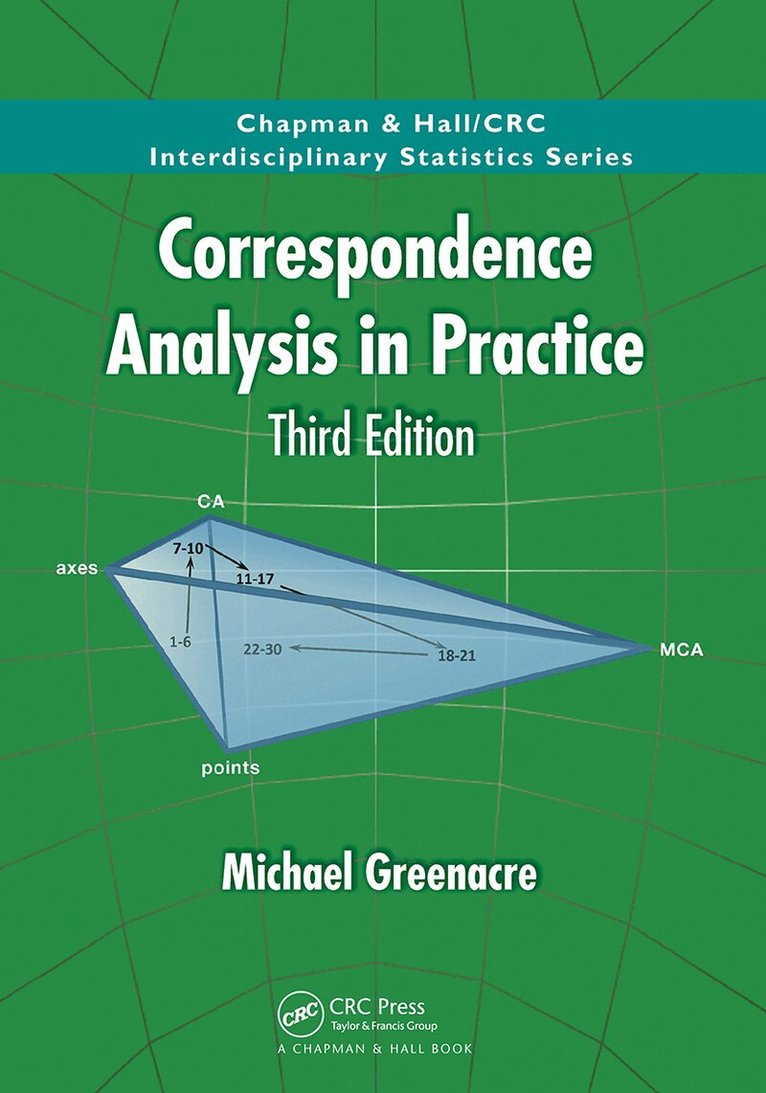
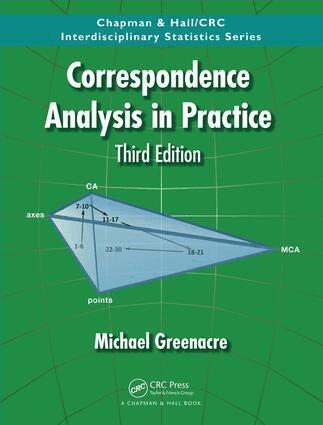
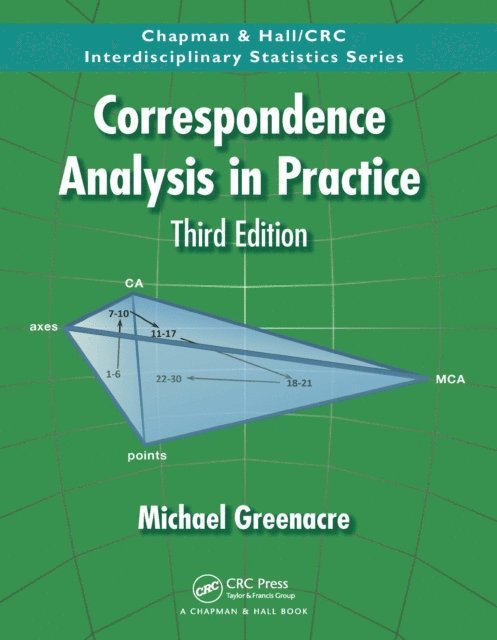
Correspondence Analysis in Practice
Häftad, 2021
866 kr
Lägg i varukorg
Drawing on the author’s 45 years of experience in multivariate analysis, Correspondence Analysis in Practice, Third Edition, shows how the versatile method of correspondence analysis (CA) can be used for data visualization in a wide variety of situations. CA and its variants, subset CA, multiple CA …
Compositional Data Analysis in Practice
E-bok, 2018
866 kr
Lägg i varukorg
Compositional data are quantitative descriptions of the parts of some whole, conveying exclusively relative information. Examples are found in various fields, including geology, medicine, chemistry, agriculture, economics, social science, etc. This concise book presents a very applied introduction …
Compositional Data Analysis in Practice
E-bok, 2018
866 kr
Lägg i varukorg
Compositional data are quantitative descriptions of the parts of some whole, conveying exclusively relative information. Examples are found in various fields, including geology, medicine, chemistry, agriculture, economics, social science, etc. This concise book presents a very applied introduction …
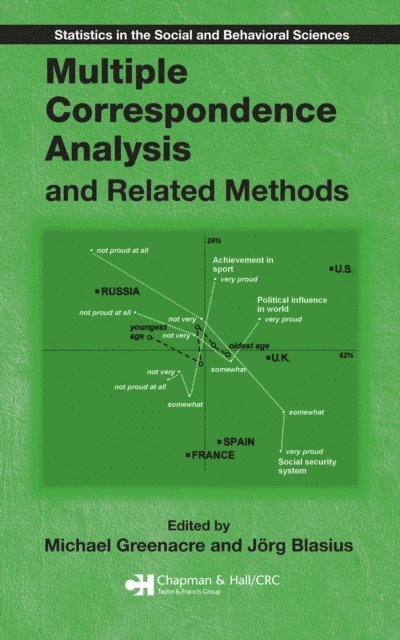
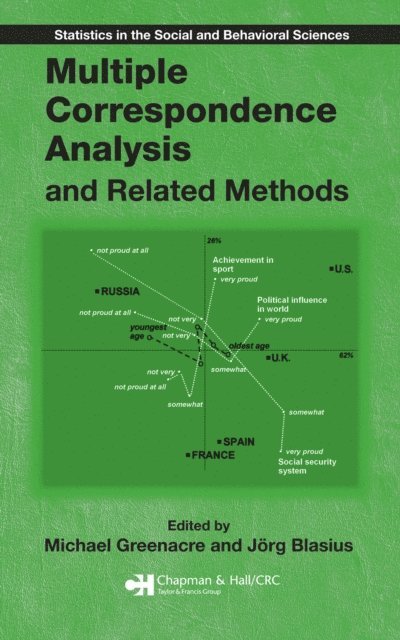
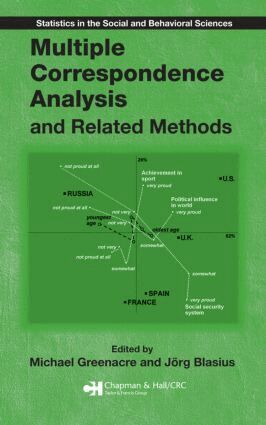
Multiple Correspondence Analysis and Related Methods
Av Jorg Blasius, Michael Greenacre
E-bok, 2006
3065 kr
Lägg i varukorg
As a generalization of simple correspondence analysis, multiple correspondence analysis (MCA) is a powerful technique for handling larger, more complex datasets, including the high-dimensional categorical data often encountered in the social sciences, marketing, health economics, and biomedical …
Visualization and Verbalization of Data
Av Michael Greenacre, Jorg Blasius
E-bok, 2014
1000 kr
Lägg i varukorg
Visualization and Verbalization of Data shows how correspondence analysis and related techniques enable the display of data in graphical form, which results in the verbalization of the structures in data. Renowned researchers in the field trace the history of these techniques and cover their …
Compositional Data Analysis in Practice
Inbunden, 2026
2101 kr
Kommande
“This book would make for a wonderful one semester course in applied multivariate statistics, suitable for upper-level undergraduates who are masters students in data science.”~Trevor Hastie, The John A. Overdeck Professor, Professor of Statistics and Biomedical Data Science (emeritus), Stanford …
Compositional Data Analysis in Practice
Häftad, 2026
796 kr
Kommande
“This book would make for a wonderful one semester course in applied multivariate statistics, suitable for upper-level undergraduates who are masters students in data science.”~Trevor Hastie, The John A. Overdeck Professor, Professor of Statistics and Biomedical Data Science (emeritus), Stanford …
Compositional Data Analysis in Practice
Häftad, 2018
822 kr
Lägg i varukorg
Compositional data are quantitative descriptions of the parts of some whole, conveying exclusively relative information. Examples are found in various fields, including geology, medicine, chemistry, agriculture, economics, social science, etc. This concise book presents a very applied introduction …
Compositional Data Analysis in Practice
Inbunden, 2018
2132 kr
Lägg i varukorg
Compositional data are quantitative descriptions of the parts of some whole, conveying exclusively relative information. Examples are found in various fields, including geology, medicine, chemistry, agriculture, economics, social science, etc. This concise book presents a very applied introduction …
Multiple Correspondence Analysis and Related Methods
Av Jorg Blasius, Michael Greenacre
E-bok, 2006
3065 kr
Lägg i varukorg
As a generalization of simple correspondence analysis, multiple correspondence analysis (MCA) is a powerful technique for handling larger, more complex datasets, including the high-dimensional categorical data often encountered in the social sciences, marketing, health economics, and biomedical …
Visualization and Verbalization of Data
Av Jorg Blasius, Michael Greenacre
Inbunden, 2014
2585 kr
Lägg i varukorg
Visualization and Verbalization of Data shows how correspondence analysis and related techniques enable the display of data in graphical form, which results in the verbalization of the structures in data. Renowned researchers in the field trace the history of these techniques and cover their …
Visualization and Verbalization of Data
Av Michael Greenacre, Jorg Blasius
E-bok, 2014
1000 kr
Lägg i varukorg
Visualization and Verbalization of Data shows how correspondence analysis and related techniques enable the display of data in graphical form, which results in the verbalization of the structures in data. Renowned researchers in the field trace the history of these techniques and cover their …
Correspondence Analysis in Practice
Inbunden, 2016
1826 kr
Lägg i varukorg
Drawing on the author’s 45 years of experience in multivariate analysis, Correspondence Analysis in Practice, Third Edition, shows how the versatile method of correspondence analysis (CA) can be used for data visualization in a wide variety of situations. CA and its variants, subset CA, multiple CA …
Correspondence Analysis in Practice
E-bok, 2017
918 kr
Lägg i varukorg
Drawing on the author’s 45 years of experience in multivariate analysis, Correspondence Analysis in Practice, Third Edition, shows how the versatile method of correspondence analysis (CA) can be used for data visualization in a wide variety of situations. CA and its variants, subset CA, multiple …
Multiple Correspondence Analysis and Related Methods
Av Michael Greenacre, Jorg Blasius
Inbunden, 2006
2743 kr
Lägg i varukorg
As a generalization of simple correspondence analysis, multiple correspondence analysis (MCA) is a powerful technique for handling larger, more complex datasets, including the high-dimensional categorical data often encountered in the social sciences, marketing, health economics, and biomedical …
Data Analysis and Classification
Proceedings of the 6th Conference of the Classification and Data Analysis Group of the Società Italiana di Statistica
Av Francesco Palumbo, Carlo Natale Lauro m. fl.
Häftad, 2009
1749 kr
Lägg i varukorg
This volume contains revised versions of selected papers presented at the biennial meeting of the Classi?cation and Data Analysis Group (CLADAG) of the Italian Statistical Society, which was held in Macerata, September 12-14, 2007. Carlo Laurochairedthe Scienti?c ProgrammeCommitteeand …
Data Analysis and Classification
Proceedings of the 6th Conference of the Classification and Data Analysis Group of the Società Italiana di Statistica
Av Michael Greenacre, Carlo Natale Lauro m. fl.
E-bok, 2010
2290 kr
Lägg i varukorg