Michael J. Wenger - Böcker
Visar alla böcker från författaren Michael J. Wenger. Handla med fri frakt och snabb leverans.
6 produkter
6 produkter
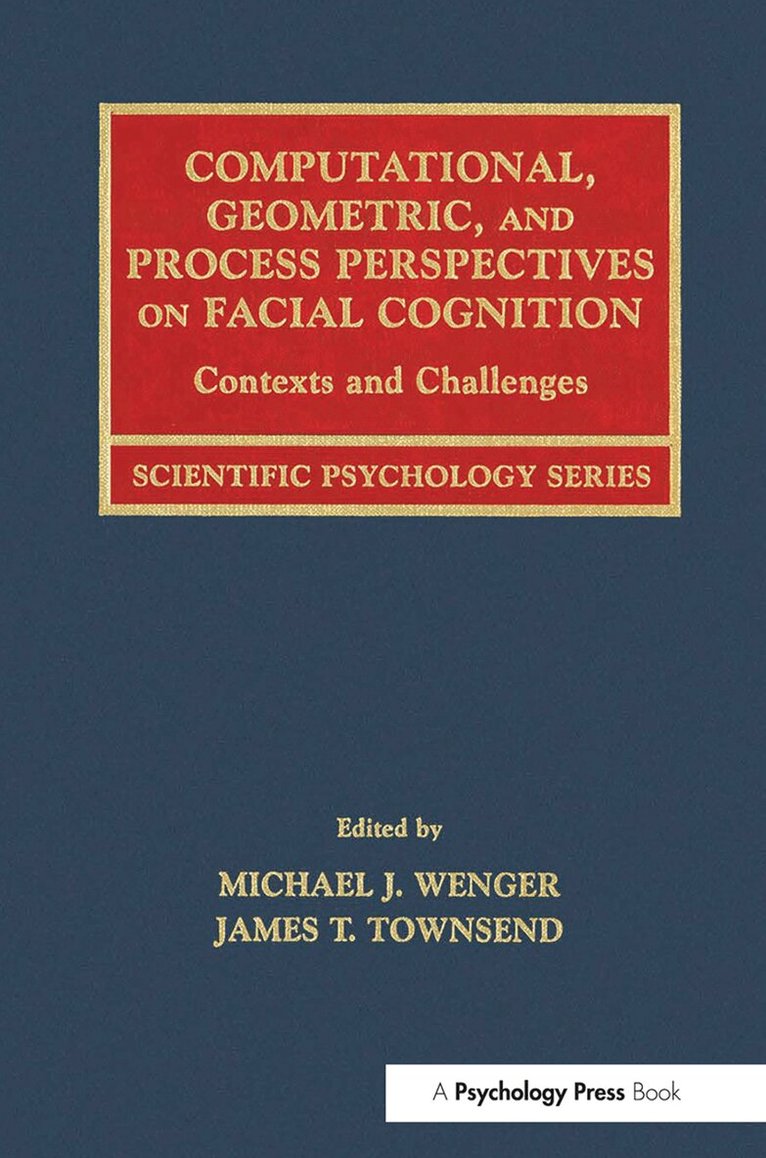
Computational, Geometric, and Process Perspectives on Facial Cognition
Contexts and Challenges
Häftad, Engelska, 2012
784 kr
Skickas inom 10-15 vardagar
Within the last three decades, interest in the psychological experience of human faces has drawn together cognitive science researchers from diverse backgrounds. Computer scientists talk to neural scientists who draw on the work of mathematicians who explicitly influence those conducting behavioral experiments.The chapters in this volume illustrate the breadth of the research on facial perception and memory, with the emphasis being on mathematical and computational approaches. In pulling together these chapters, the editors sought to do much more than illustrate breadth. They endeavored as well to illustrate the synergies and tensions that inevitably result from adopting a broad view, one consistent with the emerging discipline of cognitive science.
Computational, Geometric, and Process Perspectives on Facial Cognition
Contexts and Challenges
Inbunden, Engelska, 2001
2 029 kr
Skickas inom 10-15 vardagar
Within the last three decades, interest in the psychological experience of human faces has drawn together cognitive science researchers from diverse backgrounds. Computer scientists talk to neural scientists who draw on the work of mathematicians who explicitly influence those conducting behavioral experiments.The chapters in this volume illustrate the breadth of the research on facial perception and memory, with the emphasis being on mathematical and computational approaches. In pulling together these chapters, the editors sought to do much more than illustrate breadth. They endeavored as well to illustrate the synergies and tensions that inevitably result from adopting a broad view, one consistent with the emerging discipline of cognitive science.
1 102 kr
Tillfälligt slut
Each volume in the Notre Dame Series on Quantitative Methodology features leading methodologists and substantive experts who provide instruction on innovative techniques designed to enhance quantitative skills in a substantive area. This latest volume focuses on the methodological issues and analyses pertinent to understanding psychological data from a dynamical system perspective. Dynamical systems analysis (DSA) is increasingly used to demonstrate time-dependent variable change. It is used more and more to analyze a variety of psychological phenomena such as relationships, development and aging, emotional regulation, and perceptual processes. The book opens with the best occasions for using DSA methods. The final two chapters focus on the application of dynamical systems methods to problems in psychology such as substance use and gestural dynamics. In addition, it reviews how and when to use:time series models from a discrete time perspective stochastic differential equations in continuous time estimating continuous time differential equation models multilevel models of differential equations to estimate within-person dynamics and the corresponding population means new SEM models for dynamical systems dataData Analytic Techniques for Dynamical Systems is beneficial to advanced students and researchers in the areas of developmental psychology, family studies, language processes, cognitive neuroscience, social and personality psychology, medicine, and emotion. Due to the book’s instructive nature, it serves as an excellent text for advanced courses on this particular technique.
752 kr
Skickas inom 10-15 vardagar
Each volume in the Notre Dame Series on Quantitative Methodology features leading methodologists and substantive experts who provide instruction on innovative techniques designed to enhance quantitative skills in a substantive area. This latest volume focuses on the methodological issues and analyses pertinent to understanding psychological data from a dynamical system perspective. Dynamical systems analysis (DSA) is increasingly used to demonstrate time-dependent variable change. It is used more and more to analyze a variety of psychological phenomena such as relationships, development and aging, emotional regulation, and perceptual processes. The book opens with the best occasions for using DSA methods. The final two chapters focus on the application of dynamical systems methods to problems in psychology such as substance use and gestural dynamics. In addition, it reviews how and when to use:time series models from a discrete time perspective stochastic differential equations in continuous time estimating continuous time differential equation models multilevel models of differential equations to estimate within-person dynamics and the corresponding population means new SEM models for dynamical systems dataData Analytic Techniques for Dynamical Systems is beneficial to advanced students and researchers in the areas of developmental psychology, family studies, language processes, cognitive neuroscience, social and personality psychology, medicine, and emotion. Due to the book’s instructive nature, it serves as an excellent text for advanced courses on this particular technique.
1 366 kr
Tillfälligt slut
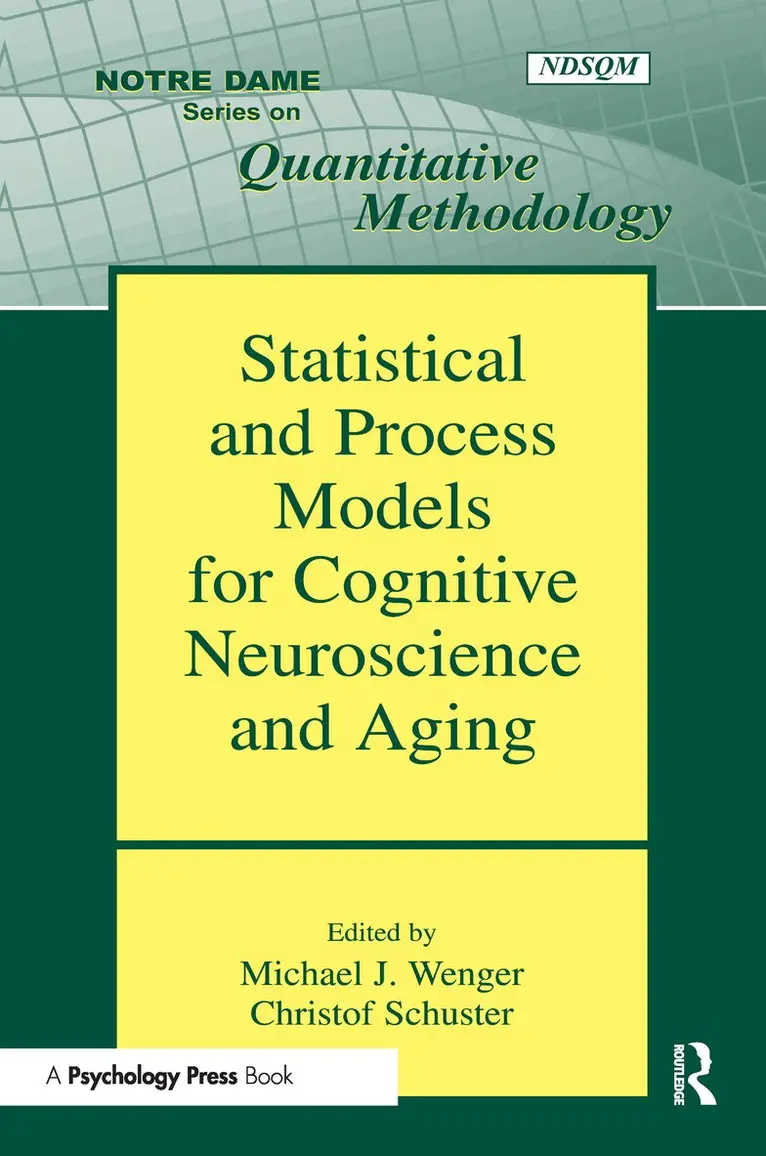
Statistical and Process Models for Cognitive Neuroscience and Aging addresses methodological techniques for researching cognitive impairment, Alzheimer's disease, the biophysics and structure of the nervous system, the physiology of memory, and the analysis of EEG data. Each chapter, written by the expert in the area, provides a carefully crafted introduction to the subject at hand and the key methodological challenges facing that area of study.Although the chapters describe sophisticated techniques, each is accessible to scientists from a variety of fields. The editors' goal is to expose researchers working on a range of issues associated with cognitive aging to a variety of approaches and technologies, in an effort to cross disciplinary boundaries and further research in cognitive aging.Intended for researchers in cognitive, behavioral, and computational neuroscience, psychometrics, gerontology, cognitive, health, and developmental psychology, radiology, and medical research, this book also serves as a text for graduate level courses in cognitive science and cognitive aging.
691 kr
Skickas inom 10-15 vardagar
Statistical and Process Models for Cognitive Neuroscience and Aging addresses methodological techniques for researching cognitive impairment, Alzheimer's disease, the biophysics and structure of the nervous system, the physiology of memory, and the analysis of EEG data. Each chapter, written by the expert in the area, provides a carefully crafted introduction to the subject at hand and the key methodological challenges facing that area of study.Although the chapters describe sophisticated techniques, each is accessible to scientists from a variety of fields. The editors' goal is to expose researchers working on a range of issues associated with cognitive aging to a variety of approaches and technologies, in an effort to cross disciplinary boundaries and further research in cognitive aging.Intended for researchers in cognitive, behavioral, and computational neuroscience, psychometrics, gerontology, cognitive, health, and developmental psychology, radiology, and medical research, this book also serves as a text for graduate level courses in cognitive science and cognitive aging.