Steven M Boker - Böcker
Visar alla böcker från författaren Steven M Boker. Handla med fri frakt och snabb leverans.
6 produkter
6 produkter
2 088 kr
Skickas inom 10-15 vardagar
Methodological Issues in Aging Research is the first volume in the "Notre Dame Series on Quantitative Methodology." This new series provides practical training on the latest quantitative methods used in social and behavioral research. Each volume features contributions from leading experts in state-of-the-art techniques applicable to a selected substantive topic.The first series volume provides researchers with innovative techniques for the collection and analyses of data focusing on aging and lifespan development. The book addresses such techniques as structural equation modeling, latent class analysis, hierarchical linear growth curve modeling, dynamical systems analysis, multivariate Rasch models, survival analysis, multilevel modeling, and quantitative genetic methods. These new techniques provide:better estimates of the direct effect of environmental or treatment effects and the dynamic pattern of genetic and environmental influences on adult development more precise predictions of outcomes which in turn increase the diagnostic power of test instrumentsthe potential for developing new treatments that take advantage of the intrinsic dynamics of the course of a disease or age-related change to enhance treatmentMethodological Issues in Aging Research appeals to advanced students and researchers in lifespan development, gerontology, health psychology, and other fields related to human development. It can be used as a main or supplemental text for advanced courses related to developmental research methods.
725 kr
Skickas inom 10-15 vardagar
Methodological Issues in Aging Research is the first volume in the "Notre Dame Series on Quantitative Methodology." This new series provides practical training on the latest quantitative methods used in social and behavioral research. Each volume features contributions from leading experts in state-of-the-art techniques applicable to a selected substantive topic.The first series volume provides researchers with innovative techniques for the collection and analyses of data focusing on aging and lifespan development. The book addresses such techniques as structural equation modeling, latent class analysis, hierarchical linear growth curve modeling, dynamical systems analysis, multivariate Rasch models, survival analysis, multilevel modeling, and quantitative genetic methods. These new techniques provide:better estimates of the direct effect of environmental or treatment effects and the dynamic pattern of genetic and environmental influences on adult development more precise predictions of outcomes which in turn increase the diagnostic power of test instrumentsthe potential for developing new treatments that take advantage of the intrinsic dynamics of the course of a disease or age-related change to enhance treatmentMethodological Issues in Aging Research appeals to advanced students and researchers in lifespan development, gerontology, health psychology, and other fields related to human development. It can be used as a main or supplemental text for advanced courses related to developmental research methods.
1 102 kr
Tillfälligt slut
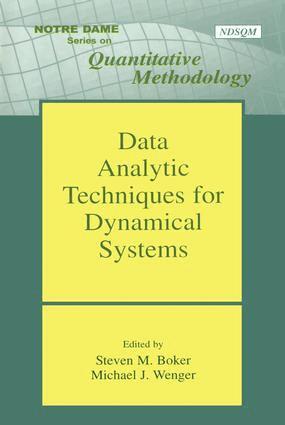
Each volume in the Notre Dame Series on Quantitative Methodology features leading methodologists and substantive experts who provide instruction on innovative techniques designed to enhance quantitative skills in a substantive area. This latest volume focuses on the methodological issues and analyses pertinent to understanding psychological data from a dynamical system perspective. Dynamical systems analysis (DSA) is increasingly used to demonstrate time-dependent variable change. It is used more and more to analyze a variety of psychological phenomena such as relationships, development and aging, emotional regulation, and perceptual processes. The book opens with the best occasions for using DSA methods. The final two chapters focus on the application of dynamical systems methods to problems in psychology such as substance use and gestural dynamics. In addition, it reviews how and when to use:time series models from a discrete time perspective stochastic differential equations in continuous time estimating continuous time differential equation models multilevel models of differential equations to estimate within-person dynamics and the corresponding population means new SEM models for dynamical systems dataData Analytic Techniques for Dynamical Systems is beneficial to advanced students and researchers in the areas of developmental psychology, family studies, language processes, cognitive neuroscience, social and personality psychology, medicine, and emotion. Due to the book’s instructive nature, it serves as an excellent text for advanced courses on this particular technique.
752 kr
Skickas inom 10-15 vardagar
Each volume in the Notre Dame Series on Quantitative Methodology features leading methodologists and substantive experts who provide instruction on innovative techniques designed to enhance quantitative skills in a substantive area. This latest volume focuses on the methodological issues and analyses pertinent to understanding psychological data from a dynamical system perspective. Dynamical systems analysis (DSA) is increasingly used to demonstrate time-dependent variable change. It is used more and more to analyze a variety of psychological phenomena such as relationships, development and aging, emotional regulation, and perceptual processes. The book opens with the best occasions for using DSA methods. The final two chapters focus on the application of dynamical systems methods to problems in psychology such as substance use and gestural dynamics. In addition, it reviews how and when to use:time series models from a discrete time perspective stochastic differential equations in continuous time estimating continuous time differential equation models multilevel models of differential equations to estimate within-person dynamics and the corresponding population means new SEM models for dynamical systems dataData Analytic Techniques for Dynamical Systems is beneficial to advanced students and researchers in the areas of developmental psychology, family studies, language processes, cognitive neuroscience, social and personality psychology, medicine, and emotion. Due to the book’s instructive nature, it serves as an excellent text for advanced courses on this particular technique.
2 029 kr
Skickas inom 10-15 vardagar
This volume presents a collection of chapters focused on the study of multivariate change. As people develop and change, multivariate measurement of that change and analysis of those measures can illuminate the regularities in the trajectories of individual development, as well as time-dependent changes in population averages. As longitudinal data have recently become much more prevalent in psychology and the social sciences, models of change have become increasingly important. This collection focuses on methodological, statistical, and modeling aspects of multivariate change and applications of longitudinal models to the study of psychological processes. The volume is divided into three major sections: Extension of latent change models, Measurement and testing issues in longitudinal modeling, and Novel applications of multivariate longitudinal methodology. It is intended for advanced students and researchers interested in learning about state-of-the-art techniques for longitudinal data analysis, as well as understanding the history and development of such techniques.
665 kr
Skickas inom 10-15 vardagar
This volume presents a collection of chapters focused on the study of multivariate change. As people develop and change, multivariate measurement of that change and analysis of those measures can illuminate the regularities in the trajectories of individual development, as well as time-dependent changes in population averages. As longitudinal data have recently become much more prevalent in psychology and the social sciences, models of change have become increasingly important. This collection focuses on methodological, statistical, and modeling aspects of multivariate change and applications of longitudinal models to the study of psychological processes. The volume is divided into three major sections: Extension of latent change models, Measurement and testing issues in longitudinal modeling, and Novel applications of multivariate longitudinal methodology. It is intended for advanced students and researchers interested in learning about state-of-the-art techniques for longitudinal data analysis, as well as understanding the history and development of such techniques.