Michael P. Murphy – författare
Visar alla böcker från författaren Michael P. Murphy. Handla med fri frakt och snabb leverans.
12 produkter
12 produkter
Inbunden, Engelska, 2008
1 286 kr
Skickas inom 5-8 vardagar
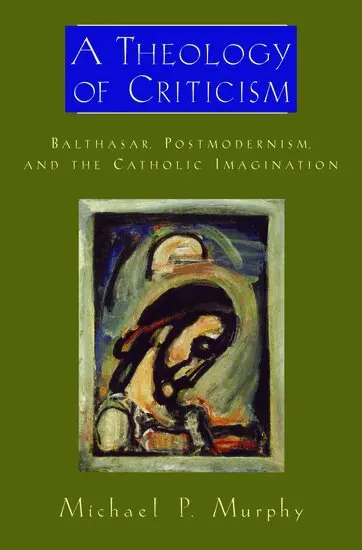
A number of critics and scholars argue for the notion of a distinctly Catholic variety of imagination, not as a matter of doctrine or even of belief, but rather as an artistic sensibility. They figure the blend of intellectual, emotional, spiritual and ethical assumptions that proceed from Catholic belief constitutes a vision of reality that necessarily informs the artist's imaginative expression. The notion of a Catholic imagination, however, has lacked thematic and theological coherence. To articulate this intuition is to cross the problematic interdisciplinary borders between theology and literature; and, although scholars have developed useful methods for undertaking such interdisciplinary "border-crossings," relatively few have been devoted to a serious examination of the theological aesthetic upon which these other aesthetics might hinge. In A Theology of Criticism, Michael Patrick Murphy proposes a new framework to better define the concept of a Catholic imagination. He explores the many ways in which the theological work of Hans Urs von Balthasar (1905-1988) can provide the model, content, and optic for distinguishing this type of imagination from others. Since Balthasar views art and literature precisely as theologies, Murphy surveys a broad array of poetry, drama, fiction, and film and sets it against central aspects of Balthasar's theological program. In doing so, Murphy seeks to develop a theology of criticism. This interdisciplinary work recovers the legitimate place of a distinct "theological imagination" in critical theory, showing that Balthasar's voice both challenges and complements contemporary developments. Murphy also contends that postmodern interpretive methodology, with its careful critique of entrenched philosophical assumptions and reiterated codes of meaning, is not the threat to theological meaning that many fear. On the contrary, by juxtaposing postmodern critical methodologies against Balthasar's visionary theological range, a space is made available for literary critics and theologians alike. More important, the critic is provided with the tools to assess, challenge, and celebrate the theological imagination as it is depicted today.
E-bok
PDF, Engelska, 20081 048 kr
Läs direkt efter köp
A number of critics and scholars argue for the notion of a distinctly Catholic variety of imagination, not as a matter of doctrine or even of belief, but rather as an artistic sensibility. They figure the blend of intellectual, emotional, spiritual and ethical assumptions that proceed from Catholic belief constitutes a vision of reality that necessarily informs the artist''s imaginative expression. The notion of a Catholic imagination, however, has lacked thematic and theological coherence. To articulate this intuition is to cross the problematic interdisciplinary borders between theology and literature; and, although scholars have developed useful methods for undertaking such interdisciplinary "border-crossings," relatively few have been devoted to a serious examination of the theological aesthetic upon which these other aesthetics might hinge.In A Theology of Criticism, Michael Patrick Murphy proposes a new framework to better define the concept of a Catholic imagination. He explores the many ways in which the theological work of Hans Urs von Balthasar (1905-1988) can provide the model, content, and optic for distinguishing this type of imagination from others. Since Balthasar views art and literature precisely as theologies, Murphy surveys a broad array of poetry, drama, fiction, and film and sets it against central aspects of Balthasar''s theological program. In doing so, Murphy seeks to develop a theology of criticism.This interdisciplinary work recovers the legitimate place of a distinct "theological imagination" in critical theory, showing that Balthasar''s voice both challenges and complements contemporary developments. Murphy also contends that postmodern interpretive methodology, with its careful critique of entrenched philosophical assumptions and reiterated codes of meaning, is not the threat to theological meaning that many fear. On the contrary, by juxtaposing postmodern critical methodologies against Balthasar''s visionary theological range, a space is made available for literary critics and theologians alike. More important, the critic is provided with the tools to assess, challenge, and celebrate the theological imagination as it is depicted today.
Inbunden, Engelska, 1995
1 016 kr
Skickas inom 7-10 vardagar
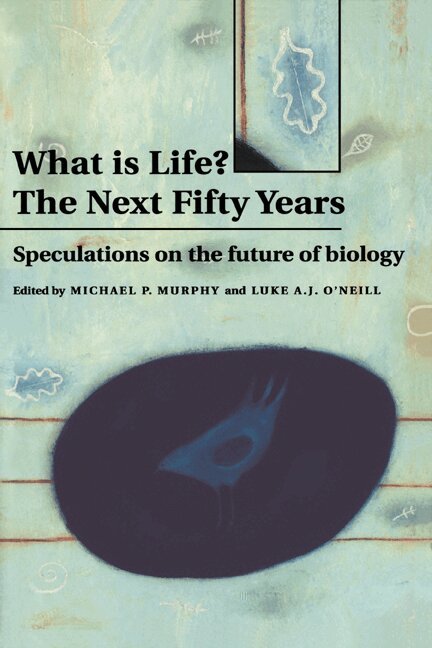
Erwin Schrödinger's book What is Life? had a tremendous influence on the development of molecular biology, stimulating scientists such as Watson and Crick to explore the physical basis of life. Much of the appeal of Schrödinger's book lay in its approach to the central problems in biology - heredity and how organisms use energy to maintain order - from a physicist's perspective. At Trinity College, Dublin a number of outstanding scientists from a range of disciplines gathered to celebrate the fiftieth anniversary of What is Life? and following Schrödinger's example fifty years previously, presented their views on the current central problems in biology. The contributors to this volume include Stephen Jay Gould, Roger Penrose, Jared Diamond, Manfred Eigen, John Maynard Smith, Christien de Duve and Lewis Wolpert. This collection is essential reading for anyone interested in biology and its future.
Häftad, Engelska, 1997
560 kr
Skickas inom 7-10 vardagar
Erwin Schrödinger's book What is Life? had a tremendous influence on the development of molecular biology, stimulating scientists such as Watson and Crick to explore the physical basis of life. Much of the appeal of Schrödinger's book lay in its approach to the central problems in biology - heredity and how organisms use energy to maintain order - from a physicist's perspective. At Trinity College, Dublin a number of outstanding scientists from a range of disciplines gathered to celebrate the fiftieth anniversary of What is Life? and following Schrödinger's example fifty years previously, presented their views on the current central problems in biology. The contributors to this volume include Stephen Jay Gould, Roger Penrose, Jared Diamond, Manfred Eigen, John Maynard Smith, Christien de Duve and Lewis Wolpert. This collection is essential reading for anyone interested in biology and its future.
Häftad, Engelska, 2002
185 kr
Skickas inom 5-8 vardagar
Häftad, Engelska, 2004
238 kr
Skickas inom 5-8 vardagar
Häftad, Engelska, 2009
262 kr
Skickas inom 5-8 vardagar
Häftad, Engelska, 2019
367 kr
Skickas inom 5-8 vardagar
Inbunden, Engelska, 2019
564 kr
Skickas inom 5-8 vardagar
E-bok
PDF, Engelska, 2019561 kr
Läs direkt efter köp
That Denise Levertov (1923-97) was one of the most pioneering and skilled poets of her generation is beyond dispute. Her masterly use of language, innovative experimentations with organic form, and the political acuity disclosed by her activist poetry are well marked by critical communities. But it is also quite clear that the poems Levertov wrote in the last twenty years of her life, with their more explicit focus on theological themes and subjects, are among the best poems written on religious experience of any century, let alone the twentieth. The collection of essays gathered here shed vital light on this neglected aspect of Levertov studies so as to expand and enrich the scope of critical engagement. In a mixture of theoretical considerations and close readings, these essays provide valuable reflections about the complex relationship between poetry and belief and offer philosophically robust insights into different styles of poetic imagination. The abiding hope is to broaden the terrain for discussions in twenty-first-century theology, literary theory, poetics, and aesthetics--honoring immanence, exploring transcendence, and dwelling with integrity within the spaces between.
Häftad, Engelska, 2026
298 kr
Kommande
Catholic Cosmotechnics for the AI Age resurrects Marshall McLuhan’s prophetic insight that “the medium is the message” and baptizes it in the sacramental imagination and liturgical wisdom of the Church. The result is a principled framework for technological creativity in the AI age that draws equally on Thomistic semiotics, media ecology, and human-computer interface design. Where Silicon Valley sees users to capture, the authors see participants in a cosmic leitourgia—a common work of returning creation to its source.Written by a diverse team of scholars and practitioners including designers, educators, radio hosts, and theologians, this profoundly interdisciplinary work bridges liturgy and technics, devotion and design, papal teaching and new media scholarship. The authors demonstrate how liturgical signs—from stained glass to sacred architecture to the gestures of the Mass—embody the paradoxical qualities of epiphany and asceticism, standing in stark contrast to the addictive, “frictionless” interfaces dominating our lives. Ranging from the semiotic structure of human-computer interaction to practical examples in community gardens and Catholic education, this book charts a path beyond the design mantras and attention economies that dominate the technocene.It is a summons to rediscover technology as poiesis—creative making in service of the Kingdom—and interface design as a site of liturgical participation. In an era of doomscrolling and algorithmic manipulation, Catholic Cosmotechnics for the AI Age reclaims the option of tending to the human face through a practice of interface design rejuvenated by the liturgy.
Häftad, Engelska, 2000
221 kr
Skickas inom 5-8 vardagar