Michael R. Greenberg – författare
645 kr
Skickas inom 10-15 vardagar
2 222 kr
Skickas inom 10-15 vardagar
679 kr
Skickas inom 10-15 vardagar
2 227 kr
Skickas inom 10-15 vardagar
730 kr
Läs direkt efter köp
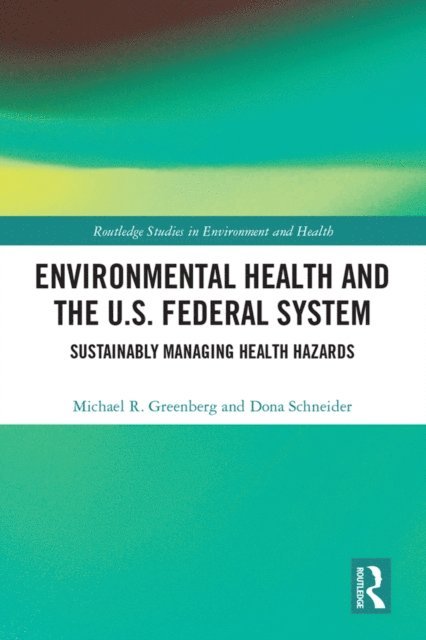
This book explains how the U.S. federal system manages environmental health issues, with a unique focus on risk management and human health outcomes.
Building on a generic approach for understanding human health risk, this book shows how federalism has evolved in response to environmental health problems, political and ideological variations in Washington D.C, as well as in-state and local governments. It examines laws, rules and regulations, showing how they stretch or fail to adapt to environmental health challenges. Emphasis is placed on human health and safety risk and how decisions have been influenced by environmental health information. The authors review different forms of federalism, and analyse how it has had to adapt to ever evolving environmental health hazards, such as global climate change, nanomaterials, nuclear waste, fresh air and water, as well as examining the impact of robotics and artificial intelligence on worker environmental health. They demonstrate the process for assessing hazard information and the process for federalism risk management, and subsequently arguing that human health and safety should receive greater attention.
This book will be essential reading for students and scholars working on environmental health and environmental policy, particularly from a public health, and risk management viewpoint, in addition to practitioners and policymakers involved in environmental management and public policy.
730 kr
Läs direkt efter köp
This book explains how the U.S. federal system manages environmental health issues, with a unique focus on risk management and human health outcomes.
Building on a generic approach for understanding human health risk, this book shows how federalism has evolved in response to environmental health problems, political and ideological variations in Washington D.C, as well as in-state and local governments. It examines laws, rules and regulations, showing how they stretch or fail to adapt to environmental health challenges. Emphasis is placed on human health and safety risk and how decisions have been influenced by environmental health information. The authors review different forms of federalism, and analyse how it has had to adapt to ever evolving environmental health hazards, such as global climate change, nanomaterials, nuclear waste, fresh air and water, as well as examining the impact of robotics and artificial intelligence on worker environmental health. They demonstrate the process for assessing hazard information and the process for federalism risk management, and subsequently arguing that human health and safety should receive greater attention.
This book will be essential reading for students and scholars working on environmental health and environmental policy, particularly from a public health, and risk management viewpoint, in addition to practitioners and policymakers involved in environmental management and public policy.
365 kr
Skickas inom 5-8 vardagar
465 kr
Skickas inom 5-8 vardagar
1 389 kr
Skickas inom 5-8 vardagar
564 kr
Skickas inom 5-8 vardagar
687 kr
Skickas inom 10-15 vardagar
746 kr
Läs direkt efter köp
With a historical sweep that recent events have made definitive, the authors examine the influence of Soviet ideology on the presentation of social reality in films produced in the Soviet Union between the October Revolution and the final days of glasnost. Within the framework of an introduction that lays out the conceptual terminology used to describe that shifting ideological landscape, the authors analyze both the social groups appearing in the films and the relations of film directors and other film makers to state censorship and ideological control.
746 kr
Läs direkt efter köp
With a historical sweep that recent events have made definitive, the authors examine the influence of Soviet ideology on the presentation of social reality in films produced in the Soviet Union between the October Revolution and the final days of glasnost. Within the framework of an introduction that lays out the conceptual terminology used to describe that shifting ideological landscape, the authors analyze both the social groups appearing in the films and the relations of film directors and other film makers to state censorship and ideological control.
650 kr
Skickas inom 10-15 vardagar
795 kr
Läs direkt efter köp
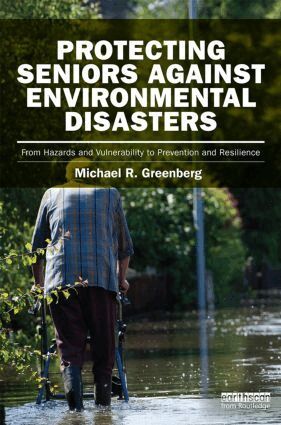
The baby boom generation were born between 1946 and 1964 and are the largest population cohort in US history. They should number about 90 million by mid-century, more than doubling their current size. The massive increase in seniors and relative decline of those of working age in the US is mirrored in almost all the world’s most populous countries.
This book connects the dots between the US baby boom generation and the marked increase in natural and human-caused disasters. It evaluates options available to seniors, their aids, for and not-for and for-profit organizations and government to reduce vulnerability to hazard events. These include coordinated planning, risk assessment, regulations and guidelines, education, and other risk management efforts. Using interviews with experts, cases studies, especially of Superstorm Sandy, and literature, it culls best practice and identify major gaps. It is original and successful in making the connection between the growing group of vulnerable US seniors, environmental events, and risk management practices in order to isolate the most effective lessons learned.
795 kr
Läs direkt efter köp
The baby boom generation were born between 1946 and 1964 and are the largest population cohort in US history. They should number about 90 million by mid-century, more than doubling their current size. The massive increase in seniors and relative decline of those of working age in the US is mirrored in almost all the world’s most populous countries.
This book connects the dots between the US baby boom generation and the marked increase in natural and human-caused disasters. It evaluates options available to seniors, their aids, for and not-for and for-profit organizations and government to reduce vulnerability to hazard events. These include coordinated planning, risk assessment, regulations and guidelines, education, and other risk management efforts. Using interviews with experts, cases studies, especially of Superstorm Sandy, and literature, it culls best practice and identify major gaps. It is original and successful in making the connection between the growing group of vulnerable US seniors, environmental events, and risk management practices in order to isolate the most effective lessons learned.
2 222 kr
Skickas inom 10-15 vardagar
687 kr
Skickas inom 10-15 vardagar
2 158 kr
Skickas inom 10-15 vardagar
1 742 kr
Skickas inom 10-15 vardagar
802 kr
Läs direkt efter köp
795 kr
Läs direkt efter köp
785 kr
Läs direkt efter köp
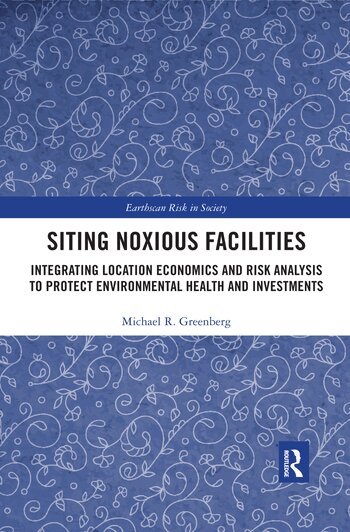
Siting Noxious Facilities explains and illustrates processes and criteria used to site noxious manufacturing and waste management facilities. It proposes a framework that integrates economic location analysis and risk analysis, emphasizing the reduction of uncertainty.
This book begins by defining noxious facilities and considers the important role of manufacturing in the world economy, before going on to describe the historical practices used in locating these facilities for much of the twentieth century. It then shifts focus to analyze the complex set of considerations in the twenty-first century that mean that any facility that produces annoying smells and sounds, is unsightly and emits hazardous substances has had the bar of acceptability markedly raised for economic, environmental, social and political acceptability.
Drawing on case study examples that highlight pollution prevention, choosing locations at major plants (CLAMP), negotiations, and surrendering control of an activity, Greenberg presents a hybrid framework that advocates the amalgamation of industrial location processes with human health and environmental-oriented risk analysis.
This book will be of great interest to students and scholars of location economics, environmental science, risk analysis and land-use planning. It will also be of great relevance to decision-makers and their major advisers who must make choices about siting noxious facilities.
785 kr
Läs direkt efter köp
Siting Noxious Facilities explains and illustrates processes and criteria used to site noxious manufacturing and waste management facilities. It proposes a framework that integrates economic location analysis and risk analysis, emphasizing the reduction of uncertainty.
This book begins by defining noxious facilities and considers the important role of manufacturing in the world economy, before going on to describe the historical practices used in locating these facilities for much of the twentieth century. It then shifts focus to analyze the complex set of considerations in the twenty-first century that mean that any facility that produces annoying smells and sounds, is unsightly and emits hazardous substances has had the bar of acceptability markedly raised for economic, environmental, social and political acceptability.
Drawing on case study examples that highlight pollution prevention, choosing locations at major plants (CLAMP), negotiations, and surrendering control of an activity, Greenberg presents a hybrid framework that advocates the amalgamation of industrial location processes with human health and environmental-oriented risk analysis.
This book will be of great interest to students and scholars of location economics, environmental science, risk analysis and land-use planning. It will also be of great relevance to decision-makers and their major advisers who must make choices about siting noxious facilities.
756 kr
Läs direkt efter köp
354 kr
Skickas inom 5-8 vardagar
714 kr
Skickas inom 5-8 vardagar