Michał Baczyński - Böcker
Visar alla böcker från författaren Michał Baczyński. Handla med fri frakt och snabb leverans.
6 produkter
6 produkter
Del 15883 - Lecture Notes in Computer Science
Advances in Fuzzy Logic and Technology
14th Conference of the European Society for Fuzzy Logic and Technology, EUSFLAT 2025, Riga, Latvia, July 21–25, 2025, Proceedings, Part I
Häftad, Engelska, 2025
830 kr
Skickas inom 10-15 vardagar
This two-volume set LNCS 15883-15884 constitutes the proceedings of the 14th Conference of the European Society for Fuzzy Logic and Technology, EUSFLAT 2025, held in Riga, Latvia, during July 21–25, 2025.The 45 full papers and 8 short papers presented in this book were carefully reviewed and selected from 60 submissions. The papers are divided into special sessions on: fuzzy relations and applications; fuzzy transforms; generalized quantifiers, logical syllogisms and applications; fuzzy entropy; fuzzy metric spaces and their generalizations; information fusion techniques; mathematical fuzzy logic; modeling complex dynamics: adapting analytical tools for diverse scenarios; new contexts in aggregation theory; representing and managing uncertainty; soft methods in statistical inference and data analysis; type 2 fuzzy sets; and advancements and applications of fuzzy theory.
Del 15884 - Lecture Notes in Computer Science
Advances in Fuzzy Logic and Technology
14th Conference of the European Society for Fuzzy Logic and Technology, EUSFLAT 2025, Riga, Latvia, July 21–25, 2025, Proceedings, Part II
Häftad, Engelska, 2025
721 kr
Skickas inom 10-15 vardagar
This two-volume set LNCS 15883-15884 constitutes the proceedings of the 14th Conference of the European Society for Fuzzy Logic and Technology, EUSFLAT 2025, held in Riga, Latvia, during July 21–25, 2025.The 45 full papers and 8 short papers presented in this book were carefully reviewed and selected from 60 submissions. The papers are divided into special sessions on: fuzzy relations and applications; fuzzy transforms; generalized quantifiers, logical syllogisms and applications; fuzzy entropy; fuzzy metric spaces and their generalizations; information fusion techniques; mathematical fuzzy logic; modeling complex dynamics: adapting analytical tools for diverse scenarios; new contexts in aggregation theory; representing and managing uncertainty; soft methods in statistical inference and data analysis; type 2 fuzzy sets; and advancements and applications of fuzzy theory.
1 590 kr
Skickas inom 7-10 vardagar
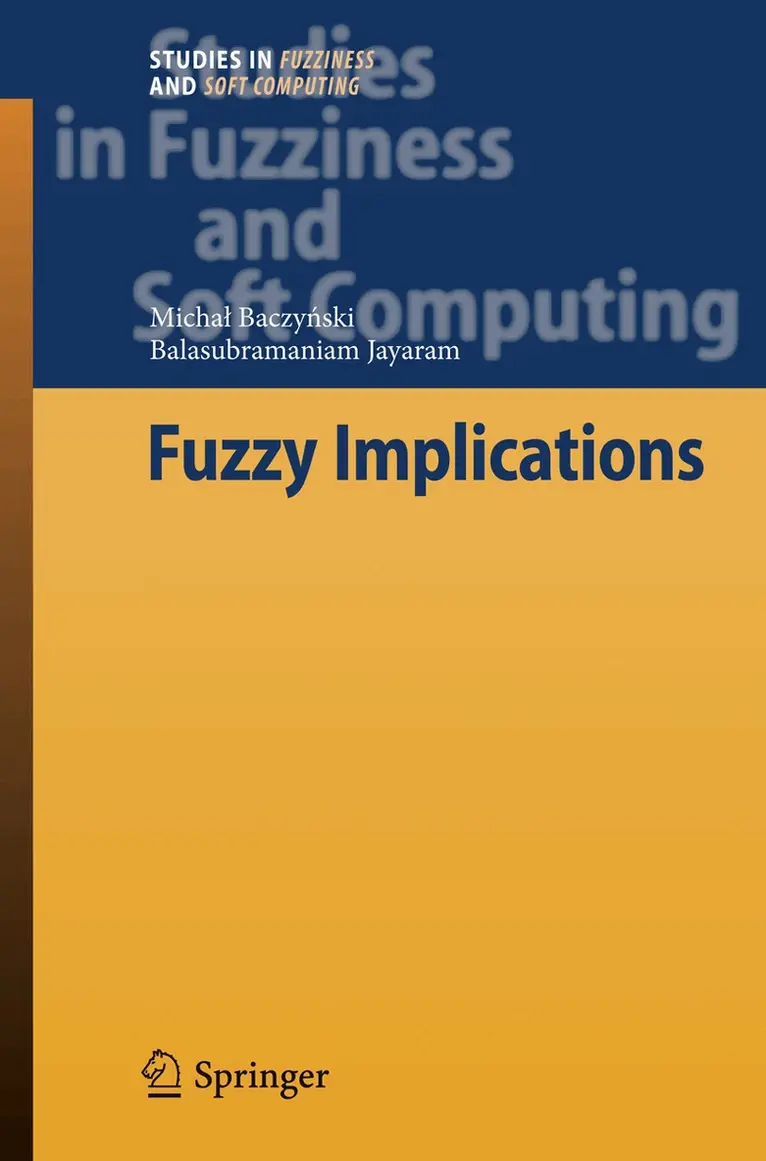
Nothing new had been done in Logic since Aristotle! -KurtGodel .. (1906-1978) Fuzzyimplicationsareoneof themain operationsinfuzzy logic.Theygeneralize the classical implication, which takes values in {0,1}, to fuzzy logic, where the truth values belong to the unit interval [0,1]. In classical logic the implication canbede?nedindi?erentways.Threeofthesehavecometo assumegreatert- oreticalimportance,viz. the usual materialimplication from the Kleene algebra, the implication obtained as the residuum of the conjunction in Heyting algebra (also called pseudo-Boolean algebra) in the intuitionistic logic framework and the implication (also called as 'Sasaki arrow') in the setting of quantum logic. Interestingly, despite their di?ering de?nitions, their truth tables are identical in classical case. However, the natural generalizations of the above de?nitions in the fuzzy logic framework are not identical. This diversity is more a boon than a bane and has led to some intensive research on fuzzy implications for close to three decades. It will be our endeavor to cover the various works churned out in this period to su?cient depth and allowable breadth in this treatise.In the forewordto Klir andYuan's book[147],ProfessorLot?A. Zadehstates the following: "The problem is that the term 'fuzzy logic' has two di?erent meanings.
1 590 kr
Skickas inom 10-15 vardagar
Nothing new had been done in Logic since Aristotle! -KurtGodel .. (1906-1978) Fuzzyimplicationsareoneof themain operationsinfuzzy logic.Theygeneralize the classical implication, which takes values in {0,1}, to fuzzy logic, where the truth values belong to the unit interval [0,1]. In classical logic the implication canbede?nedindi?erentways.Threeofthesehavecometo assumegreatert- oreticalimportance,viz. the usual materialimplication from the Kleene algebra, the implication obtained as the residuum of the conjunction in Heyting algebra (also called pseudo-Boolean algebra) in the intuitionistic logic framework and the implication (also called as 'Sasaki arrow') in the setting of quantum logic. Interestingly, despite their di?ering de?nitions, their truth tables are identical in classical case. However, the natural generalizations of the above de?nitions in the fuzzy logic framework are not identical. This diversity is more a boon than a bane and has led to some intensive research on fuzzy implications for close to three decades. It will be our endeavor to cover the various works churned out in this period to su?cient depth and allowable breadth in this treatise.In the forewordto Klir andYuan's book[147],ProfessorLot?A. Zadehstates the following: "The problem is that the term 'fuzzy logic' has two di?erent meanings.
Del 300 - Studies in Fuzziness and Soft Computing
Advances in Fuzzy Implication Functions
Inbunden, Engelska, 2013
1 105 kr
Skickas inom 10-15 vardagar
Fuzzy implication functions are one of the main operations in fuzzy logic. They generalize the classical implication, which takes values in the set {0,1}, to fuzzy logic, where the truth values belong to the unit interval [0,1]. These functions are not only fundamental for fuzzy logic systems, fuzzy control, approximate reasoning and expert systems, but they also play a significant role in mathematical fuzzy logic, in fuzzy mathematical morphology and image processing, in defining fuzzy subsethood measures and in solving fuzzy relational equations. This volume collects 8 research papers on fuzzy implication functions.Three articles focus on the construction methods, on different ways of generating new classes and on the common properties of implications and their dependencies. Two articles discuss implications defined on lattices, in particular implication functions in interval-valued fuzzy set theories. One paper summarizes the sufficient and necessary conditions of solutions for one distributivity equation of implication. The following paper analyzes compositions based on a binary operation * and discusses the dependencies between the algebraic properties of this operation and the induced sup-* composition. The last article discusses some open problems related to fuzzy implications, which have either been completely solved or those for which partial answers are known. These papers aim to present today’s state-of-the-art in this area.
Del 300 - Studies in Fuzziness and Soft Computing
Advances in Fuzzy Implication Functions
Häftad, Engelska, 2015
1 105 kr
Skickas inom 10-15 vardagar
Fuzzy implication functions are one of the main operations in fuzzy logic. They generalize the classical implication, which takes values in the set {0,1}, to fuzzy logic, where the truth values belong to the unit interval [0,1]. These functions are not only fundamental for fuzzy logic systems, fuzzy control, approximate reasoning and expert systems, but they also play a significant role in mathematical fuzzy logic, in fuzzy mathematical morphology and image processing, in defining fuzzy subsethood measures and in solving fuzzy relational equations. This volume collects 8 research papers on fuzzy implication functions.Three articles focus on the construction methods, on different ways of generating new classes and on the common properties of implications and their dependencies. Two articles discuss implications defined on lattices, in particular implication functions in interval-valued fuzzy set theories. One paper summarizes the sufficient and necessary conditions of solutions for one distributivity equation of implication. The following paper analyzes compositions based on a binary operation * and discusses the dependencies between the algebraic properties of this operation and the induced sup-* composition. The last article discusses some open problems related to fuzzy implications, which have either been completely solved or those for which partial answers are known. These papers aim to present today’s state-of-the-art in this area.