Michel de Mathelin – författare
Visar alla böcker från författaren Michel de Mathelin. Handla med fri frakt och snabb leverans.
3 produkter
3 produkter
Inbunden, Engelska, 2009
1 669 kr
Skickas inom 10-15 vardagar
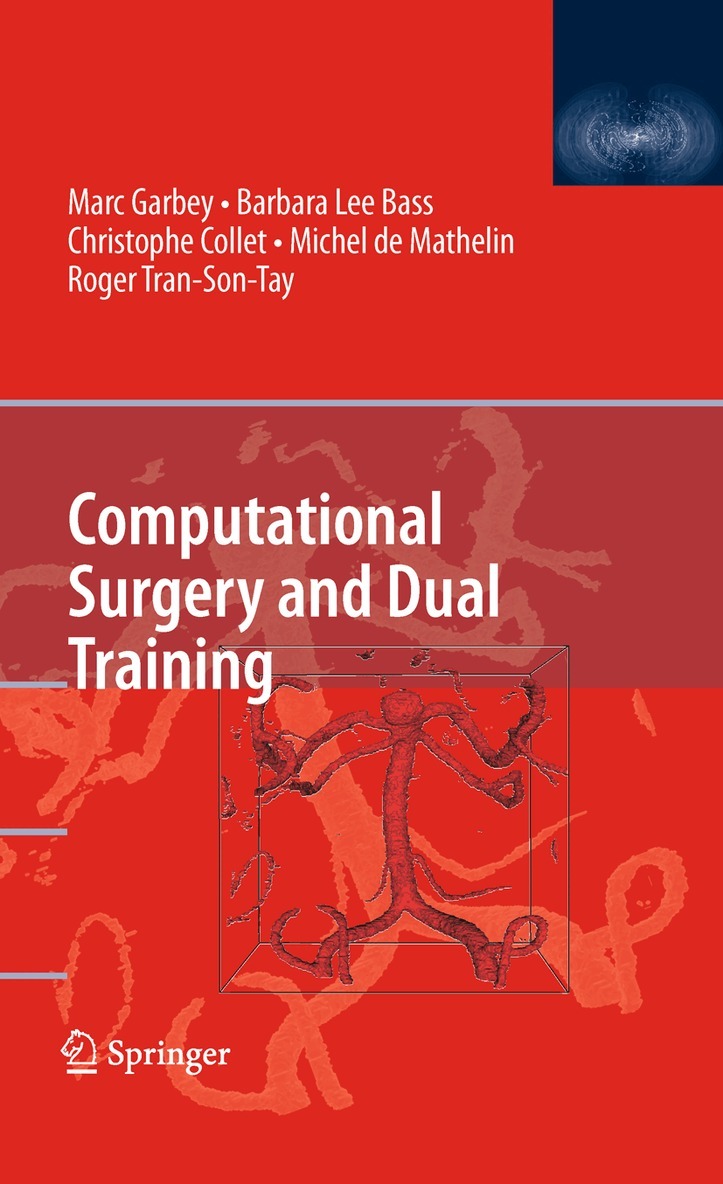
The future of surgery is intrinsically linked to the future of computational sciences: the medical act will be computer assisted at every single step, from planning to post-surgery recovery and through the surgical procedure itself. Looking back at the history of surgery, surgery practice has changed drama- cally with the extensive use of revolutionary techniques, such as medical imaging, laparoscopy, endoscopy, sensors and actuators, and robots. This trend is dependent on the use of computer processing, computational method, and virtualization. Computational surgery will not only improve the ef?ciency and quality of surgery, but will also give new access to very complex operations that require extreme precision and minimum intrusion. Such examples are today’s inoperable cancer tumors that have invaded critical tissues or nervous centers. In order for this milestone to be reached quicker and more ef?ciently, surgeons will have to become very familiar with computing methods, such as image analysis, augmented re- ity, and/or robotics. It will be critical for surgeons to assimilate computers in their training, understand how computers work, understand the limitations/advantages of these computer tools, and be able to interpret computer imaging and simulations.
E-bok
PDF, Engelska, 20092 054 kr
Läs direkt efter köp
The future of surgery is intrinsically linked to the future of computational sciences: the medical act will be computer assisted at every single step, from planning to post-surgery recovery and through the surgical procedure itself. Looking back at the history of surgery, surgery practice has changed drama- cally with the extensive use of revolutionary techniques, such as medical imaging, laparoscopy, endoscopy, sensors and actuators, and robots. This trend is dependent on the use of computer processing, computational method, and virtualization. Computational surgery will not only improve the ef?ciency and quality of surgery, but will also give new access to very complex operations that require extreme precision and minimum intrusion. Such examples are today’s inoperable cancer tumors that have invaded critical tissues or nervous centers. In order for this milestone to be reached quicker and more ef?ciently, surgeons will have to become very familiar with computing methods, such as image analysis, augmented re- ity, and/or robotics. It will be critical for surgeons to assimilate computers in their training, understand how computers work, understand the limitations/advantages of these computer tools, and be able to interpret computer imaging and simulations.
Häftad, Engelska, 2014
1 667 kr
Skickas inom 10-15 vardagar
The future of surgery is intrinsically linked to the future of computational sciences: the medical act will be computer assisted at every single step, from planning to post-surgery recovery and through the surgical procedure itself. Looking back at the history of surgery, surgery practice has changed drama- cally with the extensive use of revolutionary techniques, such as medical imaging, laparoscopy, endoscopy, sensors and actuators, and robots. This trend is dependent on the use of computer processing, computational method, and virtualization. Computational surgery will not only improve the ef?ciency and quality of surgery, but will also give new access to very complex operations that require extreme precision and minimum intrusion. Such examples are today’s inoperable cancer tumors that have invaded critical tissues or nervous centers. In order for this milestone to be reached quicker and more ef?ciently, surgeons will have to become very familiar with computing methods, such as image analysis, augmented re- ity, and/or robotics. It will be critical for surgeons to assimilate computers in their training, understand how computers work, understand the limitations/advantages of these computer tools, and be able to interpret computer imaging and simulations.