Michio Nitta – författare
Visar alla böcker från författaren Michio Nitta. Handla med fri frakt och snabb leverans.
2 produkter
2 produkter
Inbunden, Engelska, 1998
1 097 kr
Skickas inom 5-8 vardagar
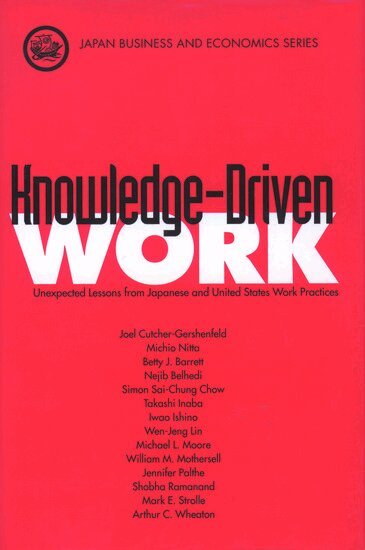
The daily work experiences of people in almost any part of the world are shaped by workplace innovations. Despite the vast diffusion of work practices, little is known about what it means for a company in the region to identify what it sees as the best practice and then introduce these practices in another culture which are less visible than the global exchange of products and services, but more significant. This book provides us with a closeup of eight Japanese affiliated manufacturing facilities operating in the United States and the beginnings of a reverse diffusion of innovation back to Japan. The key finding in this book is that massive global diffusion of work practices rests on something very fragile. This is the process by which individuals and groups of people come to new understandings that enable them to adopt new work practices. It is a process termed "virtual knowledge", which can be found at that critical time when understandings are still in formation. Also , the book reveals how some organizations have anticipated and channeled virtual knowledge that is constantly emerging from different groups in the organization. This turns out to be the core building block for continuous improvement in operations and is central to the process of diffusion. The process is part of a much larger process of global diffusion from Japan, the United States and other nations to all parts of the world.
E-bok
PDF, Engelska, 1998935 kr
Läs direkt efter köp
Knowledge-Driven Work is a pioneering study of the cross-cultural iffusion of ideas about the organization of work. These ideas, linked with the knowledge of the workforce, are rapidly becoming the primary source of competitive advantage in the world economy. The book provides an in-depth look at eight Japanese-affiliated manufacturing facilities operating in the United States, combined with examinations of their sister facilities in Japan. The authors offer their insights into the complex process by which elements of work systems in one country interact with those in another. They trace the flow of ideas from Japan to the US and other nations, and the beginnings of a reverse diffusion of innovation back to Japan. The authors organize their findings into six categories: the cross-cultural diffusion of work practices, team-based work systems, kaizen and employee involvement, employment security, human resource management, and labor-management relations. Their study of team-based work systems yields a taxonomy of teams and reveals some conflicts between the desire for self-management and the existence of interdependencies. Investigations into kaizen (ongoing incremental improvement) indicate that its emphasis on employee-driven, systematic problem solving makes it a strong counterpoint to the idea of top-down "re-engineering." Looking at employment security, the authors note that while most US managers believe that it restrains managerial flexibility, managers at the firms they observed see it as essential to the flexibility associated with teamwork and kaizen. The study of human resource management practices suggests competitive advantages in diverse, older, unionized, and urban work forces, and emphasizes the importance of wide-ranging training programs in a work system premised on a long-term perspective. The "wildcard" in the work places observed is labor-management relations, the area in which Japanese managers have been least likely to import their ideas. The authors report on several situations in which existing labor-management structures remained untouched, with mixed results: greater labor-management consultation, for example, but also increased ambiguity of roles. The thread running through all of these areas of work is "virtual knowledge," an ephemeral form of knowledge derived from a particular combination of people focused on a given issue. The authors point out that this powerful form of knowledge is only effectively harnessed in environments that are free of fear, that have established procedures for collective problem-solving, and that have some stability in group composition. They claim that too often companies allow virtual knowledge to dissipate, squandering opportunities to create more competitive workplaces. For those organizations that have succeeded in anticipating and channeling it, however, virtual knowledge leads to a knowledge-driven workplace and continuous improvement.