Miguel Nogueira de Brito – författare
Visar alla böcker från författaren Miguel Nogueira de Brito. Handla med fri frakt och snabb leverans.
7 produkter
Political Dimension of Constitutional Law
Av Miguel Nogueira de Brito, Luís Pereira Coutinho
Inbunden, 2020
1641 kr
Lägg i varukorg
This book discusses in what sense constitutional law has a political dimension, raising the question whether constitutional law is fundamentally political as to its validity, terms of its origin, conceptual structure and/or corresponding practice. It also poses the question whether that dimension …
Political Dimension of Constitutional Law
Av Luis Pereira Coutinho, Miguel Nogueira de Brito
E-bok, 2020
1942 kr
Lägg i varukorg
This book discusses in what sense constitutional law has a political dimension, raising the question whether constitutional law is fundamentally political as to its validity, terms of its origin, conceptual structure and/or corresponding practice. It also poses the question whether that dimension …
Political Dimension of Constitutional Law
Av Miguel Nogueira de Brito, Luís Pereira Coutinho
Häftad, 2021
1641 kr
Lägg i varukorg
This book discusses in what sense constitutional law has a political dimension, raising the question whether constitutional law is fundamentally political as to its validity, terms of its origin, conceptual structure and/or corresponding practice. It also poses the question whether that dimension …
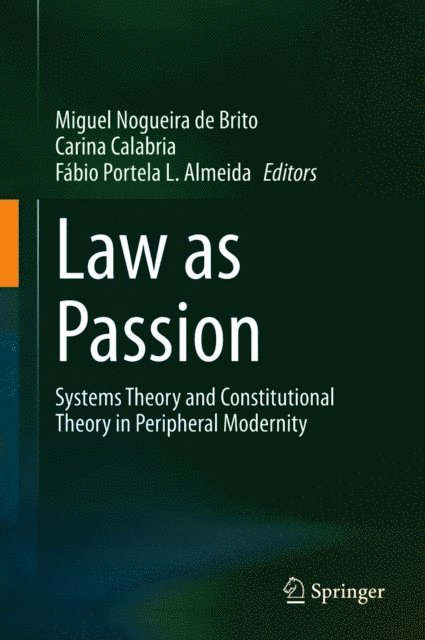
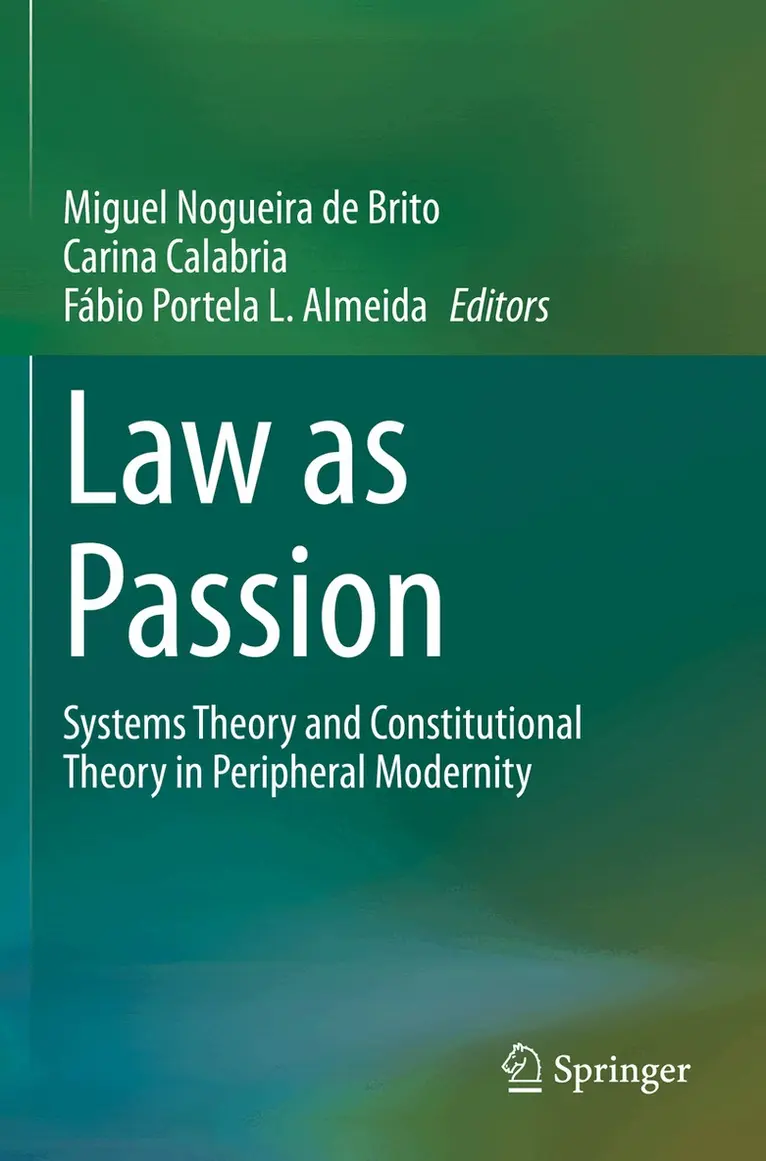
Law as Passion
Systems Theory and Constitutional Theory in Peripheral Modernity
Av Miguel Nogueira de Brito, Carina Calabria m. fl.
Inbunden, 2021
1599 kr
Lägg i varukorg
Inspired by the works of Professor Marcelo Neves, in this book colleagues come together to explore how their research has been influenced by non-European and post-colonial approaches. With a foreword by Karl-Heinz Ladeur, it features essays written by leading scholars in the fields of sociology of …
Law as Passion
Systems Theory and Constitutional Theory in Peripheral Modernity
Av Fabio Portela L. Almeida, Carina Calabria m. fl.
E-bok, 2021
2092 kr
Lägg i varukorg
Inspired by the works of Professor Marcelo Neves, in this book colleagues come together to explore how their research has been influenced by non-European and post-colonial approaches. With a foreword by Karl-Heinz Ladeur, it features essays written by leading scholars in the fields of sociology of …
Law as Passion
Systems Theory and Constitutional Theory in Peripheral Modernity
Av Miguel Nogueira de Brito, Carina Calabria m. fl.
Häftad, 2022
1599 kr
Lägg i varukorg
Inspired by the works of Professor Marcelo Neves, in this book colleagues come together to explore how their research has been influenced by non-European and post-colonial approaches. With a foreword by Karl-Heinz Ladeur, it features essays written by leading scholars in the fields of sociology of …
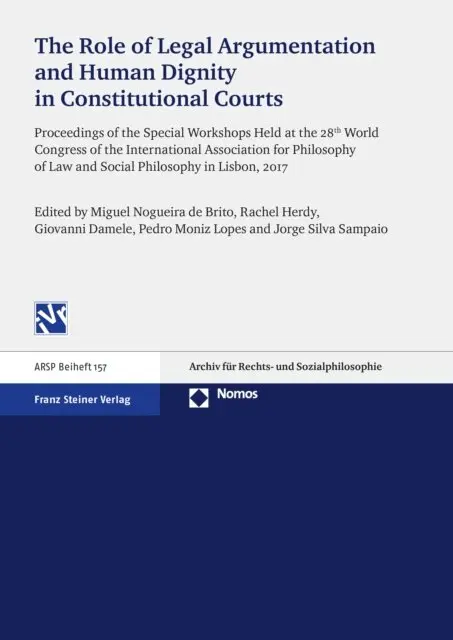
Role of Legal Argumentation and Human Dignity in Constitutional Courts
Proceedings of the Special Workshops Held at the 28th World Congress of the International Association for Philosophy of Law and Social Philosophy in Lisbon, 2017
Av Jorge Silva Sampaio, Pedro Moniz Lopes m. fl.
E-bok, 2019
573 kr
Lägg i varukorg
The legal argumentation of constitutional courts, for instance on human dignity, has been in the centre of interest both from theoretical and practical perspectives. This e-book addresses the role of legal argumentation at first in general, covering empirical and comparative perspectives on …