Ming C. Lin – författare
Visar alla böcker från författaren Ming C. Lin. Handla med fri frakt och snabb leverans.
9 produkter
9 produkter
E-bok
Engelska, 20082 438 kr
Läs direkt efter köp
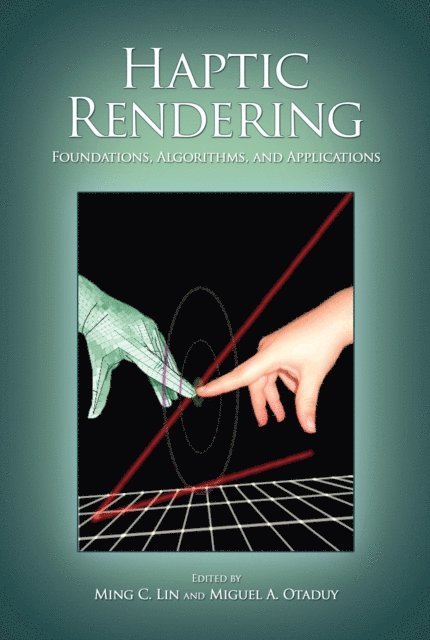
For a long time, human beings have dreamed of a virtual world where it is possible to interact with synthetic entities as if they were real. It has been shown that the ability to touch virtual objects increases the sense of presence in virtual environments. This book provides an authoritative overview of state-of-theart haptic rendering algorithms
E-bok
PDF, Engelska, 20082 614 kr
Läs direkt efter köp
For a long time, human beings have dreamed of a virtual world where it is possible to interact with synthetic entities as if they were real. It has been shown that the ability to touch virtual objects increases the sense of presence in virtual environments. This book provides an authoritative overview of state-of-theart haptic rendering algorithms
Inbunden, Engelska, 2008
2 511 kr
Skickas inom 10-15 vardagar
For a long time, human beings have dreamed of a virtual world where it is possible to interact with synthetic entities as if they were real. It has been shown that the ability to touch virtual objects increases the sense of presence in virtual environments. This book provides an authoritative overview of state-of-theart haptic rendering algorithms and their applications. The authors examine various approaches and techniques for designing touch-enabled interfaces for a number of applications, including medical training, model design, and maintainability analysis for virtual prototyping, scientific visualization, and creative processes.
Häftad, Engelska, 2007
362 kr
Skickas inom 10-15 vardagar
The human haptic system, among all senses, provides unique and bidirectional communication between humans and their physical environment. Yet, to date, most human-computer interactive systems have focused primarily on the graphical rendering of visual information and, to a lesser extent, on the display of auditory information. Extending the frontier of visual computing, haptic interfaces, or force feedback devices, have the potential to increase the quality of human-computer interaction by accommodating the sense of touch. They provide an attractive augmentation to visual display and enhance the level of understanding of complex data sets. They have been effectively used for a number of applications including molecular docking, manipulation of nano-materials, surgical training, virtual prototyping, and digital sculpting. Compared with visual and auditory display, haptic rendering has extremely demanding computational requirements. In order to maintain a stable system while displaying smooth and realistic forces and torques, high haptic update rates in the range of 500-1000 Hz or more are typically used. Haptics present many new challenges to researchers and developers in computer graphics and interactive techniques. Some of the critical issues include the development of novel data structures to encode shape and material properties, as well as new techniques for geometry processing, data analysis, physical modeling, and haptic visualization.This synthesis examines some of the latest developments on haptic rendering, while looking forward to exciting future research in this area. It presents novel haptic rendering algorithms that take advantage of the human haptic sensory modality. Specifically it discusses different rendering techniques for various geometric representations (e.g. point-based, polygonal, multiresolution, distance fields, etc), as well as textured surfaces.It also shows how psychophysics of touch can provide the foundational design guidelines for developing perceptually driven force models and concludes with possible applications and issues to consider in future algorithmic design, validating rendering techniques, and evaluating haptic interfaces.
E-bok
PDF, Engelska, 2022443 kr
Läs direkt efter köp
The human haptic system, among all senses, provides unique and bidirectional communication between humans and their physical environment. Yet, to date, most human-computer interactive systems have focused primarily on the graphical rendering of visual information and, to a lesser extent, on the display of auditory information. Extending the frontier of visual computing, haptic interfaces, or force feedback devices, have the potential to increase the quality of human-computer interaction by accommodating the sense of touch. They provide an attractive augmentation to visual display and enhance the level of understanding of complex data sets. They have been effectively used for a number of applications including molecular docking, manipulation of nano-materials, surgical training, virtual prototyping, and digital sculpting. Compared with visual and auditory display, haptic rendering has extremely demanding computational requirements. In order to maintain a stable system while displaying smooth and realistic forces and torques, high haptic update rates in the range of 500-1000 Hz or more are typically used. Haptics present many new challenges to researchers and developers in computer graphics and interactive techniques. Some of the critical issues include the development of novel data structures to encode shape and material properties, as well as new techniques for geometry processing, data analysis, physical modeling, and haptic visualization.This synthesis examines some of the latest developments on haptic rendering, while looking forward to exciting future research in this area. It presents novel haptic rendering algorithms that take advantage of the human haptic sensory modality. Specifically it discusses different rendering techniques for various geometric representations (e.g. point-based, polygonal, multiresolution, distance fields, etc), as well as textured surfaces.It also shows how psychophysics of touch can provide the foundational design guidelines for developing perceptually driven force models and concludes with possible applications and issues to consider in future algorithmic design, validating rendering techniques, and evaluating haptic interfaces.
Häftad, Engelska, 1996
546 kr
Skickas inom 10-15 vardagar
This anthology is based on the First ACM Workshop on Applied Computational Geometry, WACG '96, held in Philadelphia, PA, USA, in May 1996, as part of the FCRC Conference.Today, CG is in transition and applied computational geometry has established itself as a fertile meeting ground for theorists from core computational geometry and practitioners from the potential application areas to exchange their ideas and identify issues of common interest. The book presents 11 invited contributions and state-of-the-art reports by leading experts together with 12 refereed full papers selected from 32 submissions. It points the way towards geometrical engineering and addresses researchers and professionals sharing an interest in geometric algorithms and techniques and their use in computational sciences and engineering.
Inbunden, Engelska, 2010
1 623 kr
Skickas inom 10-15 vardagar
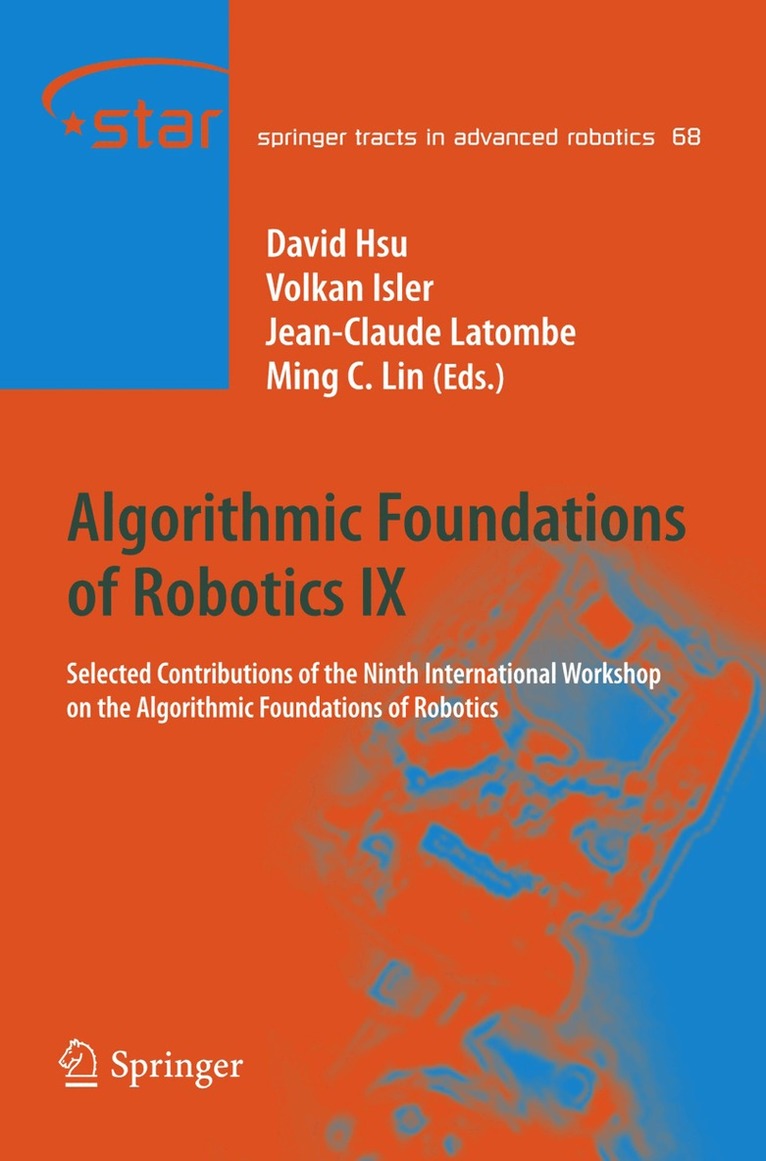
Robotics is at the cusp of dramatic transformation. Increasingly complex robots with unprecedented autonomy are finding new applications, from medical surgery, to construction, to home services. Against this background, the algorithmic foundations of robotics are becoming more crucial than ever, in order to build robots that are fast, safe, reliable, and adaptive. Algorithms enable robots to perceive, plan, control, and learn. The design and analysis of robot algorithms raise new fundamental questions that span computer science, electrical engineering, mechanical engineering, and mathematics. These algorithms are also finding applications beyond robotics, for example, in modeling molecular motion and creating digital characters for video games and architectural simulation. The Workshop on Algorithmic Foundations of Robotics (WAFR) is a highly selective meeting of leading researchers in the field of robot algorithms. Since its creation in 1994, it has published some of the field’s most important and lasting contributions. This book contains the proceedings of the 9th WAFR, held on December 13-15, 2010 at the National University of Singapore. The 24 papers included in this book span a wide variety of topics from new theoretical insights to novel applications.
E-bok
PDF, Engelska, 20102 049 kr
Läs direkt efter köp
Robotics is at the cusp of dramatic transformation. Increasingly complex robots with unprecedented autonomy are finding new applications, from medical surgery, to construction, to home services. Against this background, the algorithmic foundations of robotics are becoming more crucial than ever, in order to build robots that are fast, safe, reliable, and adaptive. Algorithms enable robots to perceive, plan, control, and learn. The design and analysis of robot algorithms raise new fundamental questions that span computer science, electrical engineering, mechanical engineering, and mathematics. These algorithms are also finding applications beyond robotics, for example, in modeling molecular motion and creating digital characters for video games and architectural simulation. The Workshop on Algorithmic Foundations of Robotics (WAFR) is a highly selective meeting of leading researchers in the field of robot algorithms. Since its creation in 1994, it has published some of the field’s most important and lasting contributions. This book contains the proceedings of the 9th WAFR, held on December 13-15, 2010 at the National University of Singapore. The 24 papers included in this book span a wide variety of topics from new theoretical insights to novel applications.
Häftad, Engelska, 2014
1 623 kr
Skickas inom 10-15 vardagar
Robotics is at the cusp of dramatic transformation. Increasingly complex robots with unprecedented autonomy are finding new applications, from medical surgery, to construction, to home services. Against this background, the algorithmic foundations of robotics are becoming more crucial than ever, in order to build robots that are fast, safe, reliable, and adaptive. Algorithms enable robots to perceive, plan, control, and learn. The design and analysis of robot algorithms raise new fundamental questions that span computer science, electrical engineering, mechanical engineering, and mathematics. These algorithms are also finding applications beyond robotics, for example, in modeling molecular motion and creating digital characters for video games and architectural simulation. The Workshop on Algorithmic Foundations of Robotics (WAFR) is a highly selective meeting of leading researchers in the field of robot algorithms. Since its creation in 1994, it has published some of the field’s most important and lasting contributions. This book contains the proceedings of the 9th WAFR, held on December 13-15, 2010 at the National University of Singapore. The 24 papers included in this book span a wide variety of topics from new theoretical insights to novel applications.