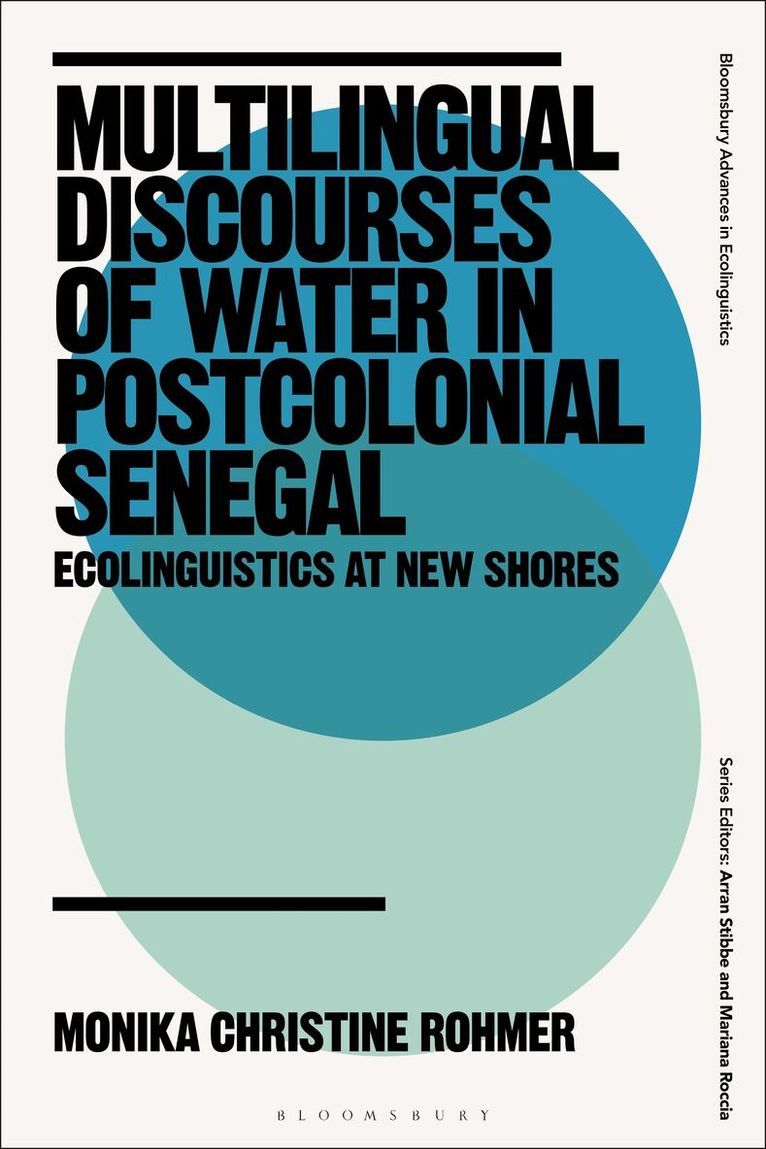
Exploring multilingual discourses on water in Senegal, this book takes ecolinguistics beyond its Eurocentric confinements and illustrates important contemporary developments in the field.Senegal is marked by a linguistic discrepancy: Wolof, spoken by roughly 90% of the population, is used in everyday communication, while French, spoken by roughly 20% of the population, is the only official language since colonisation. Inspired by water’s movement, this book proposes an innovative approach to studying two languages coexisting in one environment. Water is a constant in any natural environment and a crucial basis of human life. Its availability shapes socioeconomic and cultural practices, including language and discourse. In multilingual environments, speakers need to navigate contradicting evaluations and metaphors.The comparative and contrastive study of conceptualisations and discourses in two languages advances the discipline of ecolinguistics by integrating new approaches, methods, and contexts. The double-language approach unravels dimensions of meaning that would otherwise go unnoticed. With selected examples, the book demonstrates the relevance for other world regions and the global nature of water problems and water discourses. It offers researchers in ecolinguistics and (critical) discourse analysis a methodological framework to empirically investigate language practices beyond monolingualism.
This book explores digital politics from an African perspective. It sheds light on how digital technologies are reshaping political landscapes across Africa, and examines the implications and analytical consequences. Each chapter focuses on different aspects of political dynamics, navigating the nexus between the analogue and digital worlds.Drawing on case studies from East, West and South Africa, the book provides in-depth analyses of political mobilisation, digital identification, medical drones, electoral campaigning and the monetisation of digital platforms. Theoretical discussions include African communitarianism, digital indigeneity, democratisation and changes in political discourse.Based on a comprehensive theoretical framework and grounded in empirical research, this book offers critical reflection and a deeper understanding of digital politics. It will appeal to students, researchers and scholars of African studies, media and digital studies, African politics, political science and area studies, as well as policy-makers interested in a better understanding of digital politics in Africa.
Exploring multilingual discourses on water in Senegal, this book takes ecolinguistics beyond its Eurocentric confinements and illustrates important contemporary developments in the field.Senegal is marked by a linguistic discrepancy: Wolof, spoken by roughly 90% of the population, is used in everyday communication, while French, spoken by roughly 20% of the population, is the only official language since colonisation. Inspired by water’s movement, this book proposes an innovative approach to studying two languages coexisting in one environment. Water is a constant in any natural environment and a crucial basis of human life. Its availability shapes socioeconomic and cultural practices, including language and discourse. In multilingual environments, speakers need to navigate contradicting evaluations and metaphors.The comparative and contrastive study of conceptualisations and discourses in two languages advances the discipline of ecolinguistics by integrating new approaches, methods, and contexts. The double-language approach unravels dimensions of meaning that would otherwise go unnoticed. With selected examples, the book demonstrates the relevance for other world regions and the global nature of water problems and water discourses. It offers researchers in ecolinguistics and (critical) discourse analysis a methodological framework to empirically investigate language practices beyond monolingualism.
This book explores digital politics from an African perspective. It sheds light on how digital technologies are reshaping political landscapes across Africa, and examines the implications and analytical consequences. Each chapter focuses on different aspects of political dynamics, navigating the nexus between the analogue and digital worlds.Drawing on case studies from East, West and South Africa, the book provides in-depth analyses of political mobilisation, digital identification, medical drones, electoral campaigning and the monetisation of digital platforms. Theoretical discussions include African communitarianism, digital indigeneity, democratisation and changes in political discourse.Based on a comprehensive theoretical framework and grounded in empirical research, this book offers critical reflection and a deeper understanding of digital politics. It will appeal to students, researchers and scholars of African studies, media and digital studies, African politics, political science and area studies, as well as policy-makers interested in a better understanding of digital politics in Africa.