Monin - Böcker
Visar alla böcker från författaren Monin. Handla med fri frakt och snabb leverans.
9 produkter
9 produkter
2 115 kr
Skickas inom 10-15 vardagar
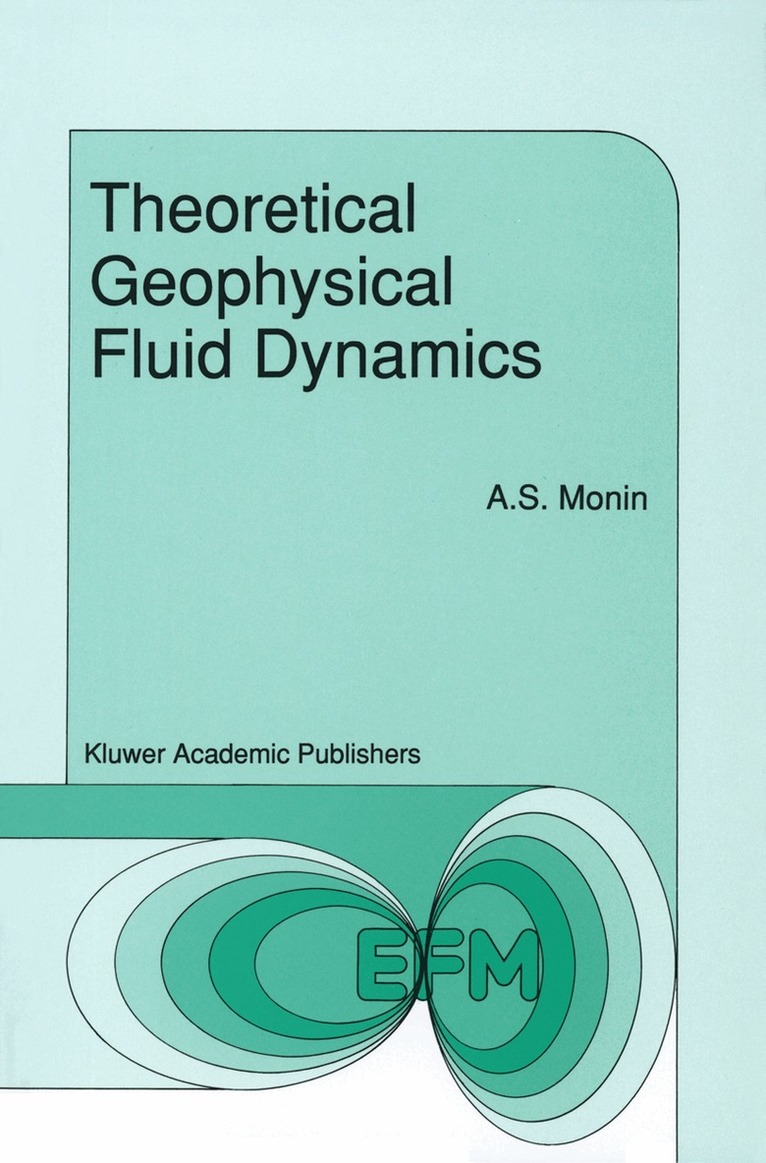
This book grew out of lectures on geophysical fluid dynamics delivered over many years at the Moscow Institute of Physics and Technology by the author (and, with regard to some parts of the book, by his colleagues). During these lectures the students were advised to read many books, and sometimes individual articles, in order to acquaint themselves with the necessary material, since there was no single book available which provided a sufficiently complete and systematic account (except, perhaps, the volumes on Hydrophysics of the Ocean, Hydrodynamics of the Ocean, and Geodynamics in the ten-volume Oceanology series published by Nauka Press in 1978-1979; these refer, however, specifically to the ocean, and anyway they are much too massive to be convenient for study by students). As far as we know, no text corresponding to our understanding of geophysical fluid dynamics has as yet been published outside the Soviet Union. The present book is designed to fill this gap. Since it is customary to write the preface after the entire book has been completed, the author has an opportunity there to raise some points of possible criticism by the reviewers and readers. First of all, note that this work presents the theoretical fundamentals of geophysical fluid dynamics, and that observational and experimental data (which in the natural sciences are always very copious) are referred to only rarely and briefly.
197 kr
Skickas inom 5-8 vardagar
1 061 kr
Skickas inom 10-15 vardagar
Four years have elapsed since the preparation of the original Russian version of this book. This is a long time when dealing with such actively expanding fields of oceanography as research into small-scale structures and the investigation of hydro physical processes. Over this period new quick-response devices have been developed and successfully used for measurements taken in various ocean areas. Improvements in high-frequency meters used to measure hydrophysical parameters has enabled workers to obtain more accurate absolute values of the fluctuations measured by such devices. In view of this scientific progress, some of the ideas presented in this book now require additional explanation. Great care should be used in dealing with the absolute fluctuation values of hydro physical fields, since the methods used for the determination of the accuracy of the high-frequency measuring devices have been imperfect in the past. Never theless, it would appear that the results of the investigations summarized in this book have not lost their importance, and that the established laws governing small-scale pro cesses in the ocean are of a sufficiently universal nature and, as such, have not been shattered with the qualitative and quantitative advances in devices used for measurements taken in oceans. The authors feel that their work is of interest to English-speaking readers. The appearance of the English translation of the book is, to a very large extent, due to the tremendous amount of editing work brilliantly done by Prof. H. Tennekes.
1 588 kr
Skickas inom 10-15 vardagar
1 061 kr
Skickas inom 10-15 vardagar
During the last 20 years the study of, and the prediction of, changes in the climate of our planet have become an urgent social imperative, addressed to scientists the world over. The first principles on which to base such a study were formulated in 1974 in Stockholm, at the international GARP conference on the physical fundamentals of climate theory and climate modeling. In 1979 the World Meteorological Organization and the International Council of Scientific Unions decided to conduct a global program of climate research. This World Climate Program is designed mainly to investigate the variability of the climate on time scales ranging from a few weeks to a few decades and to create a scientific basis for the long-term forecasting of weather. There is at present a definite need for a monograph which can serve as an introduction to the theory of climate. On a qualitative level (without the apparatus of theoretical physics and mathematics) such an introduction has already been presented, in Part I of a book on the history of climate by Yu. A. Shishkov and the author (Monin and Shishkov, 1979). Part II of that work gives factual data on climatic changes during the course of the Earth's history. The present book is designed to provide such an introduction on a quantita tive level.
2 115 kr
Skickas inom 10-15 vardagar
This book grew out of lectures on geophysical fluid dynamics delivered over many years at the Moscow Institute of Physics and Technology by the author (and, with regard to some parts of the book, by his colleagues). During these lectures the students were advised to read many books, and sometimes individual articles, in order to acquaint themselves with the necessary material, since there was no single book available which provided a sufficiently complete and systematic account (except, perhaps, the volumes on Hydrophysics of the Ocean, Hydrodynamics of the Ocean, and Geodynamics in the ten-volume Oceanology series published by Nauka Press in 1978-1979; these refer, however, specifically to the ocean, and anyway they are much too massive to be convenient for study by students). As far as we know, no text corresponding to our understanding of geophysical fluid dynamics has as yet been published outside the Soviet Union. The present book is designed to fill this gap. Since it is customary to write the preface after the entire book has been completed, the author has an opportunity there to raise some points of possible criticism by the reviewers and readers. First of all, note that this work presents the theoretical fundamentals of geophysical fluid dynamics, and that observational and experimental data (which in the natural sciences are always very copious) are referred to only rarely and briefly.
1 588 kr
Skickas inom 10-15 vardagar
1 061 kr
Skickas inom 10-15 vardagar
During the last 20 years the study of, and the prediction of, changes in the climate of our planet have become an urgent social imperative, addressed to scientists the world over. The first principles on which to base such a study were formulated in 1974 in Stockholm, at the international GARP conference on the physical fundamentals of climate theory and climate modeling. In 1979 the World Meteorological Organization and the International Council of Scientific Unions decided to conduct a global program of climate research. This World Climate Program is designed mainly to investigate the variability of the climate on time scales ranging from a few weeks to a few decades and to create a scientific basis for the long-term forecasting of weather. There is at present a definite need for a monograph which can serve as an introduction to the theory of climate. On a qualitative level (without the apparatus of theoretical physics and mathematics) such an introduction has already been presented, in Part I of a book on the history of climate by Yu. A. Shishkov and the author (Monin and Shishkov, 1979). Part II of that work gives factual data on climatic changes during the course of the Earth's history. The present book is designed to provide such an introduction on a quantita tive level.
1 061 kr
Skickas inom 10-15 vardagar
Four years have elapsed since the preparation of the original Russian version of this book. This is a long time when dealing with such actively expanding fields of oceanography as research into small-scale structures and the investigation of hydro physical processes. Over this period new quick-response devices have been developed and successfully used for measurements taken in various ocean areas. Improvements in high-frequency meters used to measure hydrophysical parameters has enabled workers to obtain more accurate absolute values of the fluctuations measured by such devices. In view of this scientific progress, some of the ideas presented in this book now require additional explanation. Great care should be used in dealing with the absolute fluctuation values of hydro physical fields, since the methods used for the determination of the accuracy of the high-frequency measuring devices have been imperfect in the past. Never theless, it would appear that the results of the investigations summarized in this book have not lost their importance, and that the established laws governing small-scale pro cesses in the ocean are of a sufficiently universal nature and, as such, have not been shattered with the qualitative and quantitative advances in devices used for measurements taken in oceans. The authors feel that their work is of interest to English-speaking readers. The appearance of the English translation of the book is, to a very large extent, due to the tremendous amount of editing work brilliantly done by Prof. H. Tennekes.