Muhammad Ali Jamshed – författare
1 577 kr
Skickas inom 10-15 vardagar
1 994 kr
Läs direkt efter köp
1 331 kr
Skickas inom 5-8 vardagar
1 559 kr
Läs direkt efter köp
LOW ELECTROMAGNETIC FIELD EXPOSURE WIRELESS DEVICES
Comprehensive resource covering methods of designing energy efficient and low EMF wireless device techniques
Supported with real case studies and recent advancements and laying the foundation for future advancements in the field, Low Electromagnetic Field Exposure Wireless Devices: Fundamentals and Recent Advances describes both ways, i.e. hardware and software, in which the user-centric wireless communication devices can be designed to reduce the levels of EMF to limit the potential long-term effects of EMF on human health.
The text covers state-of-the-art and advanced topics such as EMF exposure standards and rationale, EMF evaluation tools, radio resource allocation, energy conservation, energy harvesting, EMF-aware antenna designs, and MIMO, and highlights advancements in this exciting field to date. To aid reader comprehension, the text contains numerous tables, illustrations, and photographs.
In Low Electromagnetic Field Exposure Wireless Devices: Fundamentals and Recent Advances, readers can expect to find information on:
Fundamentals and key practices, and mechanisms and assessment methods, of exposure to electromagnetic fields The role of the smartphone on the assessment of exposure from 5G and antenna design considerations and techniques for low SAR mobile handsets Numerical exposure assessments of communication systems at higher frequencies and age-dependent exposure estimation using numerical methods Reinforcement learning and device-to-device communication in minimizing EMF exposure and emission-aware uplink resource allocation scheme for non-orthogonal multiple access systemsFor wireless user equipment designers and hardware engineers, teachers in wireless communications, and postgraduate students in antennas for communication systems, Low Electromagnetic Field Exposure Wireless Devices: Fundamentals and Recent Advances is a must-have resource, covering an important topic that is expected to only grow in significance as future technological developments are made.
1 559 kr
Läs direkt efter köp
LOW ELECTROMAGNETIC FIELD EXPOSURE WIRELESS DEVICES
Comprehensive resource covering methods of designing energy efficient and low EMF wireless device techniques
Supported with real case studies and recent advancements and laying the foundation for future advancements in the field, Low Electromagnetic Field Exposure Wireless Devices: Fundamentals and Recent Advances describes both ways, i.e. hardware and software, in which the user-centric wireless communication devices can be designed to reduce the levels of EMF to limit the potential long-term effects of EMF on human health.
The text covers state-of-the-art and advanced topics such as EMF exposure standards and rationale, EMF evaluation tools, radio resource allocation, energy conservation, energy harvesting, EMF-aware antenna designs, and MIMO, and highlights advancements in this exciting field to date. To aid reader comprehension, the text contains numerous tables, illustrations, and photographs.
In Low Electromagnetic Field Exposure Wireless Devices: Fundamentals and Recent Advances, readers can expect to find information on:
Fundamentals and key practices, and mechanisms and assessment methods, of exposure to electromagnetic fields The role of the smartphone on the assessment of exposure from 5G and antenna design considerations and techniques for low SAR mobile handsets Numerical exposure assessments of communication systems at higher frequencies and age-dependent exposure estimation using numerical methods Reinforcement learning and device-to-device communication in minimizing EMF exposure and emission-aware uplink resource allocation scheme for non-orthogonal multiple access systemsFor wireless user equipment designers and hardware engineers, teachers in wireless communications, and postgraduate students in antennas for communication systems, Low Electromagnetic Field Exposure Wireless Devices: Fundamentals and Recent Advances is a must-have resource, covering an important topic that is expected to only grow in significance as future technological developments are made.
1 601 kr
Skickas inom 5-8 vardagar
1 851 kr
Läs direkt efter köp
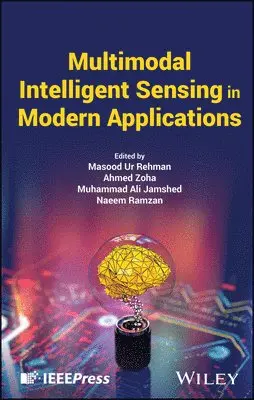
Discover the design, implementation, and analytical techniques for multi-modal intelligent sensing in this cutting-edge text
The Internet of Things (IoT) is becoming ever more comprehensively integrated into everyday life. The intelligent systems that power smart technologies rely on increasingly sophisticated sensors in order to monitor inputs and respond dynamically. Multi-modal sensing offers enormous benefits for these technologies, but also comes with greater challenges; it has never been more essential to offer energy-efficient, reliable, interference-free sensing systems for use with the modern Internet of Things.
Multimodal Intelligent Sensing in Modern Applications provides an introduction to systems which incorporate multiple sensors to produce situational awareness and process inputs. It is divided into three parts—physical design aspects, data acquisition and analysis techniques, and security and energy challenges—which together cover all the major topics in multi-modal sensing. The result is an indispensable volume for engineers and other professionals looking to design the smart devices of the future.
Multimodal Intelligent Sensing in Modern Applications readers will also find:
Contributions from multidisciplinary contributors in wireless communications, signal processing, and sensor design Coverage of both software and hardware solutions to sensing challenges Detailed treatment of advanced topics such as efficient deployment, data fusion, machine learning, and moreMultimodal Intelligent Sensing in Modern Applications is ideal for experienced engineers and designers who need to apply their skills to Internet of Things and 5G/6G networks. It can also act as an introductory text for graduate researchers into understanding the background, design, and implementation of various sensor types and data analytics tools.
1 786 kr
Läs direkt efter köp
Discover the design, implementation, and analytical techniques for multi-modal intelligent sensing in this cutting-edge text
The Internet of Things (IoT) is becoming ever more comprehensively integrated into everyday life. The intelligent systems that power smart technologies rely on increasingly sophisticated sensors in order to monitor inputs and respond dynamically. Multi-modal sensing offers enormous benefits for these technologies, but also comes with greater challenges; it has never been more essential to offer energy-efficient, reliable, interference-free sensing systems for use with the modern Internet of Things.
Multimodal Intelligent Sensing in Modern Applications provides an introduction to systems which incorporate multiple sensors to produce situational awareness and process inputs. It is divided into three parts—physical design aspects, data acquisition and analysis techniques, and security and energy challenges—which together cover all the major topics in multi-modal sensing. The result is an indispensable volume for engineers and other professionals looking to design the smart devices of the future.
Multimodal Intelligent Sensing in Modern Applications readers will also find:
Contributions from multidisciplinary contributors in wireless communications, signal processing, and sensor design Coverage of both software and hardware solutions to sensing challenges Detailed treatment of advanced topics such as efficient deployment, data fusion, machine learning, and moreMultimodal Intelligent Sensing in Modern Applications is ideal for experienced engineers and designers who need to apply their skills to Internet of Things and 5G/6G networks. It can also act as an introductory text for graduate researchers into understanding the background, design, and implementation of various sensor types and data analytics tools.
543 kr
Skickas inom 10-15 vardagar
712 kr
Läs direkt efter köp
This book aims to address a wide range of topics in wireless/satellite communications to tackle the issues related to the integration of terrestrial networks (TN) with non-terrestrial networks (NTN). In Release 17, the third-generation partnership project (3GPP) proposed the standardization of NTN to allow 5G-based TN to support NTN. According to Release 17, the NTN will consist of satellites, with unmanned aerial vehicles (UAVs) and high-altitude platforms (HAPs) regarded as specific use cases of NTN. Similar to the Global Positioning System (GPS), signals based on NTN are unable to provide indoor coverage, as these signals are attenuated and scattered by roofs, walls, etc. Moreover, power and delay are critical factors that restrict a cellular-enabled mobile handset from achieving reliability, seamless coverage, and low latency while relying on NTN. This book has brought together multidisciplinary contributors in the field of wireless/satellite communications to identify and present technical challenges and recent results related to the design of energy-efficient, delay-tolerant, and enhanced coverage-based integrated TN and NTN. Given that challenges and future aspects are also considered, the book covers a wide variety of subject categories and would therefore benefit a larger readership in the scientific community.
543 kr
Skickas inom 10-15 vardagar
543 kr
Skickas inom 10-15 vardagar
687 kr
Läs direkt efter köp