Muhammad Tayyab – författare
Visar alla böcker från författaren Muhammad Tayyab. Handla med fri frakt och snabb leverans.
6 produkter
Titanium-Based MXenes
From 2D Nanomaterials to 3D Macroassemblies
Av Han Zhang, Nasir Mahmood Abbasi m. fl.
Inbunden, 2025
2133 kr
Lägg i varukorg
This book explores titanium-based MXenes, an emergent class of materials with a broad range of properties and potential applications. It introduces 3D MXene assemblies and compares their properties with such other well-known two-dimensional materials as graphene and transition metal …
Titanium-Based MXenes
From 2D Nanomaterials to 3D Macroassemblies
Av Han Zhang, Nasir Mahmood Abbasi m. fl.
Häftad, 2026
953 kr
Lägg i varukorg
This book explores titanium-based MXenes, an emergent class of materials with a broad range of properties and potential applications. It introduces 3D MXene assemblies and compares their properties with such other well-known two-dimensional materials as graphene and transition metal …
Titanium-Based MXenes
From 2D Nanomaterials to 3D Macroassemblies
Av Muhammad Tayyab, Nasir Mahmood Abbasi m. fl.
E-bok, 2025
989 kr
Lägg i varukorg
This book explores titanium-based MXenes, an emergent class of materials with a broad range of properties and potential applications. It introduces 3D MXene assemblies and compares their properties with such other well-known two-dimensional materials as graphene and transition metal …
Titanium-Based MXenes
From 2D Nanomaterials to 3D Macroassemblies
Av Muhammad Tayyab, Nasir Mahmood Abbasi m. fl.
E-bok, 2025
1022 kr
Lägg i varukorg
This book explores titanium-based MXenes, an emergent class of materials with a broad range of properties and potential applications. It introduces 3D MXene assemblies and compares their properties with such other well-known two-dimensional materials as graphene and transition metal …
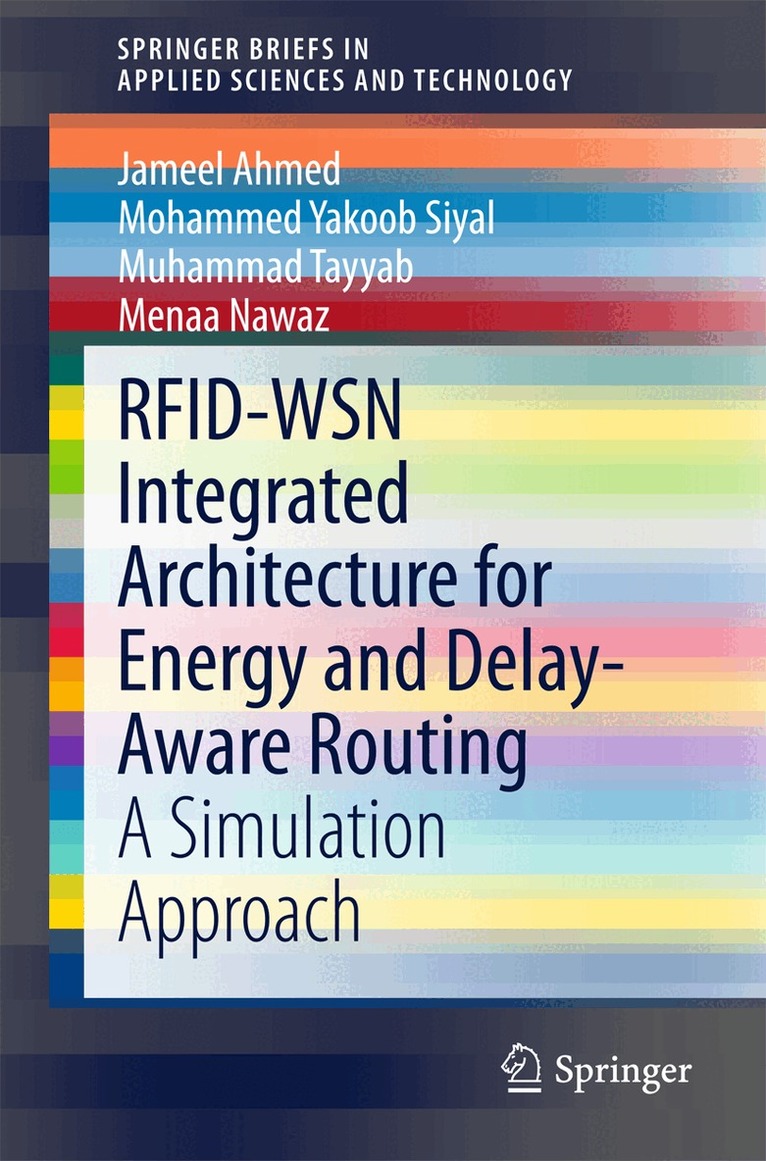
RFID-WSN Integrated Architecture for Energy and Delay- Aware Routing
A Simulation Approach
Av Jameel Ahmed, Mohammed Yakoob Siyal m. fl.
Häftad, 2015
552 kr
Lägg i varukorg
The book identifies the performance challenges concerning Wireless Sensor Networks (WSN) and Radio Frequency Identification (RFID) and analyzes their impact on the performance of routing protocols. It presents a thorough literature survey to identify the issues affecting routing protocol …
RFID-WSN Integrated Architecture for Energy and Delay- Aware Routing
A Simulation Approach
Av Menaa Nawaz, Muhammad Tayyab m. fl.
E-bok, 2015
718 kr
Lägg i varukorg
The book identifies the performance challenges concerning Wireless Sensor Networks (WSN) and Radio Frequency Identification (RFID) and analyzes their impact on the performance of routing protocols. It presents a thorough literature survey to identify the issues affecting routing protocol …