Munishwar N. Gupta – författare
Visar alla böcker från författaren Munishwar N. Gupta. Handla med fri frakt och snabb leverans.
6 produkter
6 produkter
E-bok
PDF, Engelska, 2013687 kr
Läs direkt efter köp
E-bok
PDF, Engelska, 20131 977 kr
Läs direkt efter köp
Extending the range of enzymatic catalysis by using non-aqueous media has now developed into a powerful approach in biochemistry and biotechnology. One peculiar feature which distinguishes it from the conventional enzymology (carried out in aqueous buffers) is that the awareness of different parameters that control and influence the behaviour of enzymes in such environments has emerged rather slowly. Science is about being able to repeat what somebody else has done. Absence of knowledge about such well-defined parameters/fac tors has sometimes made some workers rather cautious and diffident about using this approach in their laboratories. But for this, non-aqueous enzymol ogy would be more widely practised. It is these thoughts that made me feel that the availability of some well-defined protocols for various applications invol ving enzymes in non-aqueous environments would further catalyze the growth of this area. Hence this book, in which each chapter has some protocols in a specific area. The protocols are preceded by brief background material. The early chapters, which are of general importance, concern control of water ac tivity and stabilization via immobilization. Some subsequent chapters provide the protocols for transformations involving lipids and carbohydrates, peptide synthesis, and preparation of chiral compounds. The disproportionate focus on lipases is not a coincidence; this class of enzymes has been used more often than others in non-aqueous enzymology.
Inbunden, Engelska, 2000
1 631 kr
Skickas inom 10-15 vardagar
Extending the range of enzymatic catalysis by using non-aqueous media has now developed into a powerful approach in biochemistry and biotechnology. One peculiar feature which distinguishes it from the conventional enzymology (carried out in aqueous buffers) is that the awareness of different parameters that control and influence the behaviour of enzymes in such environments has emerged rather slowly. Science is about being able to repeat what somebody else has done. Absence of knowledge about such well-defined parameters/fac tors has sometimes made some workers rather cautious and diffident about using this approach in their laboratories. But for this, non-aqueous enzymol ogy would be more widely practised. It is these thoughts that made me feel that the availability of some well-defined protocols for various applications invol ving enzymes in non-aqueous environments would further catalyze the growth of this area. Hence this book, in which each chapter has some protocols in a specific area. The protocols are preceded by brief background material. The early chapters, which are of general importance, concern control of water ac tivity and stabilization via immobilization. Some subsequent chapters provide the protocols for transformations involving lipids and carbohydrates, peptide synthesis, and preparation of chiral compounds. The disproportionate focus on lipases is not a coincidence; this class of enzymes has been used more often than others in non-aqueous enzymology.
Häftad, Engelska, 2000
1 631 kr
Skickas inom 10-15 vardagar
Covering applications in different types of non-aqueous media, this volume covers: protocols for specific applications, peptide synthesis, sugar transformation, and preparation of chiral compounds. The book also includes an extensive troubleshooting guide as well as hints and advice from and for daily practice.
Häftad, Engelska, 2002
548 kr
Skickas inom 10-15 vardagar
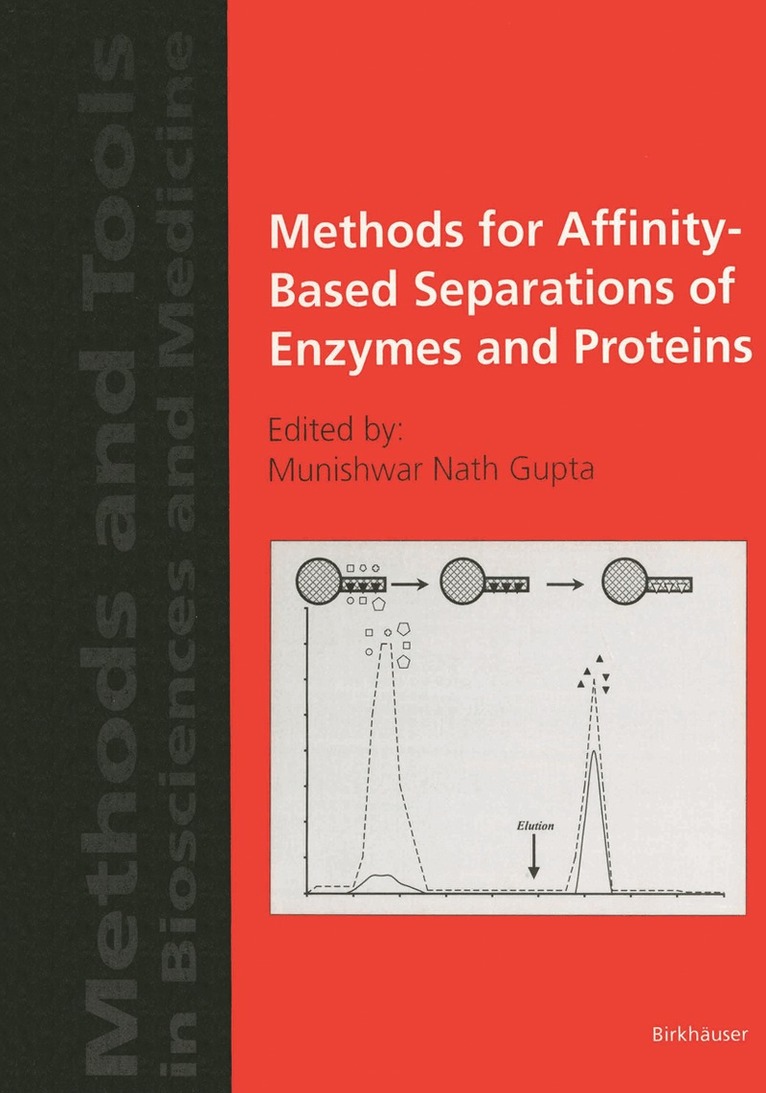
Shape your heart to front the hour, but dream not that the hour will lost. Alfred Tennyson Locksley Hall Sixty YeO!, After Numerous advances in the life sciences have necessitated the need to develop gentle, quick and economical methods for separation of proteins/enzymes. Affmity-based separations, with their high selectivity, have thus come to be used more frequently. In the beginning, we just had atrmity chromatography. Today we have several strategies that employ atrmity interactions for separa- tion and analysis. This book is an attempt to provide a short introduction and illustrative protocols for some important and current affinity-based approaches inthe area ofdownstream processingofenzymes/proteins. Today, people from a variety of disciplines have to purify proteins. It is hoped that this book will provide some quick insight into the various available options and guide even a novice (in the area ofprotein separation) to obtain his/her target protein at the level of purity that he/she desires.
Inbunden, Engelska, 2002
548 kr
Skickas inom 10-15 vardagar
Shape your heart to front the hour, but dream not that the hour will lost. Alfred Tennyson Locksley Hall Sixty YeO!, After Numerous advances in the life sciences have necessitated the need to develop gentle, quick and economical methods for separation of proteins/enzymes. Affmity-based separations, with their high selectivity, have thus come to be used more frequently. In the beginning, we just had atrmity chromatography. Today we have several strategies that employ atrmity interactions for separa- tion and analysis. This book is an attempt to provide a short introduction and illustrative protocols for some important and current affinity-based approaches inthe area ofdownstream processingofenzymes/proteins. Today, people from a variety of disciplines have to purify proteins. It is hoped that this book will provide some quick insight into the various available options and guide even a novice (in the area ofprotein separation) to obtain his/her target protein at the level of purity that he/she desires.