Naomi Eilan - Böcker
Visar alla böcker från författaren Naomi Eilan. Handla med fri frakt och snabb leverans.
10 produkter
10 produkter
678 kr
Skickas inom 7-10 vardagar
Spatial Representation presents original, specially written essays by leading psychologists and philosophers on a fascinating set of topics at the intersection of these two disciplines. They address such questions as these: Do the extraordinary navigational abilities of birds mean that these birds have the same kind of grip on the idea of a spatial world as we do? Is there a difference between the way sighted and blind subjects represent the world 'out there'? Does the study of brain-injured subjects, such as 'blind seers', tell us anything about the working of normal spatial consciousness? The essays are arranged into five sections, each of which reflects a central area of research into spatial cognition, and opens with a short introduction by the editors, designed to facilitate cross-disciplinary reading. The volume as a whole offers a rich and compelling expression of the view that to advance our understanding of the way we represent the external world it is necessary to draw on both philosophical and psychological approaches.
1 975 kr
Skickas inom 5-8 vardagar
Philosophers and psychologists join forces to investigate a set of problems to do with agency and self-awareness, in 17 essays, presented in this book. There has been much psychological and neurological work purporting to show that consciousness and self-awareness play no role in causing actions, and indeed to demonstrate that free will is an illusion. The essays in this volume subject the assumptions that motivate such claims to sustained interdisciplinary scrutiny.
904 kr
Skickas inom 5-8 vardagar
Leading philosophers and psychologists join forces to investigate a set of problems to do with agency and self-awareness, in seventeen specially written essays. In recent years there has been much psychological and neurological work purporting to show that consciousness and self-awareness play no role in causing actions, and indeed to demonstrate that free will is an illusion. The essays in this volume subject the assumptions that motivate such claims to sustained interdisciplinary scrutiny.Patients with Anarchic Hand syndrome sometimes find their hands perform apparently goal-directed actions which the patients disown, yet seem to be unable to suppress (for example, reaching out for someone else's food in a restaurant). On the face of it, these patients lack the kind of control and self-awareness we ordinarily take ourselves to have when acting intentionally. Questions raised by this phenomenon include: What is involved in being aware of an action as one's own? What is the nature of the control these patients are lacking and which characterizes normal intentional actions? What is the relation between a priori explanations of consciousness and self-consciousness, on the one hand, and empirical work on the information-processing mechanisms involved in action control, on the other?Questions of action control and self-awareness tend to be treated separately in both philosophy and psychology. The central idea behind this volume is that outstanding unresolved issues on both topics, and in both disciplines, can only be resolved by an interdisciplinary examination of the relations between them. The editors' useful introductory essay offers a guide to cross-disciplinary reading of the contributions, and makes connections between them explicit. The book will be compulsory reading for psychologists and philosophers working on action explanation, and for anyone interested in the relation between the brain sciences and consciousness.
Joint Attention: Communication and Other Minds
Issues in Philosophy and Psychology
Häftad, Engelska, 2005
921 kr
Skickas inom 5-8 vardagar
An international team of psychologists and philosophers present the latest research into the fascinating cognitive phenomenon of 'joint attention'. Some time around their first birthday most infants begin to engage in a behaviour that is designed to bring it about - say, by means of pointing or gaze-following - that their own and another person's attention are focused on the same object. Described as manifestations of an emerging capacity for joint attention, such triangulations between infant, adult and the world are often treated as a developmental landmark and have become the subject of intensive research among developmentalists and primatologists over the past decade. More recently, work on joint attention has also begun to attract the attention of philosophers. Fuelling researchers' interest in all these disciplines is the intuition that joint attention plays a foundational role in the emergence of communicative abilities, in children's developing understanding of the mind and, possibly, in the very capacity for objective thought.This book brings together, for the first time, philosophical and psychological perspectives on the nature and significance of the phenomenon, addressing issues such as: How should we explain the kind of mutual openness that joint attention seems to involve, i.e. the sense in which both child and adult are aware that they are attending to the same thing? What sort of grip on one's own and other people's mental states does such awareness involve, and how does it relate to later-emerging 'theory of mind' abilities? In what sense, if any, is the capacity to engage in joint attention with others unique to humans? How should we explain autistic children's seeming incapacity to engage in joint attention? What role, if any, does affect play in the achievement of joint attention? And what, if any, is the connection between participation in joint attention and grasp of the idea of an objective world? The book also contains an introductory chapter aimed at providing a framework for integrating different philosophical and psychological approaches to these questions.
Joint Attention: Communication and Other Minds
Issues in Philosophy and Psychology
Inbunden, Engelska, 2005
2 236 kr
Skickas inom 5-8 vardagar
Some time around their first birthday, children begin to engage in 'triadic' interactions, i.e. interactions with adults that turn specifically on both child and adult jointly attending to an object in their surroundings. Recognized as a developmental milestone amongst psychologists for some time, joint attention has recently also started to attract the attention of philosophers. This volume brings together, for the first time, psychological and philosophical perspectives on the nature and significance of joint attention. Original contributions by leading researchers in both disciplines explore the idea that joint attention has a key foundational role to play in the emergence of communicative abilities, psychological understanding, and, possibly, in the very capacity for objective thought.
1 972 kr
Skickas inom 7-10 vardagar
To be a 'commonsense realist' is to hold that perceptual experience is (in general) an immediate awareness of mind-independent objects, and a source of direct knowledge of what such objects are like. Over the past few centuries this view has faced formidable challenges from epistemology, metaphysics, and, more recently, cognitive science. However, in recent years there has been renewed interest in it, due to new work on perceptual consciousness, objectivity, and causal understanding. This volume collects nineteen original essays by leading philosophers and psychologists on these topics. Questions addressed include: What are the commitments of commonsense realism? Does it entail any particular view of the nature of perceptual experience, or any particular view of the epistemology of perceptual knowledge? Should we think of commonsense realism as a view held by some philosophers, or is there a sense in which we are pre-theoretically committed to commonsense realism in virtue of the experience we enjoy or the concepts we use or the explanations we give? Is commonsense realism defensible, and if so how, in the face of the formidable criticism it faces? Specific issues addressed in the philosophical essays include the status of causal requirements on perception, the causal role of perceptual experience, and the relation between objective perception and causal thinking. The scientific essays present a range of perspectives on the development, phylogenetic and ontogenetic, of the human adult conception of perception.
647 kr
Skickas inom 7-10 vardagar
To be a 'commonsense realist' is to hold that perceptual experience is (in general) an immediate awareness of mind-independent objects, and a source of direct knowledge of what such objects are like. Over the past few centuries this view has faced formidable challenges from epistemology, metaphysics, and, more recently, cognitive science. However, in recent years there has been renewed interest in it, due to new work on perceptual consciousness, objectivity, and causal understanding. This volume collects nineteen original essays by leading philosophers and psychologists on these topics. Questions addressed include: What are the commitments of commonsense realism? Does it entail any particular view of the nature of perceptual experience, or any particular view of the epistemology of perceptual knowledge? Should we think of commonsense realism as a view held by some philosophers, or is there a sense in which we are pre-theoretically committed to commonsense realism in virtue of the experience we enjoy or the concepts we use or the explanations we give? Is commonsense realism defensible, and if so how, in the face of the formidable criticism it faces? Specific issues addressed in the philosophical essays include the status of causal requirements on perception, the causal role of perceptual experience, and the relation between objective perception and causal thinking. The scientific essays present a range of perspectives on the development, phylogenetic and ontogenetic, of the human adult conception of perception.
814 kr
Skickas inom 5-8 vardagar
698 kr
Skickas inom 10-15 vardagar
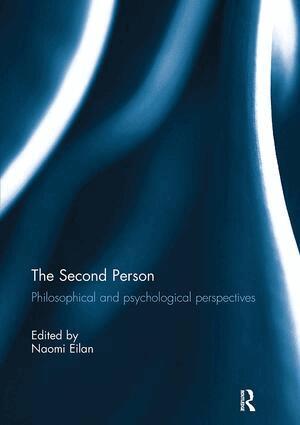
The past few years have witnessed an exponentially growing body of work conducted under the ‘second person’ heading. This idea has been explored in various areas of philosophy (philosophy of mind, philosophy of language, ethics, epistemology), in developmental psychology, in psychiatry, and even in neuroscience. We may call this interest in the second person the ‘You Turn’. To put it at its most general, and ambitious, the idea driving much of the work is this: proper attention to the ways in which we relate to one another when we stand in second person relation to each other can deliver something like a paradigm shift in the way in which we address questions about a range of fundamental issues in these fields. There is, however, very little agreement about what second person relations are, and a huge variation in why people think they are important. The contributions to this book focus on developing key second-person claims in the philosophy of mind, ethics and epistemology, with the aim of beginning to provide a framework for assessing and relating the multitude of fascinating new questions that come up under the second person heading.This book was originally published as a special issue of Philosophical Explorations.
2 155 kr
Skickas inom 10-15 vardagar
The past few years have witnessed an exponentially growing body of work conducted under the ‘second person’ heading. This idea has been explored in various areas of philosophy (philosophy of mind, philosophy of language, ethics, epistemology), in developmental psychology, in psychiatry, and even in neuroscience. We may call this interest in the second person the ‘You Turn’. To put it at its most general, and ambitious, the idea driving much of the work is this: proper attention to the ways in which we relate to one another when we stand in second person relation to each other can deliver something like a paradigm shift in the way in which we address questions about a range of fundamental issues in these fields. There is, however, very little agreement about what second person relations are, and a huge variation in why people think they are important. The contributions to this book focus on developing key second-person claims in the philosophy of mind, ethics and epistemology, with the aim of beginning to provide a framework for assessing and relating the multitude of fascinating new questions that come up under the second person heading.This book was originally published as a special issue of Philosophical Explorations.