• Fri frakt över 249 kr
  • •
  • Snabba leveranser
  • •
  • Billiga böcker
Kundservice

Du är på sajten för privatpersoner.

Företag, bibliotek eller offentlig verksamhet?

Du handlar på classic.bokus.com, där alla dina funktioner finns intakta.
Till classic.bokus.com
Bokus logotyp. Gå till startsidan.
  • Erbjudanden
  • Nyheter
  • Student
  • Topplistor
  • Barn & ungdom
  • Bokus Play
  • E-böcker
  • Pocketböcker
  • Spel & pussel

10% rabatt på allt med kod: NYSTART10 →

Sidfot

Mina sidor

    Hjälp

    • Kundservice
    • Vanliga frågor och svar
    • Frakt och leverans
    • Retur vid ångerrätt
    • Reklamera vara
    • Betalning
    • Köpvillkor
    • Allmänna villkor
    • Information om webbplatsens tillgänglighet

    Om Bokus

    • Om oss
    • Pressrum
    • För studenter
    • För företag
    • För bibliotek och offentlig verksamhet
    • För leverantörer
    • Hållbarhet

    Populärt

    • Aktuella erbjudanden
    • Presentkort
    • Studentlitteratur
    • Nya böcker
    • Topplistor
    • Signerade böcker
    • Engelska böcker

    Inspiration

    • Boktips
    • BookTok
    • Populära bokserier
    • Barnbokskaraktärer
    • Populära författare
    Logotyp för Bokus
    Följ oss på Facebook (extern länk)Följ oss på Instagram (extern länk)Följ oss på YouTube (extern länk)Följ oss på TikTok (extern länk)
    bokus @ CookiesAnpassa cookiesIntegritetspolicyKöpvillkor
    Till Citymail hemsida (extern länk)Till Budbee hemsida (extern länk)Till Postnord hemsida (extern länk)Till Schenker hemsida (extern länk)Till Early Bird hemsida (extern länk)Till Walleys hemsida (extern länk)
    1. Psykologi och pedagogik
    2. Psykologi
    3. Psykologiska teorier och skolor

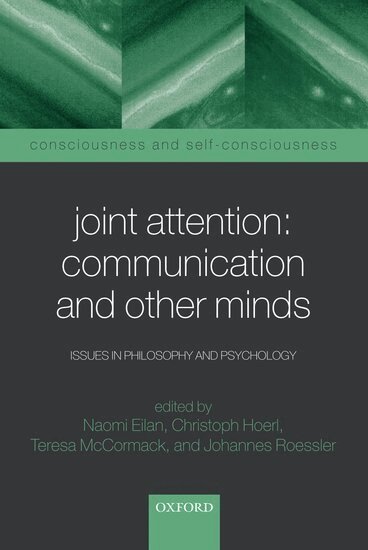
    Joint Attention: Communication and Other Minds

    Issues in Philosophy and Psychology

    AvNaomi Eilan,Christoph Hoerl

    Häftad, Engelska, 2005

    Del i serien Consciousness & Self-Consciousness Series

    1 169 kr

    Beställningsvara. Skickas inom 5-8 vardagar. Fri frakt över 249 kr.

    Beskrivning

    An international team of psychologists and philosophers present the latest research into the fascinating cognitive phenomenon of 'joint attention'. Some time around their first birthday most infants begin to engage in a behaviour that is designed to bring it about - say, by means of pointing or gaze-following - that their own and another person's attention are focused on the same object. Described as manifestations of an emerging capacity for joint attention, such triangulations between infant, adult and the world are often treated as a developmental landmark and have become the subject of intensive research among developmentalists and primatologists over the past decade. More recently, work on joint attention has also begun to attract the attention of philosophers. Fuelling researchers' interest in all these disciplines is the intuition that joint attention plays a foundational role in the emergence of communicative abilities, in children's developing understanding of the mind and, possibly, in the very capacity for objective thought.This book brings together, for the first time, philosophical and psychological perspectives on the nature and significance of the phenomenon, addressing issues such as: How should we explain the kind of mutual openness that joint attention seems to involve, i.e. the sense in which both child and adult are aware that they are attending to the same thing? What sort of grip on one's own and other people's mental states does such awareness involve, and how does it relate to later-emerging 'theory of mind' abilities? In what sense, if any, is the capacity to engage in joint attention with others unique to humans? How should we explain autistic children's seeming incapacity to engage in joint attention? What role, if any, does affect play in the achievement of joint attention? And what, if any, is the connection between participation in joint attention and grasp of the idea of an objective world? The book also contains an introductory chapter aimed at providing a framework for integrating different philosophical and psychological approaches to these questions.

    Produktinformation

    • Utgivningsdatum:2005-03-03
    • Mått:156 x 234 x 20 mm
    • Vikt:525 g
    • Format:Häftad
    • Språk:Engelska
    • Serie:Consciousness & Self-Consciousness Series
    • Antal sidor:348
    • Förlag:OUP OXFORD
    • ISBN:9780199245635

    Utforska kategorier

    • Psykologiska teorier och skolor inom Psykologi och pedagogik
    • Filosofiska discipliner inom Filosofi och religion
    • Kognitiv psykologi inom Psykologi och pedagogik

    Recensioner i media

    Although the methodological approaches that the volume brings together are widely various, its contributors have evidently learned a good deal from one another, and the result displays much more coherence than one might have expected from a book in which philosophy of various sorts shares space with primatology and with discussions of autism. This impressive coherence is heartening to the reader who has entertained fears about philosophy's ability to stay relevant when faced with psychology's unabating torrent of freshly gathered data. The volume provides every reason to suppose that joint attention is a topic on which philosophy and other disciplines can collaborate fruitfully.

    Innehållsförteckning

    • 1. Joint attention, communication, and mind ; 2. Joint attention and understanding the mind ; 3. What chimpanzees know about seeing revisited: an explanation of the third kind ; 4. Joint attention and the notion of subject: insights from apes, normal children, and children with autism ; 5. Before the 'Third Element': understanding attention to self ; 6. Infants' understanding of the actions involved in joint attention ; 7. Infant pointing: Harlequin, servant of two masters ; 8. Understanding the role of communicative intentions in word learning ; 9. What puts the jointness into joint attention? ; 10. Why do children with autism have a joint attention impairment? ; 11. Joint attention and the problem of other minds ; 12. Joint reminiscing as joint attention to the past ; 13. Joint attention and common knowledge ; 14. Joint attention: its nature, reflexivity, and relation to common knowledge?