Nils Gilman - Böcker
Visar alla böcker från författaren Nils Gilman. Handla med fri frakt och snabb leverans.
5 produkter
5 produkter
363 kr
Skickas inom 7-10 vardagar
Ideas about how to "modernize," particularly when developed countries apply them to countries less fortunate, clearly have consequences, intended and unintended. Modernization theory must be among the most important constructs of the twentieth century, certainly in the story of the social sciences. Nils Gilman here offers the first (or second) attempt to treat its development as a problem in intellectual history. The dimensions of the problem call for special ambition and competence, and Gilman has turned in a highly creditable performance. His study ranges from concepts of "modernism" to the post-World War II/Cold War American sense of global mission and responsibility. Gilman examines rising energy levels at the most prestigious university departments in the social sciences, with an entire chapter exploring Talcott Parsons and the Harvard social relations program and another on Walt Rostow and the attempt to rationalize foreign aid/foreign policy at MIT.Gilman thus supplies the background and context for the nation's "generous" Third World programs during the period of competition with the Soviet Union-and the same for our most grievous postwar blunder, the notion that our power and good intentions could save the South Vietnamese from poverty, themselves, and the post-colonialists to the north. "Nils Gilman effectively charts the development of "Modernization theory" in American intellectual life after World War II, examining the intstitutional networks that usstained it and helped make it a keystone of academic and foreign-policy discourse in the 1950s and early 1960s." --Howard Brick, Washington University, St. Louis "Gilman provides not only the fullest history of modernization theory, and its linkages to actual government policy formation, we have to date, but he explores in depth a fascinating slice of American intellectual history in the 1960s and early 1970s. His analysis of foundation and academic politics and their interface with government agencies is detailed, original and compelling...He also has some provocative things to say about its resurrection, however uncertain, following the collapse of commmand communism in Eastern Europe...No serieous author (or teacher) will be able to tackle this subject without considering his arguments and mastering his history of one of the most influential ideologies of the late 20th century." --Michael Adas, Rutgers University "Wonderfully written ...based on marvelous archival work. The [sections] on the Social Science Research Council committess and and on the internal workings of gropus at MIT and elsewhere is simply terrific...[Gilman's] interviews with Gabirel Amond, Albert Hirschmann, and others were very successful." --David A. Hollinger, University of California, Berkeley
488 kr
Skickas inom 10-15 vardagar
This collection of essays introduces the thriving illicit industries and activities within the global economy whose growth challenges traditional notions of wealth, power, and progress. Through essays contributed by leading experts and scholars, "Deviant Globalization" argues that far from being marginal, illicit activities are a fundamental part of globalization. Narcotrafficking, human trafficking, the organ trade, computer malware, transnational gangs are just as much artifacts of globalization as are CNN and McDonald's, free trade and capital mobility, accessible air travel and container shipping. In fact, almost every technology, process, and regulation that enables mainstream globalization is an enabler of deviant globalization. This unique book explains why understanding deviant globalization as a systemic and integral part of globalization is crucial for setting up policies that will maximize the benefits of globalization and minimize its ill effects. Going beyond the usual pro/con arguments about globalization, "Deviant Globalization" seeks to initiate a critical debate about the choices it presents to governments, firms, supra-national organizations, and individuals.An accessible treatment of the underbelly of globalization, the book offers a systematic treatment of the difficult policy choices that it creates and describes a much more complex and symbiotic relationship between illicit and mainstream globalization.
1 964 kr
Skickas inom 10-15 vardagar
This collection of essays introduces the thriving illicit industries and activities within the global economy whose growth challenges traditional notions of wealth, power, and progress. Through essays contributed by leading experts and scholars, "Deviant Globalization" argues that far from being marginal, illicit activities are a fundamental part of globalization. Narcotrafficking, human trafficking, the organ trade, computer malware, transnational gangs are just as much artifacts of globalization as are CNN and McDonald's, free trade and capital mobility, accessible air travel and container shipping. In fact, almost every technology, process, and regulation that enables mainstream globalization is an enabler of deviant globalization. This unique book explains why understanding deviant globalization as a systemic and integral part of globalization is crucial for setting up policies that will maximize the benefits of globalization and minimize its ill effects. Going beyond the usual pro/con arguments about globalization, "Deviant Globalization" seeks to initiate a critical debate about the choices it presents to governments, firms, supra-national organizations, and individuals.An accessible treatment of the underbelly of globalization, the book offers a systematic treatment of the difficult policy choices that it creates and describes a much more complex and symbiotic relationship between illicit and mainstream globalization.
296 kr
Skickas inom 7-10 vardagar
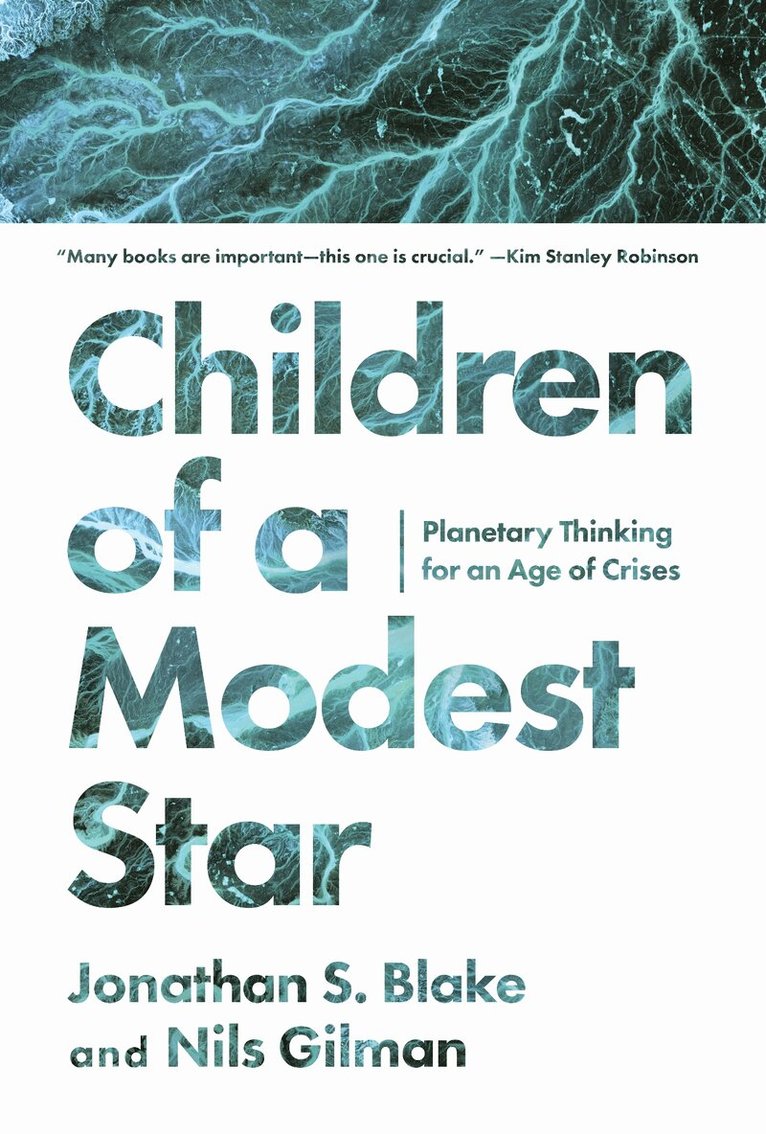
A clear-eyed and urgent vision for a new system of political governance to manage planetary issues and their local consequences.Deadly viruses, climate-changing carbon molecules, and harmful pollutants cross the globe unimpeded by national borders. While the consequences of these flows range across scales, from the planetary to the local, the authority and resources to manage them are concentrated mainly at one level: the nation-state. This profound mismatch between the scale of planetary challenges and the institutions tasked with governing them is leading to cascading systemic failures. In the groundbreaking Children of a Modest Star, Jonathan S. Blake and Nils Gilman not only challenge dominant ways of thinking about humanity's relationship to the planet and the political forms that presently govern it, but also present a new, innovative framework that corresponds to our inherently planetary condition. Drawing on intellectual history, political philosophy, and the holistic findings of Earth system science, Blake and Gilman argue that it is essential to reimagine our governing institutions in light of the fact that we can only thrive if the multi-species ecosystems we inhabit are also flourishing.Aware of the interlocking challenges we face, it is no longer adequate merely to critique our existing systems or the modernist assumptions that helped create them. Blake and Gilman propose a bold, original architecture for global governance—what they call planetary subsidiarity—designed to enable the enduring habitability of the Earth for humans and non-humans alike. Children of a Modest Star offers a clear-eyed and urgent vision for constructing a system capable of stabilizing a planet in crisis.
207 kr
Skickas inom 10-15 vardagar
A clear-eyed and urgent vision for a new system of political governance to manage planetary issues and their local consequences.Deadly viruses, climate-changing carbon molecules, and harmful pollutants cross the globe unimpeded by national borders. While the consequences of these flows range across scales, from the planetary to the local, the authority and resources to manage them are concentrated mainly at one level: the nation-state. This profound mismatch between the scale of planetary challenges and the institutions tasked with governing them is leading to cascading systemic failures. In the groundbreaking Children of a Modest Star, Jonathan S. Blake and Nils Gilman not only challenge dominant ways of thinking about humanity's relationship to the planet and the political forms that presently govern it, but also present a new, innovative framework that corresponds to our inherently planetary condition. Drawing on intellectual history, political philosophy, and the holistic findings of Earth system science, Blake and Gilman argue that it is essential to reimagine our governing institutions in light of the fact that we can only thrive if the multi-species ecosystems we inhabit are also flourishing.Aware of the interlocking challenges we face, it is no longer adequate merely to critique our existing systems or the modernist assumptions that helped create them. Blake and Gilman propose a bold, original architecture for global governance—what they call planetary subsidiarity—designed to enable the enduring habitability of the Earth for humans and non-humans alike. Children of a Modest Star offers a clear-eyed and urgent vision for constructing a system capable of stabilizing a planet in crisis.