Nirmala R. Darekar – författare
Visar alla böcker från författaren Nirmala R. Darekar. Handla med fri frakt och snabb leverans.
5 produkter
5 produkter
E-bok
PDF, Engelska, 20253 026 kr
Läs direkt efter köp
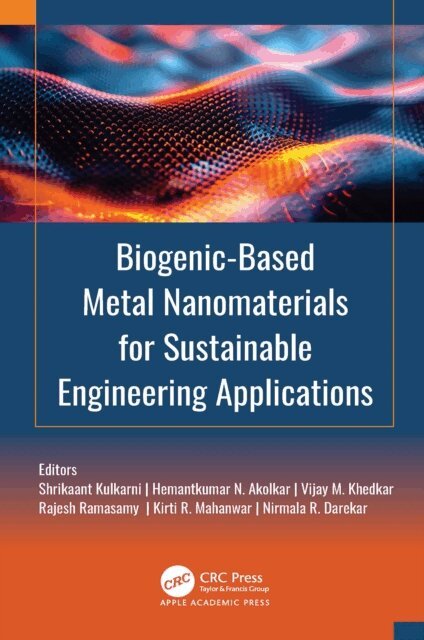
The intersection of nanotechnology and sustainable engineering has given rise to increased interest in biogenic approaches, such as the use of natural biological processes to create metal nanomaterials. This new volume provides an exploration of biogenic metal nanomaterials, from their synthesis and characterization to their diverse applications in sustainable engineering. Detailed discussions on structural, chemical, and surface characterization provide the tools needed to analyze and optimize biogenic nanomaterials for practical applications such as for environmental remediation, energy storage, catalysis, biomedical, and other uses. Case studies and real-world examples illustrate how these materials are being used to address some of the most pressing challenges of our time. The book also considers regulatory and safety issues.
E-bok
Engelska, 20253 026 kr
Läs direkt efter köp
The intersection of nanotechnology and sustainable engineering has given rise to increased interest in biogenic approaches, such as the use of natural biological processes to create metal nanomaterials. This new volume provides an exploration of biogenic metal nanomaterials, from their synthesis and characterization to their diverse applications in sustainable engineering. Detailed discussions on structural, chemical, and surface characterization provide the tools needed to analyze and optimize biogenic nanomaterials for practical applications such as for environmental remediation, energy storage, catalysis, biomedical, and other uses. Case studies and real-world examples illustrate how these materials are being used to address some of the most pressing challenges of our time. The book also considers regulatory and safety issues.
Inbunden, Engelska, 2025
2 532 kr
Skickas inom 10-15 vardagar
The intersection of nanotechnology and sustainable engineering has given rise to increased interest in biogenic approaches, such as the use of natural biological processes to create metal nanomaterials. This new volume provides an exploration of biogenic metal nanomaterials, from their synthesis and characterization to their diverse applications in sustainable engineering. Detailed discussions on structural, chemical, and surface characterization provide the tools needed to analyze and optimize biogenic nanomaterials for practical applications such as for environmental remediation, energy storage, catalysis, biomedical, and other uses. Case studies and real-world examples illustrate how these materials are being used to address some of the most pressing challenges of our time. The book also considers regulatory and safety issues.
Inbunden, Engelska, 2025
437 kr
Skickas inom 10-15 vardagar
Microalgae, such as algae and cyanobacteria, which are cultivated for their biomass and are rich in lipids, proteins, and carbohydrates, can be used as a renewable energy source. Seeking to mitigate climate change and ensuring energy security, this approach provides several advantages, including being carbon neutral, requiring low water usage, and having high oil content. However, challenges persist, including scalability, cost-effectiveness, biomass harvesting, conversion efficiency, water management, and land use competition with food crops.This book describes the development of a production method of bioenergy from microalgal biomass, and examines the entire process development, from strain improvement and cultivation optimization, through the conversion process, and systems integration. The book delves into related technologies, including catalytic conversion, separation and purification techniques. The potential of microalgal bioenergy as a sustainable energy source is assessed by considering scalability, cost-effectiveness, and environmental impact.
E-bok
Engelska, 2025554 kr
Läs direkt efter köp
Microalgae, such as algae and cyanobacteria, which are cultivated for their biomass and are rich in lipids, proteins, and carbohydrates, can be used as a renewable energy source. Seeking to mitigate climate change and ensuring energy security, this approach provides several advantages, including being carbon neutral, requiring low water usage, and having high oil content. However, challenges persist, including scalability, cost-effectiveness, biomass harvesting, conversion efficiency, water management, and land use competition with food crops.This book describes the development of a production method of bioenergy from microalgal biomass, and examines the entire process development, from strain improvement and cultivation optimization, through the conversion process, and systems integration. The book delves into related technologies, including catalytic conversion, separation and purification techniques. The potential of microalgal bioenergy as a sustainable energy source is assessed by considering scalability, cost-effectiveness, and environmental impact.