Noah A. Smith – författare
Visar alla böcker från författaren Noah A. Smith. Handla med fri frakt och snabb leverans.
6 produkter
6 produkter
Inbunden, Engelska, 2026
769 kr
Skickas inom 7-10 vardagar
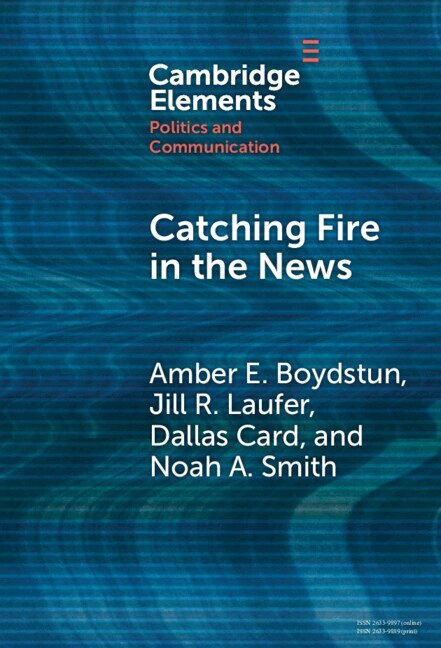
Why do some events catch fire in the news, producing a media storm, while many similar events go all but unnoticed? This Element uses a fire triangle analogy to explain the necessary conditions of media storms. The "heat" is the spark: a dramatic event or discovery. The "fuel" is the political and cultural landscape, including similar items in recent news, and current debates that allow the event to be framed in a resonant way. The "oxygen" is the available news agenda space, plus attention the event receives beyond the news (by activists, politicians, people on social media, etc.). Media storms are not easily predictable; it takes the right event, at the right time, with the right momentum of attention. But when the political stars align and a media storm erupts, it can be a window of opportunity for change. This Element is also available as Open Access on Cambridge Core.
Häftad, Engelska, 2026
239 kr
Skickas inom 7-10 vardagar
Why do some events catch fire in the news, producing a media storm, while many similar events go all but unnoticed? This Element uses a fire triangle analogy to explain the necessary conditions of media storms. The "heat" is the spark: a dramatic event or discovery. The "fuel" is the political and cultural landscape, including similar items in recent news, and current debates that allow the event to be framed in a resonant way. The "oxygen" is the available news agenda space, plus attention the event receives beyond the news (by activists, politicians, people on social media, etc.). Media storms are not easily predictable; it takes the right event, at the right time, with the right momentum of attention. But when the political stars align and a media storm erupts, it can be a window of opportunity for change. This Element is also available as Open Access on Cambridge Core.
E-bok
PDF, Engelska, 2026275 kr
Läs direkt efter köp
E-bok
Engelska, 2026275 kr
Läs direkt efter köp
Häftad, Engelska, 2011
565 kr
Skickas inom 10-15 vardagar
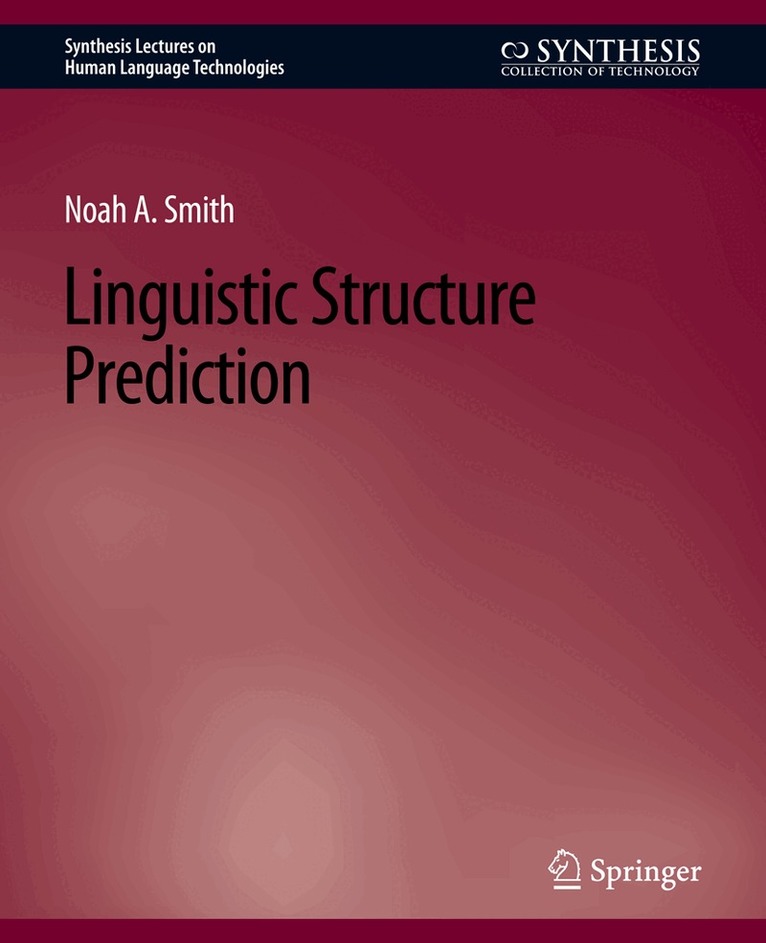
A major part of natural language processing now depends on the use of text data to build linguistic analyzers. We consider statistical, computational approaches to modeling linguistic structure. We seek to unify across many approaches and many kinds of linguistic structures. Assuming a basic understanding of natural language processing and/or machine learning, we seek to bridge the gap between the two fields. Approaches to decoding (i.e., carrying out linguistic structure prediction) and supervised and unsupervised learning of models that predict discrete structures as outputs are the focus. We also survey natural language processing problems to which these methods are being applied, and we address related topics in probabilistic inference, optimization, and experimental methodology. Table of Contents: Representations and Linguistic Data / Decoding: Making Predictions / Learning Structure from Annotated Data / Learning Structure from Incomplete Data / Beyond Decoding: Inference
E-bok
PDF, Engelska, 2022734 kr
Läs direkt efter köp
A major part of natural language processing now depends on the use of text data to build linguistic analyzers. We consider statistical, computational approaches to modeling linguistic structure. We seek to unify across many approaches and many kinds of linguistic structures. Assuming a basic understanding of natural language processing and/or machine learning, we seek to bridge the gap between the two fields. Approaches to decoding (i.e., carrying out linguistic structure prediction) and supervised and unsupervised learning of models that predict discrete structures as outputs are the focus. We also survey natural language processing problems to which these methods are being applied, and we address related topics in probabilistic inference, optimization, and experimental methodology. Table of Contents: Representations and Linguistic Data / Decoding: Making Predictions / Learning Structure from Annotated Data / Learning Structure from Incomplete Data / Beyond Decoding: Inference